
Alaska / Reconstructing the investigation
The Kodiak Coast Guard murders: the gap between two camera sightings
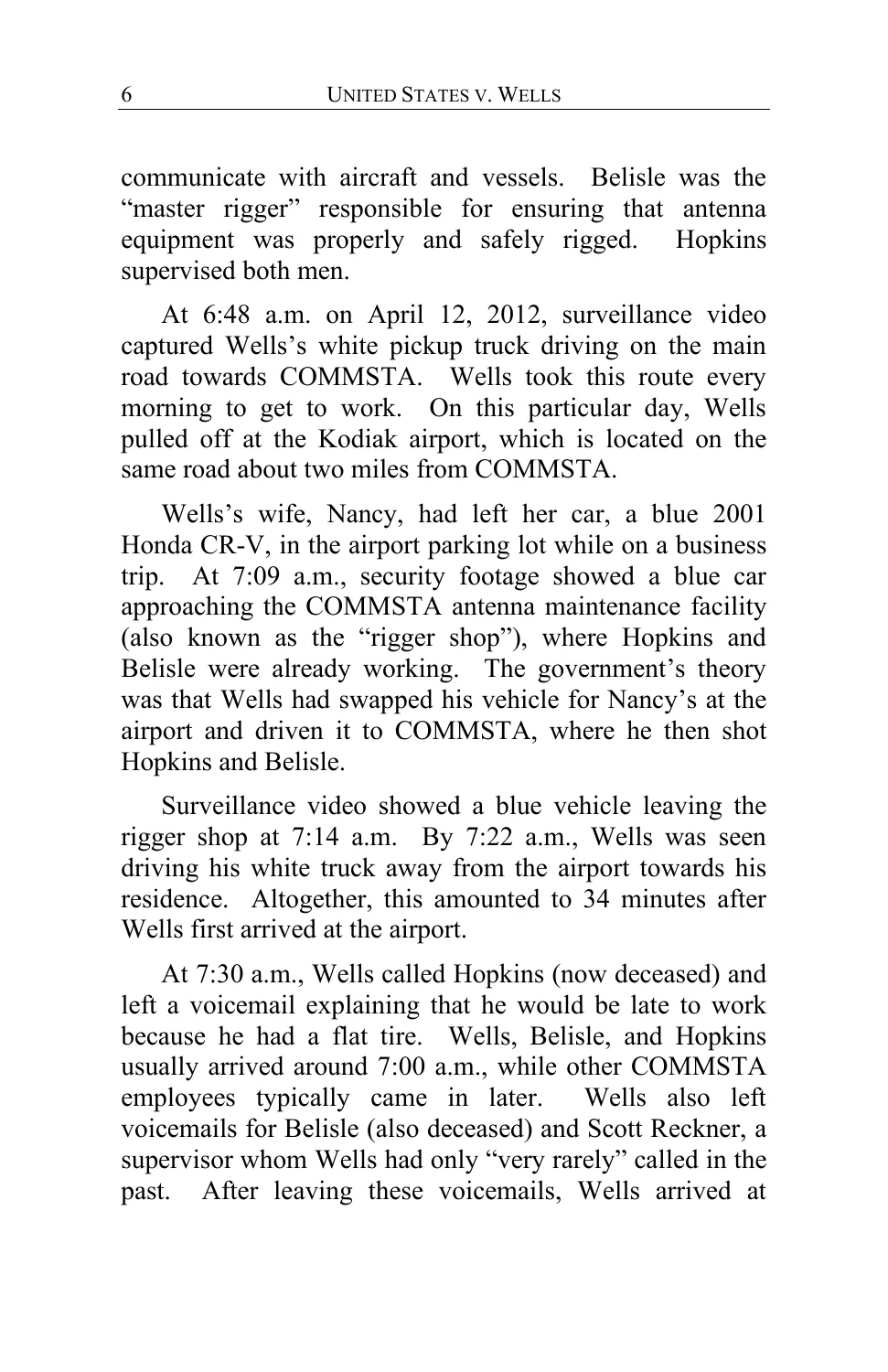
A surveillance camera can show when a vehicle passed without showing what its driver did next. That distinction sits at the center of the Kodiak Coast Guard murder investigation. On April 12, 2012, James Wells’s white pickup appeared on the road toward work at 6:48 a.m. It appeared traveling back toward his home at 7:22. Between those sightings lay thirty-four minutes that his first account did not explain.
Read the original court record ↓A workplace becomes a crime scene
Richard Belisle and James Hopkins worked with Wells at the Coast Guard’s communications station on Kodiak Island. Their work kept radio antennas operating for communications with ships and aircraft. Belisle handled rigging; Hopkins supervised the two men. Both were killed in the antenna maintenance facility, often called the rigger shop, before other employees arrived that morning.[1]
At 7:30 a.m., Wells left messages saying that a flat tire would make him late. One went to Hopkins, who was already dead. When Wells arrived later, the tire explanation placed him away from the facility during its usual early shift. Investigators could test that account against something less dependent on memory: the cameras along the road.[1]
Two vehicles, one proposed journey
The pickup was only part of the proposed route. Wells’s wife had left a blue Honda CR-V at the Kodiak airport while traveling. Footage showed a blue vehicle approaching the rigger shop at 7:09 a.m. and leaving at 7:14. Prosecutors argued that Wells exchanged vehicles at the airport, used the Honda to reach the facility and then returned to his truck.[1]
That was an inference assembled from separate observations, not a camera recording of the entire crime. Investigators found the Honda in a different airport parking space from the one Wells’s wife said she had used. Mail addressed to Wells was in the front seat. They also checked vehicle registrations and interviewed owners while trying to eliminate other possible matches for the blue vehicle.[1]
Keeping those steps separate matters. A vehicle of the right color is a lead. A sequence of timed sightings, a changed parking location and testimony about a particular car can make the lead stronger. The opinion describes investigators building that chain rather than recognizing the killer from a single clear image.[1]
The tire could answer a different question
Agents found a punctured tire in Wells’s truck. Its existence did not settle when or how it became flat. At the second trial, a forensic tire expert testified that it showed no signs of having been driven while low or flat. The expert also described the nail as lacking the abrasions expected from road use and concluded that it had been inserted by hand.[1]
Wells disputed the prosecution’s account. Testifying in his defense, he said an embarrassing bathroom emergency at the airport explained the missing time. He also said he had removed the original nail, thrown it away and inserted another to mark the hole. Those explanations gave the jury a defense account to weigh against the earlier interviews and the physical evidence; they were not admissions to the killings.[1]
A reconstruction tested in two trials
The first convictions were reversed because of prosecutorial misconduct. A second jury convicted Wells on all counts in October 2019, and the court imposed life imprisonment. In December 2022, the Ninth Circuit affirmed the convictions while sending back a separate restitution issue. Calling the first verdict the end of the case would omit an essential part of its history.[1]
A later appeal concerned restitution again: on September 26, 2025, the Ninth Circuit vacated the challenged restitution orders and remanded. It noted that Wells’s convictions had previously been affirmed. That later financial ruling did not reverse the murder convictions.[2]
The published appeal also examined whether Wells’s interviews had been coerced by a threat to his government job. The court rejected that argument on this record. For readers following the investigation, the useful detail is the coexistence of different kinds of proof: camera times tested a journey, tire examination tested an explanation, and interviews preserved what Wells said before trial. None should be mistaken for the others.[1]
Sources and references
Original companion analysis researched from the primary records identified here. A court opinion recounts the record before that court; it is not a complete investigation file.
- United States v. Wells, Nos. 20-30009 and 21-30121 (2022)December 14, 2022 · United States Court of Appeals for the Ninth Circuit
Complete 32-page published opinion; related issues were resolved in a separate memorandum.
- United States v. Wells, No. 23-3969 (2025)September 26, 2025 · United States Court of Appeals for the Ninth Circuit
Later restitution appeal; the convictions were previously affirmed.
Examines the evidence described in the 2022 appeal, which affirmed the second-trial convictions and remanded the restitution issue. It does not claim access to the complete trial exhibits.