
Arizona / Inside the court record
The Tison escape: why participation and punishment were separate questions
Ricky and Raymond Tison did not fire the shots that killed four people after an Arizona prison escape. That fact was central to their Supreme Court case, but it did not settle it. The 1987 decision asked how the law should assess someone who plays a substantial part in a violent crime without personally carrying out its final act.
Read the original court record ↓Four people stopped on the road
The brothers helped their father, Gary Tison, and Randy Greenawalt escape from prison in July 1978. They brought weapons into the prison and took part in the armed breakout. Later, after vehicle trouble, the group stopped a passing car occupied by John and Donnelda Lyons, their young son Christopher and their niece Theresa Tyson. All four were killed by Gary Tison and Greenawalt.[1]
The opinion describes Ricky and Raymond participating in the victims’ capture and the movement of property between vehicles. It also recounts their statements about the shootings. The legal dispute proceeded on the understanding that neither brother had killed, attempted to kill or specifically intended the killings. Their convictions nevertheless involved the deaths through Arizona’s felony-murder and accomplice rules.[1]
A conviction did not answer every sentencing question
The earlier Supreme Court decision in Enmund had limited the death penalty for a comparatively minor participant in a robbery who did not kill or intend a killing. The Tison brothers argued that this limitation protected them too. The Arizona court had treated lethal violence as a foreseeable consequence of their conduct, effectively using foreseeability to supply intent.[1]
The Supreme Court rejected that equation. A person can foresee a possible result without intending it. If ordinary foreseeability were enough, the protection recognized in Enmund would lose much of its meaning. The majority therefore did not approve Arizona’s reasoning simply because the escape and kidnapping were dangerous crimes.[1]
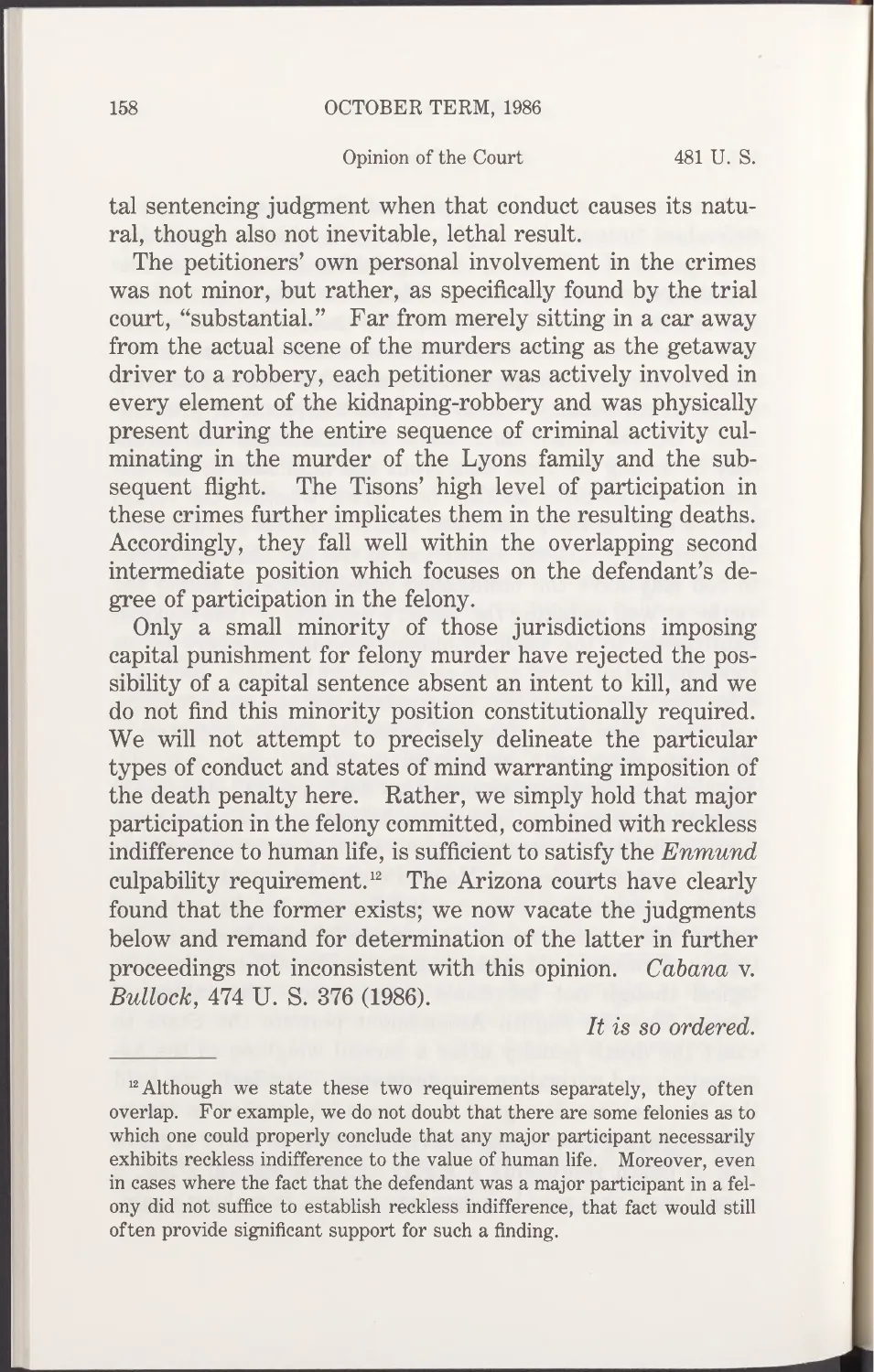
Instead, Justice Sandra Day O’Connor’s majority opinion identified a combination: major participation in the underlying felony and reckless indifference to human life. On that view, the Constitution did not confine capital punishment to the person who fired or specifically wanted a death. But involvement alone was insufficient. The participant’s role and attitude toward the danger to human life both mattered.[1]
The disagreement was about individual responsibility
Justice William Brennan’s dissent challenged the majority’s treatment of that boundary. He emphasized the need to assess each defendant’s own culpability before imposing death and disputed the extension beyond the earlier intent-based limitation. Reading the dissent beside the majority reveals the actual disagreement: not whether four murders had occurred, but what personal responsibility justified the most severe punishment.[1]
The majority sent the case back for consideration under its standard. It did not itself order the brothers executed, and the decision was not an acquittal. In 1989, Arizona’s Supreme Court again vacated their death sentences because the trial court had declined to hold the evidentiary hearing contemplated by the remand. Both sides had to have an opportunity to present evidence on the required findings.[1][2]
A famous rule and the later result
The sentencing history continued beyond those opinions. In a September 1992 UPI interview, defense attorney Robert Keefe reported that the brothers’ death sentences had been changed to life imprisonment that July. That later result belongs beside the famous Supreme Court holding; a case name used to describe a legal rule is not a complete account of the defendants’ sentences.[3]
For readers of the escape’s history, the records preserve two distinct questions. What did each participant do, and what punishment could follow from that individual conduct? The courts’ insistence on a further hearing shows why a general rule could not replace the evidence required about each brother.[1][2]
Sources and references
Original companion analysis researched from the primary records identified here. A court opinion recounts the record before that court; it is not a complete investigation file.
- Tison v. Arizona, 481 U.S. 137 (1987)April 21, 1987 · United States Supreme Court
- State v. Tison, 160 Ariz. 501 (1989)May 2, 1989 · Arizona Supreme Court opinion reproduced by Justia
- Brothers finally free from death sentence after 13 yearsSeptember 11, 1992 · Contemporaneous UPI interview with defense attorney Robert Keefe
Used only for the attorney’s report of the 1992 life sentences; not for the article’s crime chronology.
Historical analysis of the 1987 opinion, 1989 remand and a contemporaneous 1992 report of life sentences. No claim about current custody or pending proceedings.