
Arkansas / Inside the court record
West Memphis: what the 2024 DNA-testing decision actually decided
The Arkansas Supreme Court’s 2024 decision in Damien Echols’s case was important partly because of what it did not decide. It did not announce a new DNA result, identify another perpetrator or exonerate the West Memphis Three. It addressed whether a person released from prison could still ask for testing under Arkansas’s scientific-evidence law.
Read the original court record ↓Release and exoneration were different events
Three eight-year-old boys were murdered in West Memphis in 1993. Echols, Jason Baldwin and Jessie Misskelley were convicted. After years of litigation, the three entered Alford pleas in 2011 and were released. The opinion records Echols receiving a time-served sentence with an additional suspended term while continuing to maintain his innocence. Release did not erase the conviction.[1]
Earlier testing had excluded the three men as contributors to the particular biological material tested. That finding should be described at its actual scale. The 2024 court was reviewing access to further testing, not conducting a new trial of the murders. Neither an exclusion from a tested sample nor a request to test more material should be presented as a judgment identifying who committed the crime.[1]
The first obstacle was custody
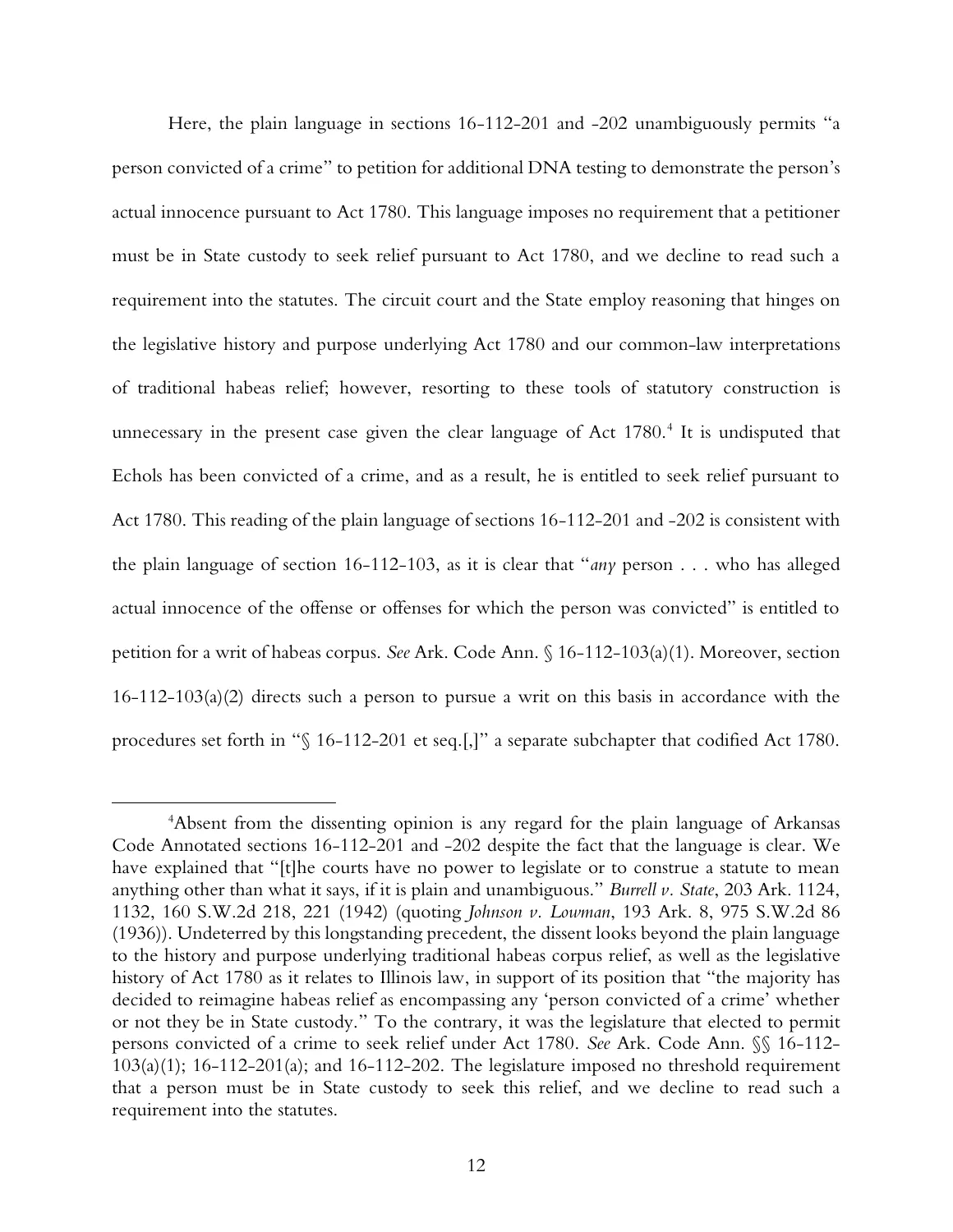
Echols’s 2022 petition sought additional testing of ligatures using a collection method unavailable during the earlier tests. The circuit court denied the petition because he was no longer in state custody. It treated the request as a form of habeas corpus, traditionally a way to challenge unlawful detention. On that reasoning, a person already at liberty could not obtain the requested relief.[1]
The Supreme Court majority focused on the words the legislature had used. The relevant provisions referred to a person convicted of a crime. They did not add a requirement that the person still be imprisoned. Justice Karen Baker’s opinion declined to insert that restriction and reversed the dismissal. The case returned to the lower court rather than ending with a finding of innocence.[1]
The plea raised a second obstacle
The state also argued that Echols’s guilty plea removed identity as an issue, preventing relief under the testing statute. The majority distinguished an Alford plea from an ordinary admission of guilt. A defendant may accept a conviction through that procedure while maintaining innocence. In the majority’s analysis, the plea did not automatically foreclose Echols’s later claim under this particular statute.[1]
That conclusion did not make testing unconditional. The opinion described statutory criteria that a person seeking scientific testing must satisfy. The narrow point was that the custody objection and the argument based on the Alford plea did not justify ending this petition in the way the lower court had done. Eligibility to seek relief and entitlement to an eventual remedy remained separate questions.[1]
The dissent identified the disagreement
Justice Barbara Webb’s dissent, joined by two other members of the court, read the law through the traditional custody requirement and the importance of final judgments. It also disputed the effect of the Alford plea and whether the proposed testing could establish innocence given the other trial evidence. Those were objections to the majority’s legal analysis, not newly completed forensic findings.[1]
The record examined here ends with a later procedural step. In August 2025, KAIT reported that a circuit judge approved an agreed order for further DNA testing of specified evidence. That report described authorization to test, not a laboratory finding. This historical analysis covers the April 2024 opinion and that August 2025 report; it does not assess subsequent testing, litigation or the men’s current legal status.[2]
The useful distinction in the 2024 record is between opening a route to evidence and deciding what that evidence proves. The majority held that release from prison did not close the statutory route in Echols’s case. Keeping that limited holding clear explains the ruling without attributing a forensic result or a finding of innocence to a court that had announced neither.[1]
Sources and references
Original companion analysis researched from the primary records identified here. A court opinion recounts the record before that court; it is not a complete investigation file.
- Echols v. State, 2024 Ark. 61April 18, 2024 · Arkansas Supreme Court opinion preserved by the Innocence Project
Complete majority and dissent. The hosting organization advocated for the appellant; the document itself is the court’s opinion.
- Judge orders DNA testing of WM3 evidenceUpdated August 1, 2025 · KAIT / Action News 5 report of the later testing order
Contemporaneous secondary reporting, used only for the later order; not evidence of any test result or exoneration.
Historical analysis of the April 18, 2024 ruling, with a separately attributed August 2025 testing-order report. The source cutoff for this article is August 2025; it is not a report of subsequent laboratory results, litigation or current legal status.