
California / Inside the court record
The Unabomber’s belongings: evidence, an auction and the victims left waiting
Years after the Unabomber pleaded guilty, his belongings were still in government custody. Selling them meant confronting an uncomfortable question: what happens when a killer’s notoriety gives his property value?
Read the original court record ↓Four checks, thirteen years after sentencing
On August 2, 2011, a federal judge in California ordered four checks issued from the proceeds of an auction. Together they totaled $225,735.56. The money came from property seized from Theodore Kaczynski, the Unabomber. His prison sentence had been settled years earlier. What remained was a dispute over the things he had left behind, and what those things could do for the people harmed by his crimes.[4][1]
The bombing campaign killed Hugh Scrutton, Thomas Mosser and Gilbert Murray. Other victims survived with devastating injuries. Kaczynski pleaded guilty in 1998 and received four consecutive life sentences plus thirty years. The restitution order was $15,026,000. A sentence could keep him in prison; collecting that debt required finding something of value he owned.[8][1]
The objects that helped make the case
The investigation broke open after publication of Kaczynski’s manifesto in 1995. His brother David recognized similarities to earlier writings and brought his suspicions to authorities. Agents arrested Kaczynski at his Montana cabin on April 3, 1996. Inside, they found journals and physical evidence connecting the secluded occupant to a bombing campaign that had begun in 1978.[5]
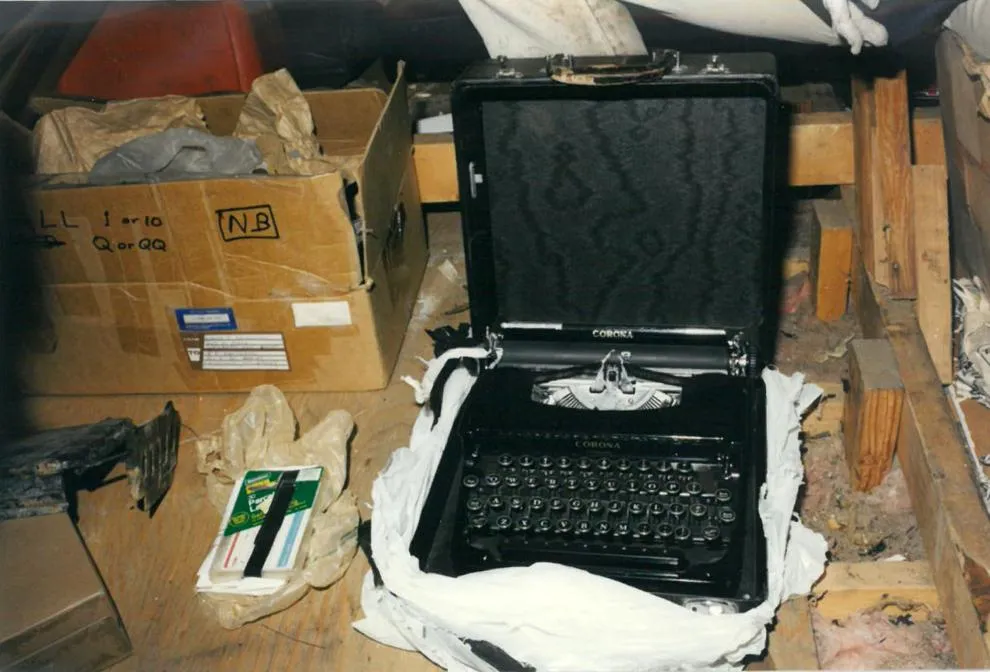
The FBI’s forensic account describes three typewriters recovered from the cabin and approximately 400 typewriting examinations. Examiners compared the machines’ distinctive impressions with questioned documents. That work matters because the connection rested on more than a brother’s recognition of a writing style. Investigators could also compare the physical traces left on paper by machines in Kaczynski’s possession.[6]
Years later, the seized property had several possible futures. Some objects remained dangerous or were tied directly to making bombs. Others were ordinary belongings. The writings were both physical property and a record of their author’s ideas. Treating every item the same way would not resolve the competing claims over them.[1]

The victims did not speak with one voice
Kaczynski asked for the return of seized property in 2003. The district court initially rejected that request and treated the property as having little value apart from its association with him. In 2005, the Ninth Circuit sent the matter back. Criminal notoriety might make the belongings more valuable, the appellate court reasoned. The government needed a commercially reasonable plan to turn that value toward restitution.[1]
The resulting plan called for a publicized internet auction of personal property, books and original writings. But an auction also meant renewed attention. Victims who supported the plan wanted the financial recovery it could provide. Other victims objected to another round of publicity and preferred donation or destruction of the property. The Ninth Circuit acknowledged those competing interests while upholding the government’s responsibility to collect restitution for the claimants.[1]
Selling the paper without silencing its author
Kaczynski challenged the plan on First Amendment grounds. In its January 9, 2009 decision, the Ninth Circuit drew a distinction between the original sheets and the ideas written on them. The government was collecting a debt through a generally applicable restitution law. Under the plan, Kaczynski or his designee would receive complete, legible copies of his writings. Selling the originals did not prevent him from communicating their contents.[1]
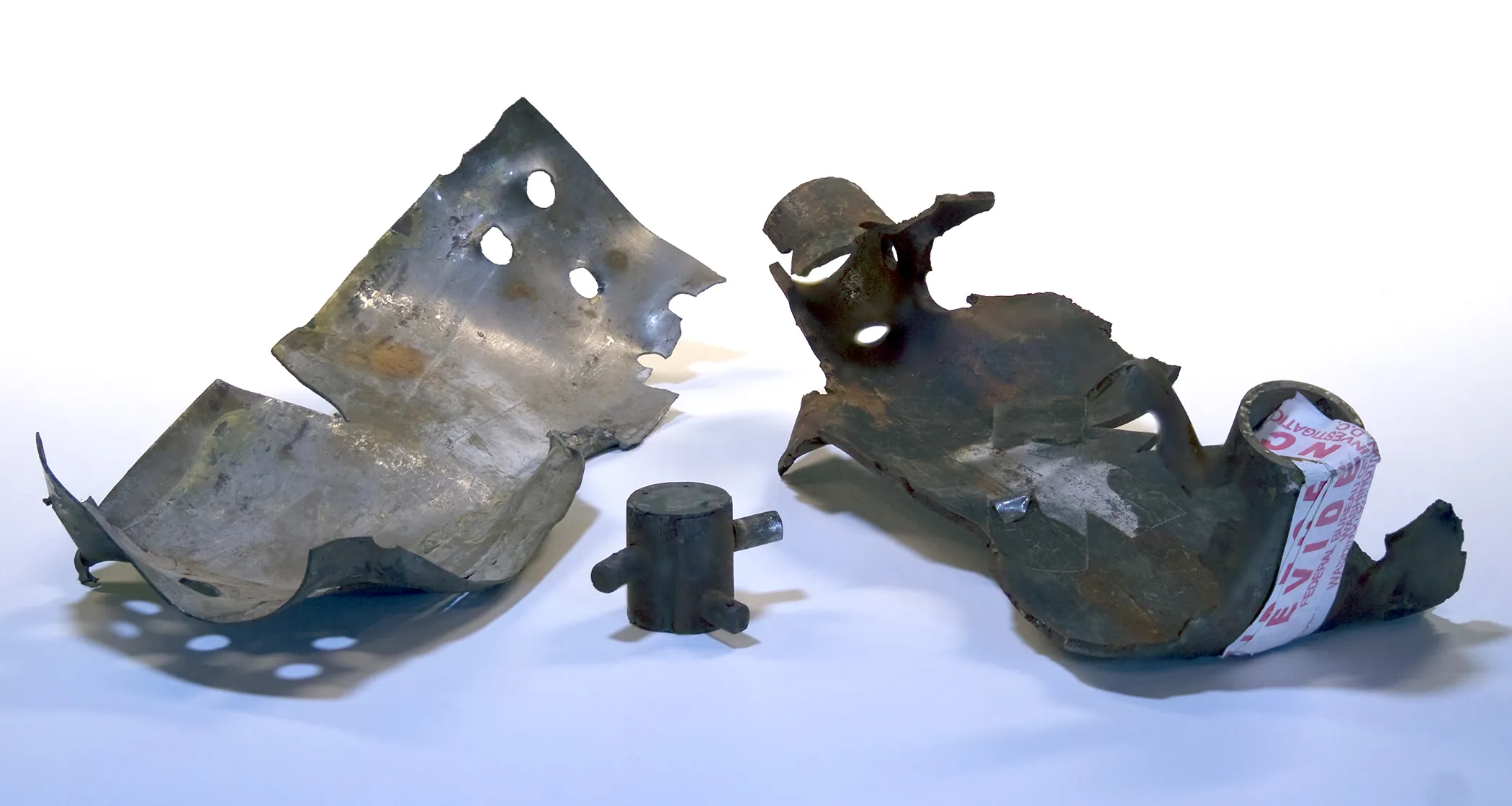
That was a limited holding about this property and this plan. The court did not decide hypothetical disputes over seizure of future writings or intellectual property rights. Nor did it approve an unrestricted sale of everything in government custody. The auction arrangements protected identifying information about victims and their families, and descriptions of injuries. Materials used or intended for bomb construction presented a separate issue and were excluded from the auction.[1]
.jpg)
Black ink, paper copies and a delayed handover
Carrying out those protections became a substantial task of its own. An August 2010 order described more than 20,000 pages of documents, much of it written on both sides; later in the order, the court referred to 40,000 pages. The court addressed whether passages should be physically cut out or covered with dark ink. It ordered ink redactions, with precautions for writing on the reverse side of a sheet. The material to be obscured included victim information and technical bomb-construction details.[2]
A September amendment changed how copies would reach Kaczynski’s counsel. Physical photocopies would replace the planned electronic copies, with delivery sixty days after the auction ended. The court also provided a process for requesting legible replacements. These details protected access to the text without supplying the electronic distribution that victims had opposed. The amendment needs to be read alongside the August order to understand the final copying arrangements.[3]
What the auction actually returned
The final accounting in the August 2011 distribution order records $230,493 in gross receipts and $4,757.44 in expenses. That left $225,735.56. The judge ordered checks mailed within three business days to Susan Mosser, Connie Murray, Gary Wright and Lois B. Epstein. Those are the court’s final figures and directions; the order itself does not establish when the recipients received their checks.[4]
The net proceeds were a small fraction of the restitution originally ordered. Yet they were money that could be recovered from property once held for an investigation. The litigation had determined which items could be sold, what information had to be removed, and how the author would retain access to his writings. After years of argument, the distribution order set out in three pages where the proceeds were to go.[4][1][2][3]
Kaczynski died in federal custody in North Carolina on June 10, 2023, aged 81. The auction record belongs to an earlier part of the aftermath, when victims and courts were still deciding what could be recovered from the possessions of the man responsible.[8][4]
Sources and page references
Page references in the article use printed document pages unless marked “PDF.” Briefs state a party's position; the majority opinion records the Court's holding.
- United States v. Kaczynski: Ninth Circuit auction decisionJanuary 9, 2009 · Federal court record
Affirms the auction plan and addresses speech, restitution, property and victims’ competing views. Article references use PDF page numbers.
- District court: supplemental auction and redaction orderFiled August 5, 2010 · Federal court record
Signed August 4. Sets redaction and copying procedures; subsequently amended by the September order.
- District court: amendment to copying proceduresSeptember 17, 2010 · Federal court record
Changes the delivery of copies and establishes procedures for obtaining legible replacements.
- District court: distribution of auction proceedsAugust 2, 2011 · Federal court record
Final gross receipts, expenses, net proceeds and directions for four checks.
- FBI: Unabomber investigationUndated; accessed October 2, 2026 · Investigative history
Supports the investigation, writings comparison and 1996 arrest. Historical custody wording is superseded by the 2023 death report.
- Dorothy-Anne E. Held: Handwriting, Typewriting, Shoeprints, and Tire Treads: FBI Laboratory’s Questioned Documents UnitApril 2001 · FBI forensic account
Supports the recovered typewriters and examinations. The accompanying cabin photograph is not identified here as a particular auction lot or the machine in Figure 9.
- FBI: Unabomber bomb shrapnelApril 2016 · FBI artifact record
Identifies the photographed fragments as evidence from the February 1987 bombing at CAAMS Inc. in Salt Lake City, Utah. These are not represented as auctioned items.
- Associated Press: Ted Kaczynski has died in prison at age 81June 10, 2023 · Contemporary reporting, published by KPBS
Supports the names of the three people killed and the Bureau of Prisons confirmation of Kaczynski’s death.
Records and source links checked October 2, 2026. This article concerns the property and restitution proceedings after the guilty plea. The 2011 order directs distribution; it is not a receipt confirming payment or a current accounting of all restitution.