
Connecticut / Investigation and evidence
Penny Serra: a fingerprint identified a person, but not a moment
A fingerprint on a tissue box survived years in which investigators could not attach a name to it. When they finally did, another question remained: when had the person touched the box? The Connecticut Supreme Court’s account of Penny Serra’s murder makes that distinction unusually clear. Identifying a source and reconstructing an event were connected tasks, but they were not the same task.
Read the original court record ↓An ordinary object became evidence
Concetta Serra was killed in New Haven’s Temple Street parking garage on July 16, 1973. Investigators found a tissue box in the Buick she had driven, along with blood in and around the vehicle. A fingerprint recovered from the box could not be matched to the roughly 70,000 prints then held by the local police. The object preserved information that the available comparison process could not yet resolve.[1]
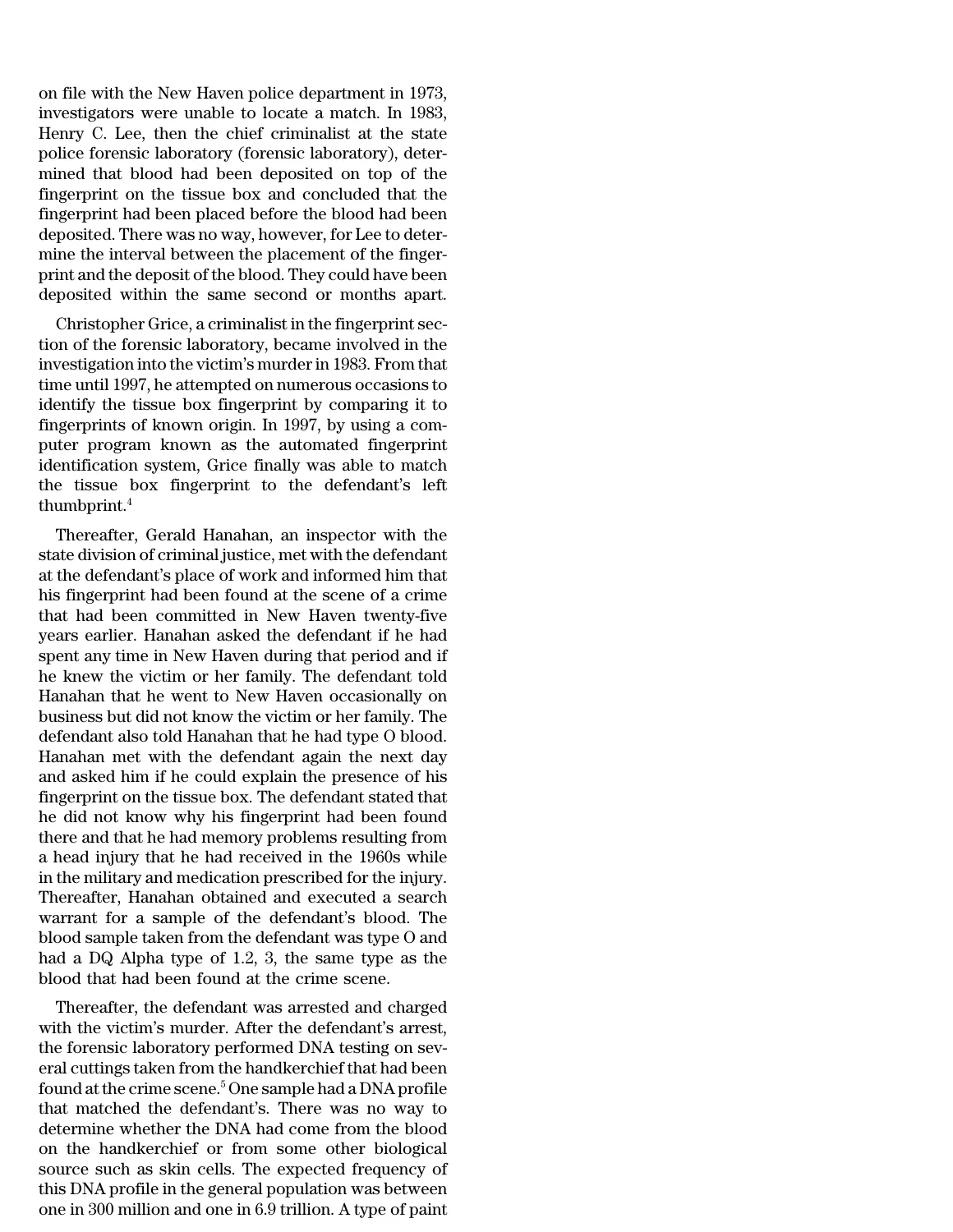
The record describes repeated comparison efforts over subsequent years. In 1997, an automated fingerprint system produced possible matches. A criminalist then compared the prints visually and identified Edward Grant’s left thumbprint. The computer helped locate candidates; the opinion’s footnote specifies that a human examiner made the comparison identifying the match.[1]
Sequence did not supply a date
An earlier examination had determined that blood lay on top of the print. That established an order: the touch came before the blood. It did not establish the elapsed time. The opinion explains that the interval could have been very brief or could have extended for months. A tissue box can be moved, and touching it is not, by itself, proof of participation in a murder.[1]
Grant challenged the warrant used to obtain a sample of his blood. Among his arguments were the possibility of an innocent explanation for the fingerprint and the failure to specify when it had been deposited. Investigators had asked him and Serra’s family about a possible connection. The warrant also described blood at the scene that differed from Serra’s blood type and Grant’s statement that he had that other type.[1]
Permission to investigate was not a verdict
The court upheld the warrant. Its analysis concerned probable cause to obtain evidence, rather than proof of guilt beyond a reasonable doubt. It concluded that possible innocent explanations did not defeat the reasonable inference supported by the combined facts in the affidavit. That is a limited proposition: the investigators had grounds for the blood sample, not a license to treat any unidentified fingerprint as conclusive.[1]
Grant also argued that omitted information, including the order in which the print and blood were deposited, should have triggered an additional hearing. The court held that adding those facts would not have defeated probable cause in this case. The opinion thus preserves the uncertainty about timing even while rejecting its use as a reason to invalidate the warrant.[1]
Later testing added a different kind of evidence
After Grant’s arrest, testing of a cutting from a handkerchief recovered at the scene produced a DNA profile matching his. The court reported a further limitation: the test could not determine whether that DNA came from the blood or from another biological source, such as skin cells. A strong identification result still did not answer every question about deposition.[1]
The Supreme Court affirmed Grant’s murder conviction in April 2008, directing only the correction of clerical errors in the charging and judgment records. The fingerprint’s long history remains instructive apart from the outcome. Better comparison tools can reveal information in old evidence, while careful interpretation still requires saying what the object cannot establish on its own.[1]
Sources and references
Original companion analysis researched from the primary records identified here. A court opinion recounts the record before that court; it is not a complete investigation file.
- State v. Grant, SC 18005April 22, 2008 · Connecticut Supreme Court; complete slip opinion preserved by Justia
Official host available for reading; preserved complete archive copy from https://cases.justia.com/connecticut/supreme-court/286CR72.pdf?ts=1462308266. The file contains the judicial opinion and front matter, not a separate publisher’s syllabus.
A historical analysis of the evidence and warrant issues in the April 22, 2008 affirmance. It does not claim that fingerprint or DNA testing independently dates a deposit, or report present custody.