
Hawaii / People and the record
Moreira Monsalve: the everyday commitments that made an absence visible
A missed day at work rarely tells a complete story. In Moreira Monsalve’s case, it stood beside unanswered calls, abandoned belongings and plans she had made with the people closest to her. The Hawaii Supreme Court’s 2025 opinion shows how witnesses described a life in progress, and why its abrupt interruption mattered to a murder prosecution brought without the recovery of her body.
Read the original court record ↓Plans that still had a future
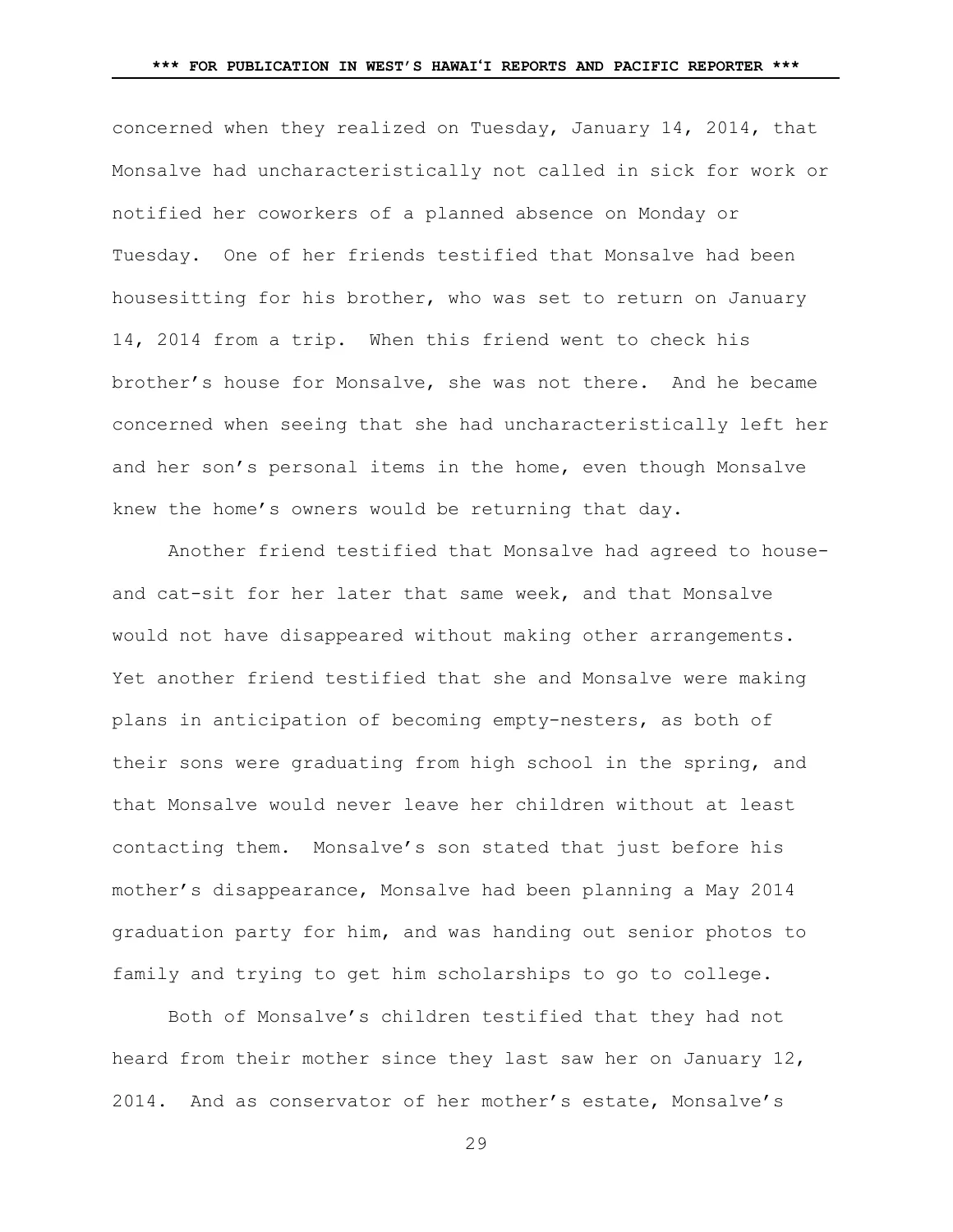
On January 12, 2014, Monsalve attended a college admissions and financial-aid workshop with her son. He later testified about preparations for his graduation, photographs she was distributing and her efforts to find scholarships. Friends described house-sitting commitments and conversations about life after their children finished high school. These were particular obligations and plans, rather than a general assertion that she would never leave.[1]
Her daughter expected continuing contact, including arrangements to be collected from the airport. When calls and messages went unanswered, the silence was unusual for their relationship. At work, colleagues knew Monsalve as a reliable financial analyst. She did not appear or call in on the Monday and Tuesday after January 12. Testimony from different parts of her life gave the jury more than one perspective on the disappearance.[1]
The belongings did not suggest an ordinary departure
Investigators recovered personal papers and a smashed phone from a public-park dumpster near Bernard Brown’s apartment. The opinion lists banking materials, work identification, college financial-aid paperwork and family documents. A witness also described finding a purse that was subsequently identified as Monsalve’s. Those discarded objects were considered alongside the complete loss of contact and the inactivity of her financial accounts.[1]
The court treated these facts as evidence from which a jury could infer death, not as a universal rule about missing adults. It described the sudden disappearance as inconsistent with the habits and relationships established through testimony. That conclusion concerned this accumulated record. A person’s absence, by itself, does not identify a killer or establish the circumstances of a death.[1]
A second question required different evidence
The prosecution still had to connect Brown to causing Monsalve’s death. He said she left his apartment between 10 and 10:30 p.m. to be picked up by her son. Her son denied receiving such a request or collecting her. Electronic records also showed her phone connecting through Brown’s internet account after the departure time he had described.[1]
The opinion places that discrepancy beside other testimony about Brown’s statements and actions, including furniture advertised for sale immediately after the disappearance and his requests for help clearing a computer. The court considered the combination when reviewing whether the jury could infer intentional or knowing conduct. It did not identify a phone connection or a furniture advertisement as sufficient proof on its own.[1]
What the appeal resolved
Brown challenged the sufficiency of the evidence and several trial rulings. In September 2025, the Supreme Court affirmed his conviction and sentence for second-degree murder. The opinion records a life sentence with the possibility of parole. Its review gave the jury’s factual findings the deference required on appeal; the appellate judges were not hearing the witnesses for a new trial.[1]
The ruling answers a legal question while leaving a human absence visible. Monsalve’s children, friends and colleagues did not merely provide background color. Their knowledge of her commitments supplied evidence about what had changed. The papers and plans in the record preserve a specific person’s unfinished week, even as the court explains why the evidence was sufficient for a conviction.[1]
Sources and references
Original companion analysis researched from the primary records identified here. A court opinion recounts the record before that court; it is not a complete investigation file.
- State v. Brown, SCAP-23-0000088 (2025)September 30, 2025 · Supreme Court of Hawaii
A focused reading of the September 30, 2025 affirmance, especially the testimony about Monsalve’s disappearance. The article does not claim recovery of her body or a particular unproved method of death.