Idaho / Inside the court record
The Samuel case: what an expert could explain to the jury
An expert can know a great deal about a subject without being qualified to answer every question touching it. That distinction became important in Eldon Samuel III’s appeal after the deaths of his father and younger brother. The Idaho Supreme Court examined what a researcher could tell the jury about adolescent behavior, and what foundation was needed before he could offer an opinion about Samuel himself.
Read the original court record ↓The disputed question was intent
Samuel was fourteen when he killed his father and brother in Coeur d’Alene in March 2014. At trial, the defense argued self-defense in his father’s death and manslaughter, rather than murder, in his brother’s death. The jury convicted him of second-degree murder for his father’s death and first-degree murder for his brother’s. The appeal therefore concerned more than identifying who had caused the deaths.[1]
The record described severe abuse and instability during Samuel’s childhood. The defense sought to explain the significance of that history through expert testimony. The courts did not treat the history as imaginary or irrelevant. The contested issue was how particular witnesses could connect their qualifications and methods to the questions the jury had to decide.[1]
Research expertise had a defined scope
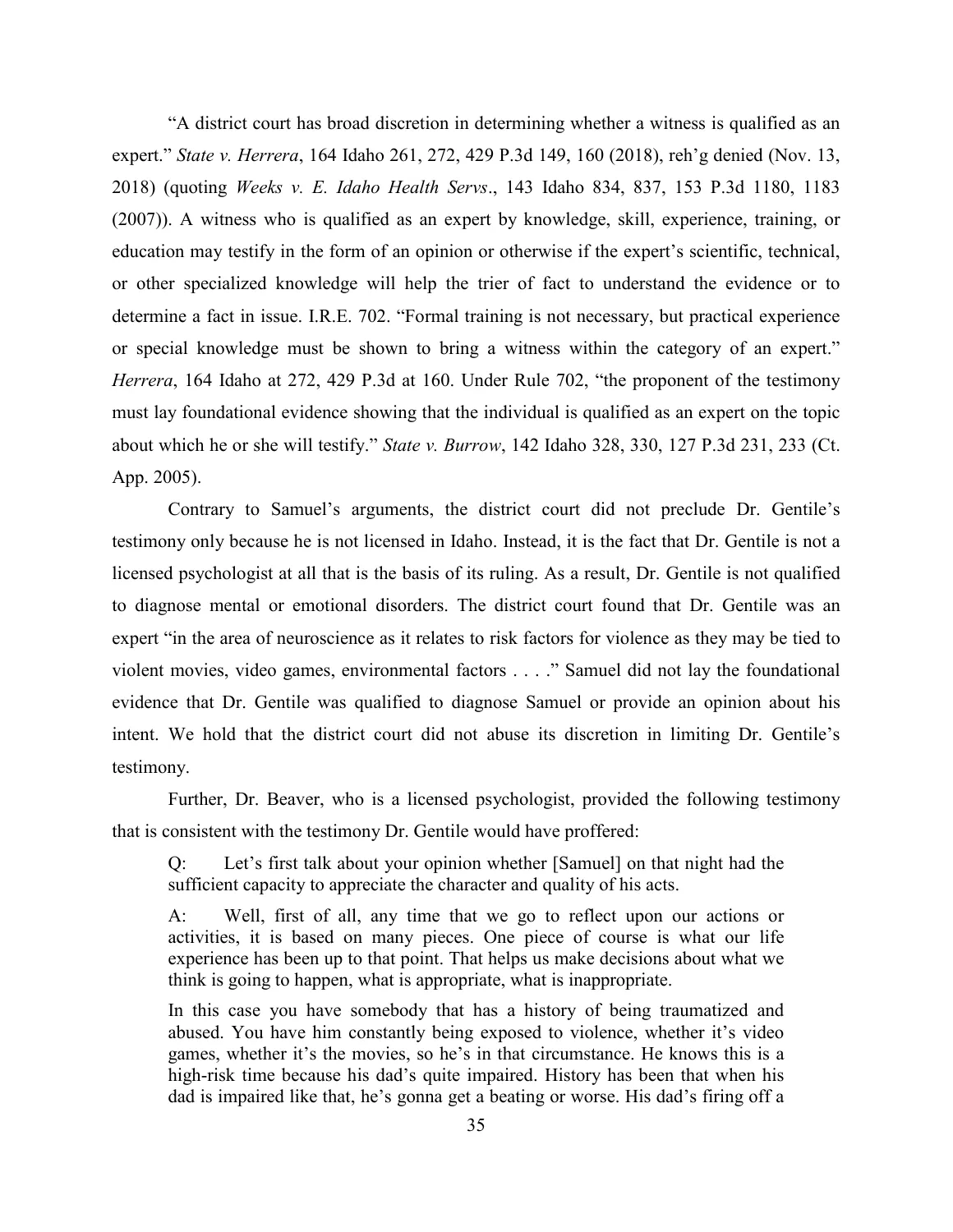
Douglas Gentile was a professor and researcher whose work concerned media violence and juveniles. His proposed opinion went beyond identifying general risk factors: it addressed whether Samuel had planned or intended his actions. The prosecution sought to limit that testimony. The trial judge reviewed the report outside the jury’s presence before determining the permitted scope.[1]
Gentile was allowed to discuss brain development, adolescent functioning and risk factors for violence. He was not allowed to give the jury his proposed conclusion about Samuel’s own intent. The Supreme Court emphasized that the defense had not established his qualifications to diagnose Samuel or give that particular opinion. The dispute was not simply whether he held an Idaho license; he was not a licensed psychologist at all.[1]
That distinction should not be turned into a claim that researchers can never testify, or that scientific knowledge has no place in a criminal trial. Gentile did testify. The ruling addressed the match between his demonstrated expertise and a specific proposed conclusion. General information about a group and a clinical assessment of an individual were not treated as interchangeable.[1]
Other testimony still reached the jury
A different defense witness, psychologist Craig Beaver, offered an opinion about Samuel’s ability to form intent and deliberate. The Supreme Court quoted that testimony when explaining why Gentile’s excluded conclusion would also have been cumulative. Reading only the exclusion would leave the mistaken impression that the jury heard no expert support for the defense’s account of Samuel’s mental state.[1]
The appellate court did find a separate error in excluding testimony from Samuel’s mother about his fear of his father. It held that error harmless because other testimony addressing that fear reached the jury. The 2019 judgment was affirmed. An affirmance did not mean the Supreme Court considered every trial ruling flawless.[1]
Keep the later proceedings distinct
In February 2025, the Ninth Circuit affirmed the denial of Samuel’s federal habeas petition, which challenged his rights waiver and the voluntariness of his confession. That review applied a demanding federal standard of deference to the state decision; it was not a new trial of the expert-testimony issue. The United States Supreme Court denied his petition for review in October 2025.[2][3]
The expert-testimony passages remain useful on their own terms. They show a court separating the value of general research from the additional foundation needed to assess one person, while also checking what the jury actually heard from other witnesses. The result depended on those details, not on a blanket dismissal of Samuel’s childhood or of adolescent psychology.[1]
Sources and references
Original companion analysis researched from the primary records identified here. A court opinion recounts the record before that court; it is not a complete investigation file.
- State v. Samuel, Idaho Supreme Court No. 44182 (2019)September 11, 2019 · Idaho Supreme Court; original opinion preserved by Justia
The original court index identifies this opinion. Its historical court-hosted PDF now returns 404; this is the complete archived judicial PDF.
- Samuel v. Carlin, No. 23-35408 (2025)February 5, 2025 · Ninth Circuit memorandum disposition
Later federal habeas review; not a precedential opinion.
- Supreme Court docket No. 24-7467October 6, 2025 denial entry · United States Supreme Court docket
Examines the 2019 expert-evidence rulings, with separately identified 2025 federal habeas and certiorari outcomes. No diagnosis by the article and no claim about current custody.