
Illinois / Aftermath and community
Dixon’s missing money: what repayment could not give back
The money in Rita Crundwell’s case can be counted. What Dixon lost while it was missing is harder to total. A federal appeals opinion describes public equipment that was not purchased, a smaller street department and roads left waiting for repairs. It is a useful corrective to a story often remembered mainly for horses and expensive possessions.
Read the original court record ↓A city account with one person in control
Crundwell used her position as Dixon’s comptroller to divert city money into an account she controlled. It carried a name suggesting a reserve fund, while false invoices supplied an apparent public purpose for transfers. She then spent the money on herself and her horse business. Her 2012 guilty plea covered wire fraud in a scheme running from 1990 to 2012.[1]
The sentencing announcement describes another part of the concealment: access to the mail. Crundwell collected bank statements and arranged for her mail to be separated when she was away. During an extended absence in 2011, another employee requested all the city’s bank statements. The unfamiliar account reached the mayor, who brought the matter to law enforcement. A routine administrative task had exposed a gap in what other officials knew.[2]
The loss appeared as ordinary budget pressure
While taking millions, Crundwell told officials that economic conditions and delayed state payments explained the city’s shortages. The appeals court recorded that the theft averaged 28 percent of Dixon’s budget during the scheme’s last six years. The consequences were dispersed through municipal decisions, making each shortage look like a problem to manage rather than evidence of the same underlying crime.[1]
The street department fell from nine workers to six. Police went without useful equipment, and road maintenance suffered. These were not losses confined to a bank balance. Residents depended on services that their taxes were supposed to support. The sentencing judge treated that disruption, together with damaged public confidence, as an important part of the harm.[1]
Recovery and repair were different things
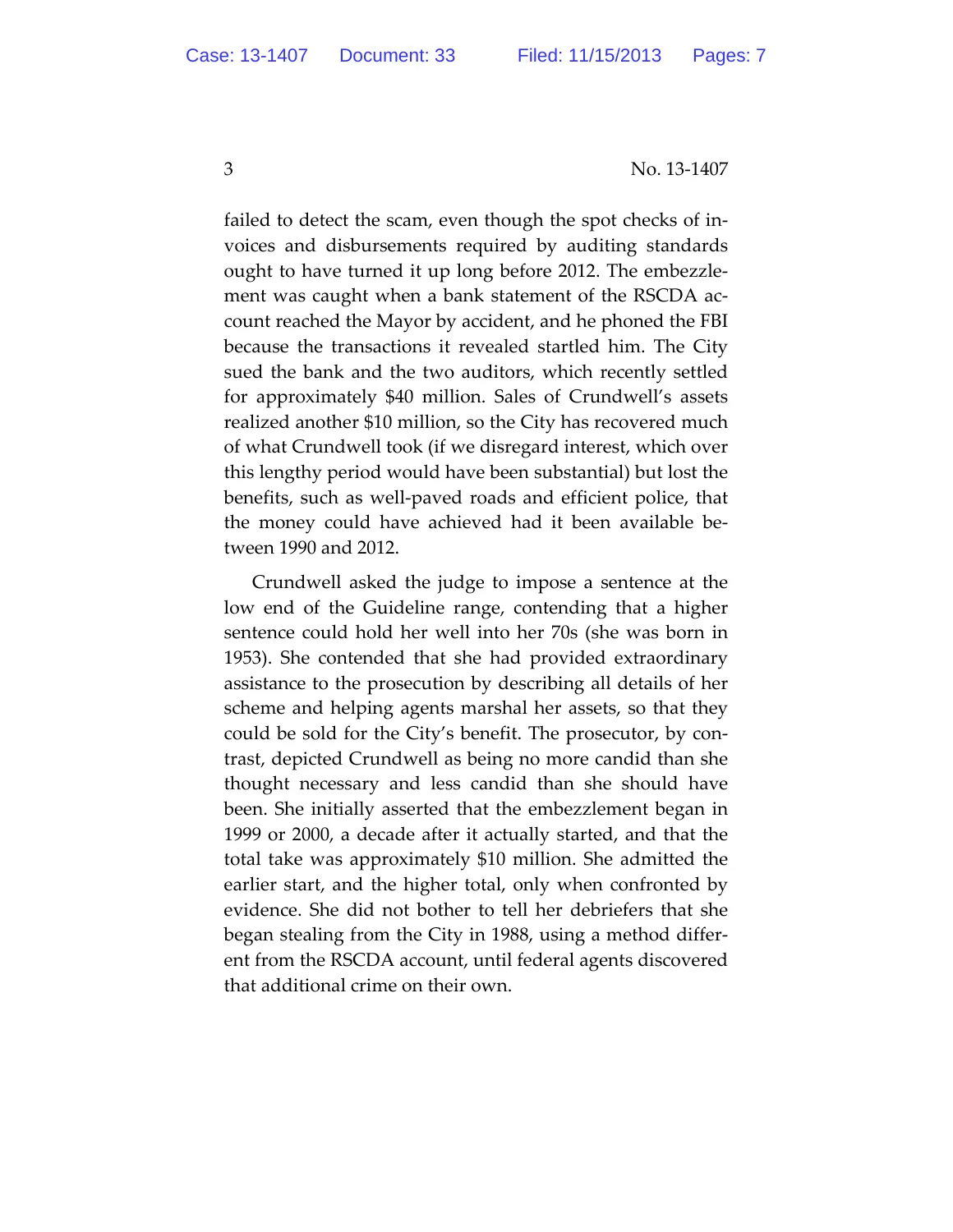
By the November 2013 appeal, the opinion reported about $40 million in settlements with the city’s bank and auditors, alongside roughly $10 million from asset sales. Those figures describe that stage of recovery, not a final accounting. The judges also noted that money returned later could not recreate the services and benefits residents had gone without over the preceding years.[1]
Crundwell argued for a lower sentence in part because she had helped identify and gather assets for sale. The trial judge acknowledged assistance but gave greater weight to the scale and duration of the public injury. The Seventh Circuit affirmed the 235-month sentence. Its reasoning did not require treating cooperation as worthless; it required considering that cooperation beside the damage already done.[1]
The sentence later changed
Crundwell appears on the Department of Justice’s December 12, 2024 commutation list. The group warrant shortened the recipients’ confinement to expire on December 22, while expressly leaving supervised release and other sentence components intact. That later action matters when describing her punishment: the original prison term should not be presented as the term she necessarily served in full.[4][3]
The record leaves a broader way to understand financial crime. Recovery totals answer how much money was returned. They do not answer what timely spending could have provided or how residents judged institutions that failed to detect the theft. In Dixon, those consequences were part of the court’s account of the offense, rather than an afterthought to the arithmetic.[1]
Sources and references
Original companion analysis researched from the primary records identified here. A court opinion recounts the record before that court; it is not a complete investigation file.
- United States v. Crundwell, No. 13-1407November 15, 2013 · United States Court of Appeals for the Seventh Circuit
- Former Dixon comptroller sentenced for $53.7 million theftFebruary 14, 2013 · U.S. Attorney’s Office, Northern District of Illinois
- Executive grant of clemency, December 12, 2024December 12, 2024 · Presidential commutation warrant published by the Department of Justice
- December 12, 2024 commutation recipientsDecember 12, 2024 · Office of the Pardon Attorney
The article distinguishes the 2013 sentencing and recovery figures from the December 2024 commutation. It does not claim a final restitution balance, present supervision status or that commutation erased the conviction.