
Indiana / Reconstructing the investigation
Richmond Hill: the insurance story that existed before the explosion
Before the Richmond Hill explosion, Mark Leonard told a friend he was looking for a Ferrari. He connected that purchase to insurance money from a house supposedly destroyed by unusual winds. The house was still standing. In the Indiana Supreme Court’s account, that premature explanation became one of the details linking an insurance scheme to the deaths of Jennifer and Dion Longworth.
Read the original court record ↓What the wreckage could establish
The explosion struck the Indianapolis neighborhood shortly after 11 p.m. on November 10, 2012. Firefighters nearby heard and felt it before emergency calls reached them. Almost thirty homes were damaged badly enough to require demolition. The Longworths, who lived beside the house where the explosion began, died despite attempts by neighbors and firefighters to rescue them.[1]
Investigators initially considered an aircraft crash, a drug laboratory and a weather-related event. They ruled those possibilities out and concentrated on natural gas. The final account attributed the explosion to deliberate changes inside Monserrate Shirley’s house. Identifying the physical cause was one task; establishing who planned it and what they understood required a different set of records and witnesses.[1]
Three weekends away
Shirley initially denied wrongdoing and later cooperated. According to her testimony, Leonard had urged her to increase insurance coverage on the home’s contents from $160,000 to $300,000. Plans to destroy the property preceded the night of the explosion. The opinion describes two earlier attempts that did not produce the intended fire.[1]
For each planned weekend, the household made arrangements to be elsewhere: a casino room for Shirley and Leonard, care for Shirley’s daughter and a kennel for the cat. Those arrangements were not criminal by themselves. Their repetition, coupled with testimony about the scheme, placed the household’s absence in a chronology. The jury did not have to treat November 10 as an isolated trip that happened to coincide with a disaster.[1]
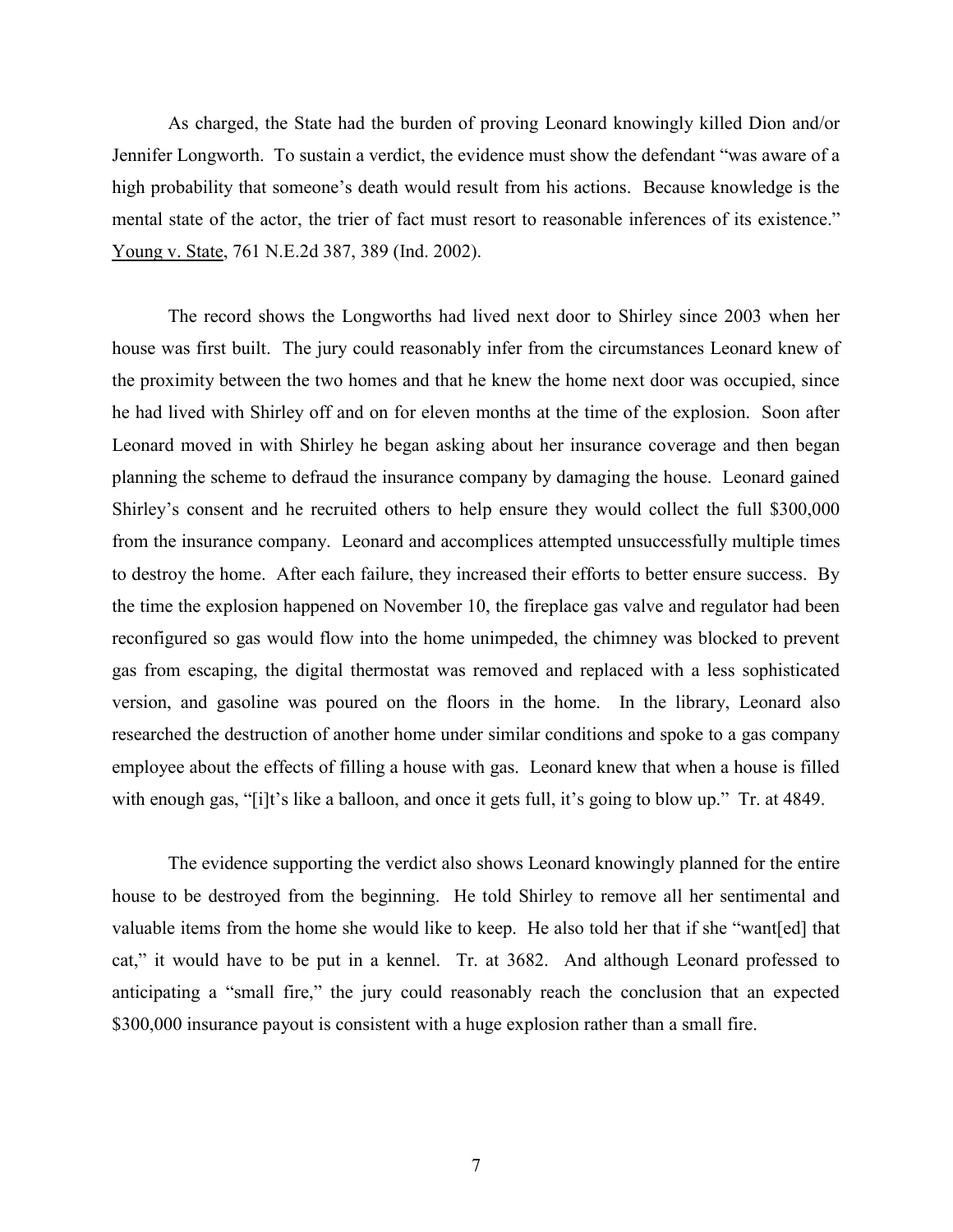
The valuable and sentimental belongings Leonard told Shirley to remove supplied another comparison. A plan for minor damage would leave a different set of expectations from one that required prized possessions and the family pet to be elsewhere. The Supreme Court pointed to these preparations when considering what a jury could infer about the scale of destruction Leonard anticipated.[1]
The explanation came too early
Mike Duckworth’s testimony added a statement made before the successful attempt. Leonard spoke about a destroyed house and an anticipated $300,000 payment while discussing a Ferrari. The significance was not the expensive car alone. It was the timing: the explanation for obtaining the money was already in circulation before the event that would supposedly justify the payment.[1]
Leonard challenged whether the evidence established that he knowingly killed the Longworths. The appellate court considered his familiarity with the occupied neighboring home, the preparations and the information he obtained about the danger. It concluded that the jury could find awareness of a high probability of death. That conclusion concerned the accumulated evidence, not a rule that any insurance fraud automatically amounts to murder.[1]
An account larger than the blast
In May 2017, the Indiana Supreme Court affirmed Leonard’s convictions and sentences, including consecutive life terms without parole for the murders. Indiana’s Department of Correction announced his death on January 30, 2018. Its announcement did not establish a cause of death, and none is inferred here.[1][2]
The case record offers a way to read an arson investigation without concentrating on the mechanism of destruction. Insurance changes, arrangements for an empty house and a statement to a longtime friend made the earlier weeks visible. Those ordinary records helped the jury assess what was planned before the Longworths’ neighborhood became an emergency scene.[1]
Sources and references
Original companion analysis researched from the primary records identified here. A court opinion recounts the record before that court; it is not a complete investigation file.
- Mark Leonard v. State of Indiana, No. 71S00-1509-LW-539 (2017)May 2, 2017 · Indiana Supreme Court
- Indiana Department of Correction confirms Mark Leonard’s deathJanuary 30, 2018 · Official correctional agency announcement
January 30, 2018; does not establish a medical cause of death.
Examines the record supporting the 2017 decision and the correctional agency’s 2018 death announcement. It does not provide instructions for causing an explosion.