
Iowa / Reconstructing the investigation
Kedarie Johnson: reconstructing a night without an eyewitness to the murder
Kedarie Johnson went to a Burlington grocery store to use its Wi-Fi. The cameras there preserved an ordinary part of a sixteen-year-old’s evening before his murder. In the later prosecution, those images became one piece of a much wider reconstruction, assembled from belongings, witness accounts, physical traces and electronic records.
Read the original court record ↓What the cameras could show
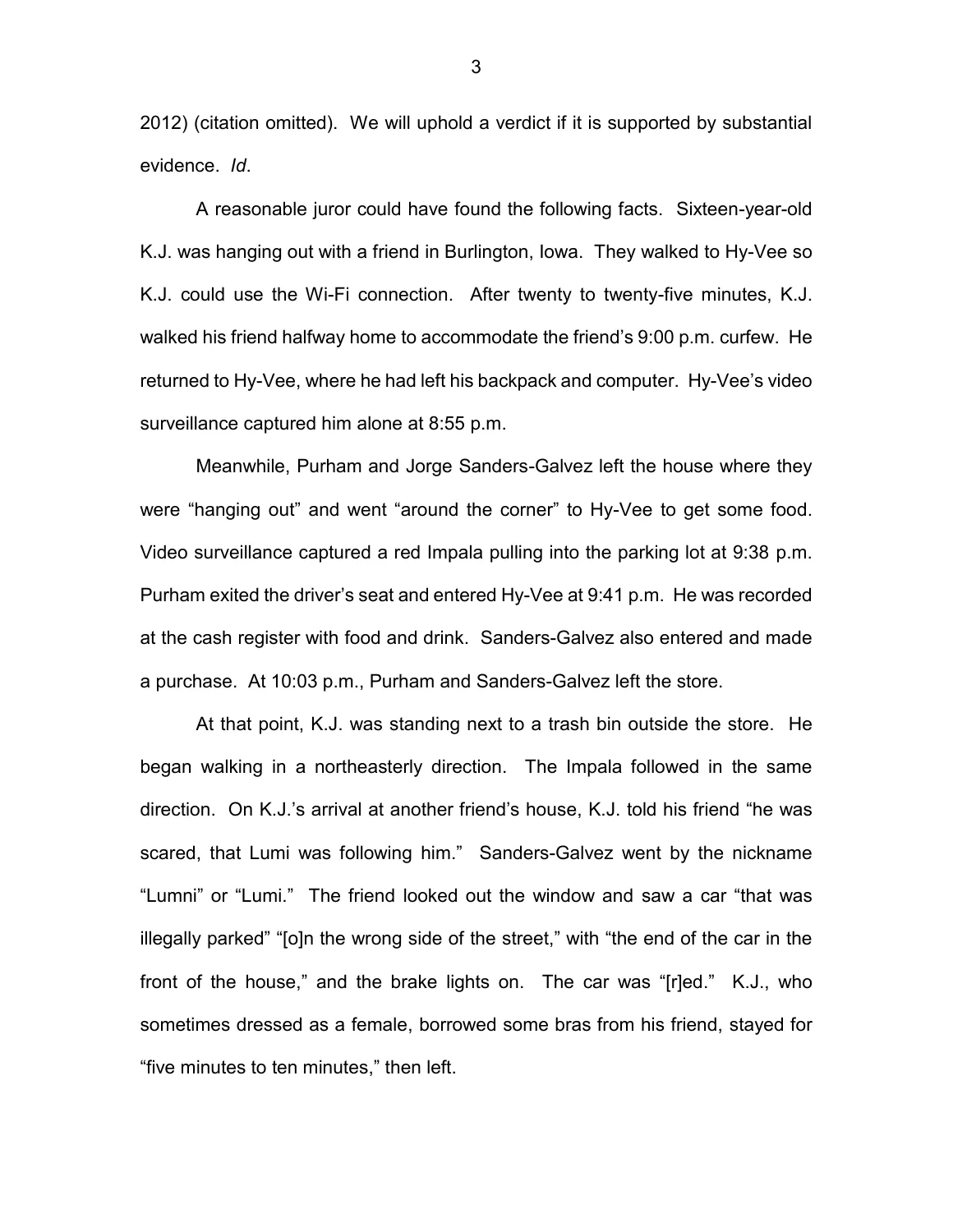
The Iowa Court of Appeals recounted the evidence in its 2021 review of Jaron Purham’s conviction. On March 2, 2016, Kedarie spent time at Hy-Vee, walked a friend partway home and returned for his backpack and computer. Store surveillance placed him there alone before recording the arrival of a red Impala and the movements of Purham and Jorge Sanders-Galvez.[1]
The cameras did not record the murder. Their contribution was narrower: the car’s arrival, the men entering and leaving the store, and the direction of travel afterward. A friend then supplied a separate observation. Kedarie said he was frightened because someone was following him; the friend looked outside and saw a red car. The courtroom chronology connected those accounts without pretending that either witness had seen the entire crime.[1]
Belongings connected separate places
Investigators found Kedarie’s backpack, school identification, computer and shoes in a house frequented by the defendants. Fibers on his clothing matched fibers from a bedsheet in the room containing those belongings. The appellate opinion describes those comparisons as part of the evidence a reasonable juror could consider. The items connected a person and a room; their significance depended on the surrounding timeline.[1]
Purham was later arrested in Missouri while driving a red Impala. A search found a revolver and ammunition, along with belongings connecting him to the Burlington house. Purham stipulated to the vehicle and search evidence at trial. In his police interview, he acknowledged staying at the house and owning the gun. These admissions were different kinds of evidence from an investigator’s interpretation of a photograph.[1]
The Justice Department’s account adds that a firearms expert identified the recovered revolver as the murder weapon. It also describes social-media records connecting Sanders-Galvez to its earlier purchase. Those findings helped join the later vehicle search to the events in Burlington. The agency release presents the prosecution’s account; the appellate opinion supplies the court’s assessment of the evidence supporting the verdict.[2][1]
Electronic silence needed context
Phone evidence was not limited to messages that were sent. The opinion records a detective’s testimony that Purham had no active phone usage from 10:04 to 11:36 p.m. That interval did not, by itself, prove murder. Its value arose from its place beside the other evidence. A gap in phone use becomes meaningful only through a demonstrated connection to people, places and actions.[1]
The prosecution also involved cooperation across jurisdictions. Burlington police and Iowa investigators worked with FBI assistance. A federal civil-rights prosecutor joined state prosecutors through a special appointment. The resulting verdicts discussed here were Iowa first-degree murder convictions. Federal participation in the investigation and trial should not be confused with a separate federal hate-crime verdict.[2]
A record assembled from limited views
Sanders-Galvez was convicted in 2017 and Purham in 2018. In January 2021, the Iowa Court of Appeals affirmed Purham’s judgment and sentence, finding sufficient evidence under the murder theories submitted to the jury and rejecting the other challenges addressed in the opinion. The decision assessed the trial record; it did not claim that investigators had obtained an eyewitness account of the killing.[2][1]
The case shows why a reconstruction can be persuasive without a single uninterrupted recording. Each source had limits: a store camera, a friend’s view from a window, belongings in a room and information recovered later from a car. Their connections gave the evidence its force. Keeping those limits visible also keeps the article from turning a detailed investigation into a story of one miraculous clue.[1]
Sources and references
Original companion analysis researched from the primary records identified here. A court opinion recounts the record before that court; it is not a complete investigation file.
- State v. Purham, No. 18-2124 (2021)January 21, 2021 · Iowa Court of Appeals
- Justice Department account of the Kedarie Johnson prosecutionOctober 6, 2018 · United States Department of Justice
A prosecution announcement, distinguished from the later appellate decision.
Examines the investigative evidence and the January 21, 2021 affirmance. No claim about a separate federal conviction, current custody or subsequent collateral proceedings.