
Kentucky / Across the state line
The Hatfield-McCoy feud: an unlawful capture and a trial still to come
In the Hatfield-McCoy feud, the state line was more than a feature of the landscape. Crossing it could change which governor, sheriff and court had authority to act. The 1888 Supreme Court case of Mahon v. Justice shows the consequences: a capture could be unlawful without, in the majority's view, preventing the prisoner from being tried once he was in Kentucky.
Read the original court record ↓A feud reached a different kind of court
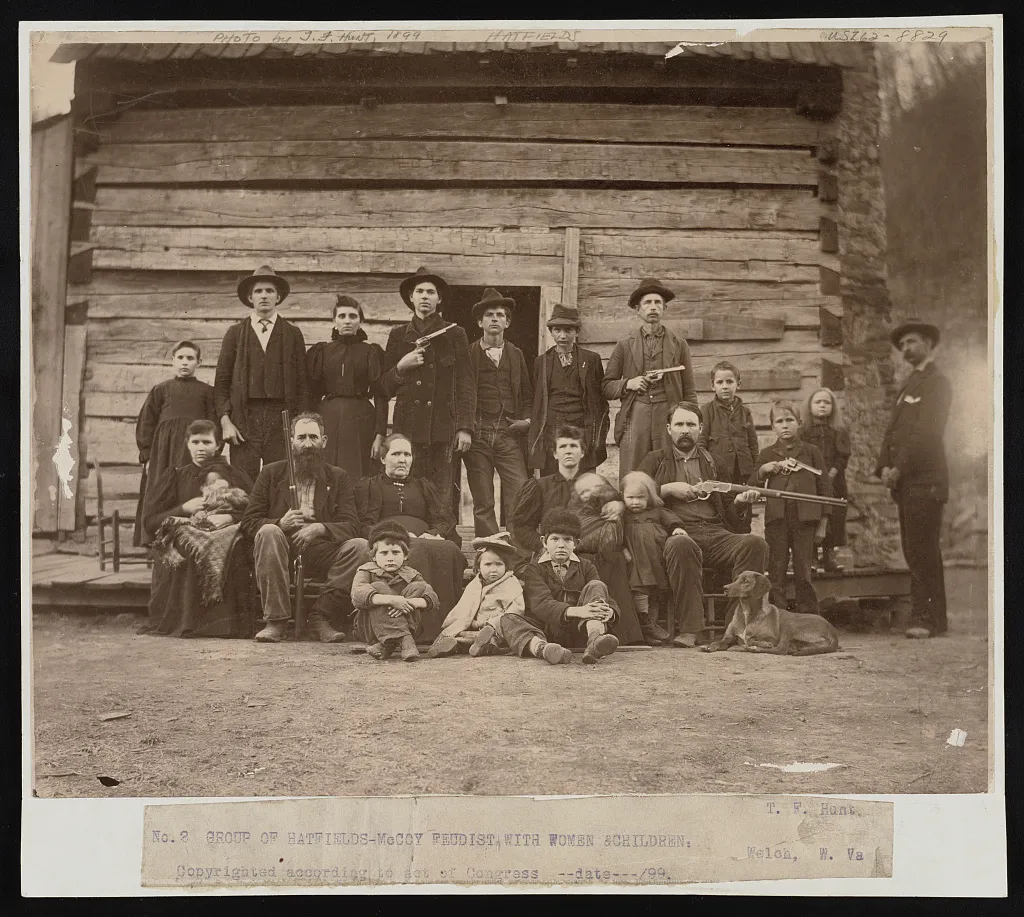
The families lived around the Tug Fork, on the Kentucky and West Virginia sides of the border. Their conflict produced separate killings, arrests and prosecutions over many years. The Supreme Court proceeding associated with that history was not a trial of the entire feud. It concerned one prisoner's detention: Plyant Mahon, who was being held in Pike County, Kentucky, on murder indictments.[2][1]
The indictments described in the opinion dated from 1882. Kentucky later requested Mahon's surrender from West Virginia, and the governors exchanged papers about that request. Before West Virginia issued an arrest warrant under the extradition process, Frank Phillips and other armed men seized Mahon there and brought him into Kentucky against his will. Kentucky officers then held him under the outstanding process issued on the indictments.[1]
West Virginia's governor demanded Mahon's return and sought a writ of habeas corpus, asking a federal court to examine the detention and order his release. Mahon also became the named applicant in a related petition. The lower federal courts declined to discharge him. The Supreme Court's task was to review that refusal. It was not being asked to hear witnesses and decide whether the murder accusations were true.[1]
The majority separated capture from detention
Justice Stephen Field's opinion did not describe the seizure as a proper extradition. Phillips had been appointed to receive Mahon if West Virginia surrendered him. That appointment did not supply authority to cross the border and take him by force. The majority condemned the abduction and said Phillips and his companions could be punished under West Virginia law. Its refusal to release Mahon was therefore not an endorsement of their conduct.[1]
Instead, the majority treated the later Kentucky custody as a different question. Mahon was now within Kentucky and held under legal process on existing indictments. The way he had arrived did not, the court concluded, remove the trial court's authority to hear those charges. Field distinguished an injury committed against the prisoner from his separate obligation to answer a criminal accusation. The court affirmed the refusal to discharge him.[1]
That reasoning contains a limit easily lost in a compressed account. The court was not saying that anyone could seize anyone else across a border with impunity. It expressly recognized the abductors' possible liability. Nor did it find Mahon guilty. The immediate consequence was that the prosecution could go forward despite the unlawful means used to bring him within reach of Kentucky's courts.[1]
The dissent saw a threat to peace between states
Justice Joseph Bradley, joined by Justice John Marshall Harlan, would have ordered Mahon's release and allowed his return to West Virginia. For the dissenters, the Constitution's provision for peaceful surrender of fugitives could not be separated from its purpose of preventing violent incursions between states. West Virginia had formally protested and sought a judicial remedy. That intervention mattered to Bradley's analysis of what the federal courts should do.[1]
The disagreement makes the opinion more revealing than a statement that the Hatfields lost an appeal. Both opinions confronted an unlawful seizure. They differed over its remedy: leave the Kentucky prosecution intact while allowing punishment of the abductors, or release Mahon to restore the peaceful process the dissent believed the Constitution required. Neither approach supplied a verdict on the underlying killings. Those questions belonged to other proceedings in the feud's long court record.[1]
Sources and references
References use the printed United States Reports page numbers. The article follows the court's spelling, Plyant Mahon, and distinguishes this detention appeal from the feud's criminal trials.
- Mahon v. Justice, 127 U.S. 700May 14, 1888 · United States Reports, Supreme Court opinion and dissent
Complete Library of Congress scan of printed pages 700-718. This is the federal detention case, not the transcripts or verdicts from the separate Kentucky murder trials.
- History and the Census: The Hatfield & McCoy FeudJanuary 1, 2022 · U.S. Census Bureau historical overview by Jason G. Gauthier
Used for the cross-border family setting and connection to the feud. The original Supreme Court opinion controls the account of Mahon's particular proceeding.
This is an analysis of the 1888 decision, not advice about present extradition law. Sources checked October 3, 2026.