
Maine / Inside the court record
Joyce McLain: when a private confession was repeated outside the room
A conversation with a pastor is not the same thing as a police interview. In the appeal arising from Joyce McLain’s murder, Maine’s highest court had to examine how one conversation led to others. The question was not whether the law recognized religious confidentiality. It did. The dispute concerned whether Philip Fournier had given up that protection by repeating a significant part of what he had said.
Read the original court record ↓A case that took decades to reach trial
McLain was sixteen when she disappeared while jogging in East Millinocket in August 1980. Her body was found near the school athletic fields. The 2019 opinion does not name her, referring instead to the victim; the police affidavit identifies her as Joyce McLain. Keeping the name beside the legal record prevents the appeal’s technical questions from displacing the person whose death brought the case to court.[1][2]
Fournier was questioned in 1981 but was not arrested then. The opinion describes accounts he gave investigators and testimony about other statements made over the following years. He was indicted in 2016 and convicted after an eleven-day trial before a judge rather than a jury. The court imposed a forty-five-year sentence.[1]
The conversation did not remain private
In May 1981, Fournier went to a parsonage and told a pastor that he had killed the victim. The pastor said he would believe that admission only if Fournier repeated it to his mother and stepfather. They came to the parsonage, and Fournier told them that he had killed her. The pastor then drove him to speak with police.[1]
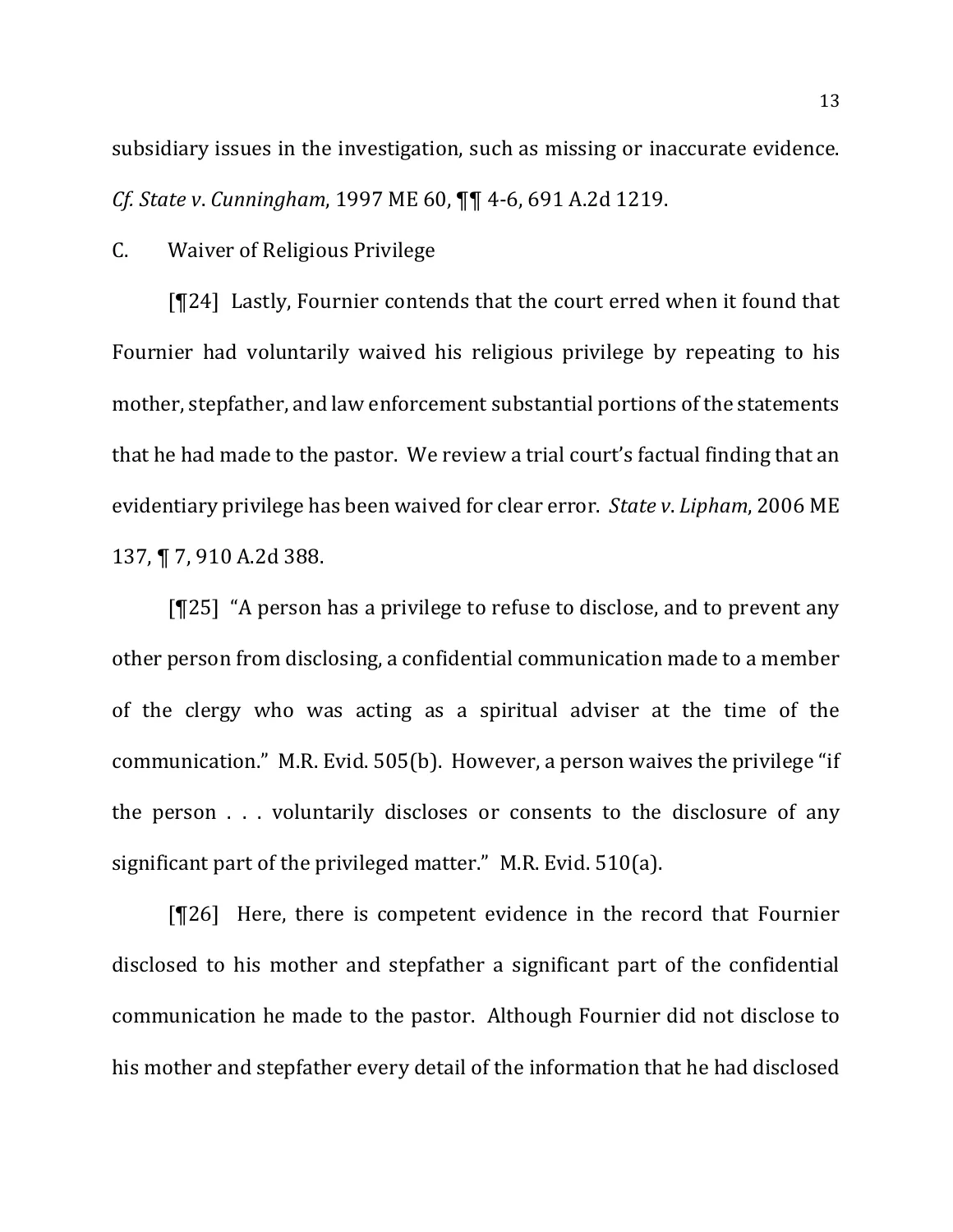
On appeal, Fournier maintained that his statements to the pastor remained protected. Maine’s evidence rule recognized a privilege for confidential communications to clergy acting as spiritual advisers. A separate rule addressed waiver: voluntarily disclosing a significant part of privileged matter could surrender the privilege. The two rules had to be read together.[1]
The Supreme Judicial Court did not require proof that every detail had been repeated. It considered the central admission to the mother and stepfather significant enough. On the record before it, the trial court had not erred by finding a waiver. The distinction was between keeping a communication confidential and later disclosing its substance, not between religious and secular people being more believable.[1]
What an investigator could still describe
The appeal addressed another boundary around the 1981 interviews. The defense wanted a detective to explain why Fournier had not been arrested after making incriminating statements. The trial judge would permit testimony about missing or inaccurate evidence, but not the detective’s overall opinion about whether the evidence was sufficient. The appellate court upheld that distinction.[1]
That ruling did not erase the delay from the case. The opinion itself records the absence of an arrest after the early interviews. It distinguished factual gaps that a witness could describe from a conclusion about the strength of the whole prosecution. A reader can therefore recognize the long investigative interval without treating an earlier decision not to arrest as a later finding of innocence.[1]
Read the ruling at its actual scale
The court affirmed Fournier’s conviction in February 2019. It also rejected his challenge to the treatment of alternative-suspect evidence, while explaining that such a defense does not transfer the burden of proof away from the prosecution. This article examines those rulings as recorded in that appeal; it makes no claim about a new or pending proceeding.[1]
The short discussion of privilege is especially useful because it avoids a sweeping answer. It did not abolish confidential spiritual advice or say that every disclosure destroys every privilege. It asked what this speaker voluntarily disclosed, to whom, and how much of the protected matter that disclosure revealed. Those details made the difference.[1]
Sources and references
Original companion analysis researched from the primary records identified here. A court opinion recounts the record before that court; it is not a complete investigation file.
- State v. Fournier, 2019 ME 28February 21, 2019 · Maine Supreme Judicial Court
- Maine State Police affidavit in the Joyce McLain prosecutionMarch 2016 · Signed police affidavit hosted by a local broadcaster
Used only to connect the victim’s name to the prosecution. Allegations are not substituted for the later judgment; the file is linked, not republished.
A focused reading of the February 21, 2019 affirmance. The judicial opinion is the source for the findings and legal result; the earlier affidavit identifies the victim.