Maryland / Aftermath and remembrance
George Armwood’s pardon: why the wording matters
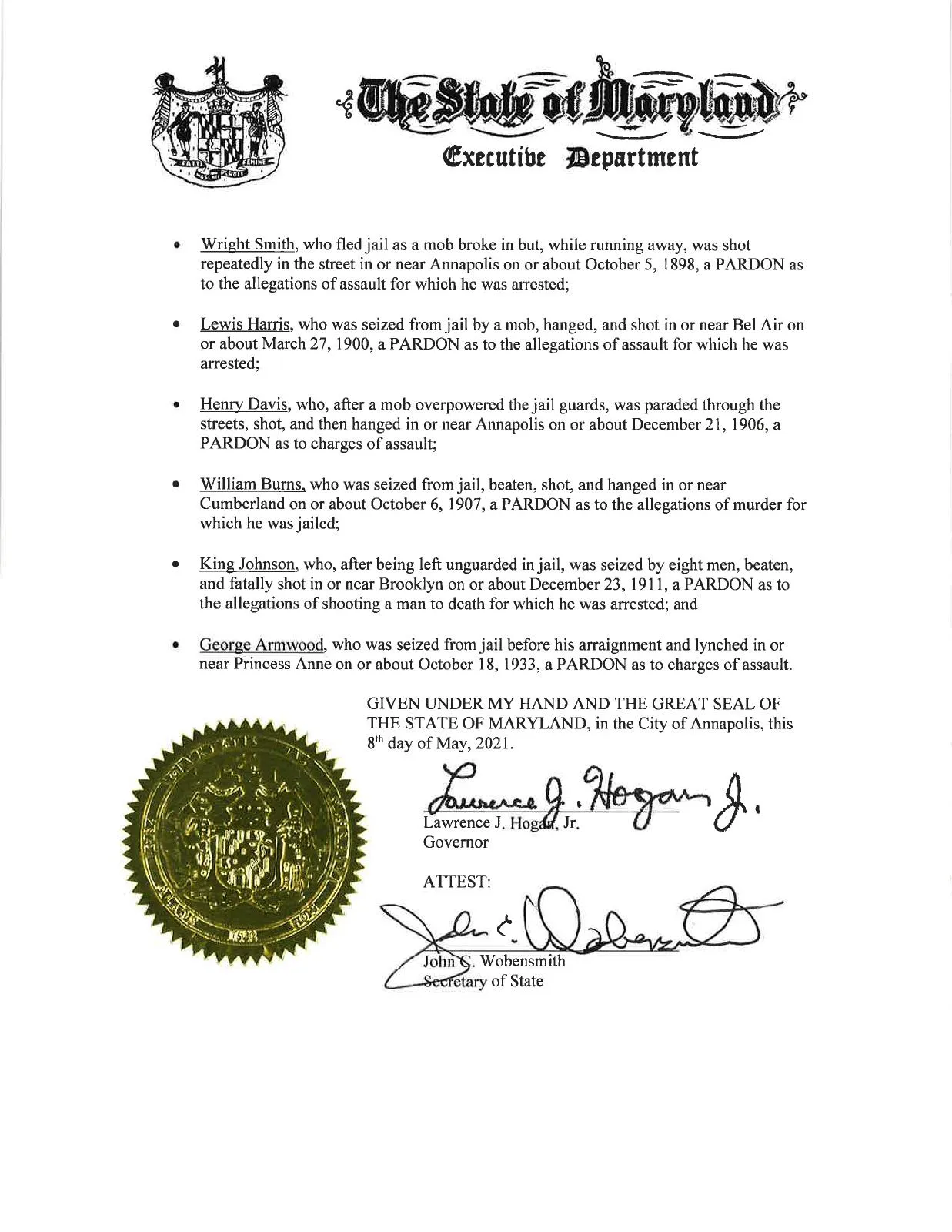
George Armwood’s name is the last one in Maryland’s May 2021 clemency document for victims of racial terror lynchings. The entry is brief: it identifies the place and date of his killing, notes that he was taken from jail before arraignment, and grants a pardon concerning assault charges. Those few lines matter because a pardon can otherwise leave a misleading impression that every person listed had been convicted.
Read the original court record ↓Read the entry before the label
The document, signed by Governor Lawrence J. Hogan Jr. on May 8, 2021, does not describe all of the victims’ legal situations in the same way. Some entries refer to convictions. Others refer to charges or allegations. Armwood’s refers to charges and explicitly says he had not yet reached arraignment when the mob seized him. A charge is not a verdict.[1]
That distinction should remain visible when the document is summarized. Calling Armwood a convicted offender would go beyond this record. Calling the pardon a new trial would also be wrong. The instrument is an executive act directed at the criminal accusations or judgments specified for the named victims, not an adjudication of the people who killed them.[1]
The state had custody
The Maryland State Archives places Armwood’s killing in Princess Anne on October 18, 1933. Its account describes officials moving him away from threats and then returning him to the Eastern Shore after assurances that a mob would not replace the courts. He was subsequently taken from the jail and killed. The clemency entry preserves the central institutional fact: he was seized while in custody.[2][1]
Keeping the jail in the story shifts attention from an undefined crowd to the setting in which protection failed. It also explains the importance of the phrase about arraignment. The mob did not carry out a lawful sentence. It interrupted the legal process, deprived Armwood of its protections and killed him before the accusation could be tested through that process.[1]
What the state acknowledged in 2021
The first page sets out the reason for the action. It identifies the killings as extrajudicial, says justice had not been done and connects them to violations of due process and equal protection. It credits the Maryland Lynching Memorial Project’s review of available documentation. The names that follow are therefore attached to an explicit acknowledgment of failed justice, not merely to a ceremonial list.[1]
The individual entries retain places, approximate dates and procedural circumstances. That specificity resists a common flattening of historical violence into a single general statement. The document includes people taken while being transported, people seized from cells and people killed at different stages of prosecution. Armwood’s short entry belongs within that varied record.[1]
The pardon cannot restore his life or recreate a hearing the mob prevented. Nor does its text identify a convicted perpetrator of his lynching or award damages to his family. Those are different forms of accountability. Treating executive recognition as though it accomplished all of them would obscure what remains absent from the record.[1]
An exact record of recognition
The complete document is preserved here with its signatures and all four pages. Reading Armwood’s entry alongside the opening statement shows both the action and its limits: Maryland formally addressed the charge left attached to his name while recognizing that the state’s legal protections had been violated. Precision does not diminish that acknowledgment. It keeps recognition from repeating the assumption of guilt that a trial never established.[1]
Sources and references
Independently researched companion article, written from the linked primary records.
- Executive clemency: victims of racial terror lynchings in MarylandMay 8, 2021 · Signed Maryland gubernatorial clemency instrument, state Archive-It copy
Complete four-page original scan. Armwood’s entry and signature appear on page 4.
- George Armwood, Maryland State Archives biographical seriesMSA SC3520-13750 · State archive historical context
Context for detention, transfers and killing; accusations are not adopted as findings of guilt.
The pardon concerns charges against Armwood. It is not a criminal conviction of anyone involved in his killing, a damages award or evidence that Armwood received a trial.