
Massachusetts / Objects left behind
The Gardner Museum theft: what the empty frames preserve
An empty frame can look like a temporary gap in a gallery. At Boston's Isabella Stewart Gardner Museum, the gaps have outlasted decades of investigation. Five surviving painting frames preserve something the thieves did not take: a visible relationship between particular works and the rooms where visitors once encountered them. Their history offers a way into the case that begins with the loss, rather than a suspect.
Explore the museum and investigative records ↓Thirteen works, not thirteen paintings
On March 18, 1990, two men dressed as police officers gained entry to the museum and restrained its guards. Thirteen works were stolen. The museum's inventory shows why calling them thirteen paintings is misleading: the missing objects include five works by Edgar Degas, a small Rembrandt etching, a Chinese bronze vessel and an eagle finial, as well as the better-known paintings. Recovery requires recognizing individual objects, not merely remembering a large theft.[1]
The rooms matter as well. The museum records removals from the Dutch Room and Short Gallery on the second floor, and Manet's Chez Tortoni from the Blue Room below. Its public account follows the stolen pieces across different spaces instead of treating the collection as an interchangeable stock of valuables. The harm was also to an arrangement of art that visitors could no longer experience in full.[1]
The frames are artifacts too
In her conservation essay, Holly Salmon explains that five paintings were removed or cut from their frames. The surviving frames have their own histories of alteration. Vermeer's The Concert, for example, occupied an older French frame narrowed to fit it. A frame was not necessarily made for the picture it eventually held. Studying its altered rails and other surviving details can recover part of a work's collecting history even while the painting itself remains missing.[2]
Salmon also notes an unresolved detail of the burglary: the frame from Chez Tortoni was left in a security office, unlike the Dutch Room frames discarded in that gallery. The museum does not claim to know why. It repaired the five frames and returned them to display. Their presence therefore has two meanings: they are surviving objects with physical histories, and they mark places reserved for specific missing works.[2]
A deliberate public reminder
In a 2023 FBI interview, the museum's security director, Anthony Amore, explained that the frames were rehung in 1994. He rejected the idea that their emptiness was simply forced by Gardner's will. Leaving them visible was a deliberate message about what belonged in those spaces and the museum's determination to recover it. That distinction changes how a visitor reads the display: the empty frame is an appeal to remember, as well as an absence.[3]
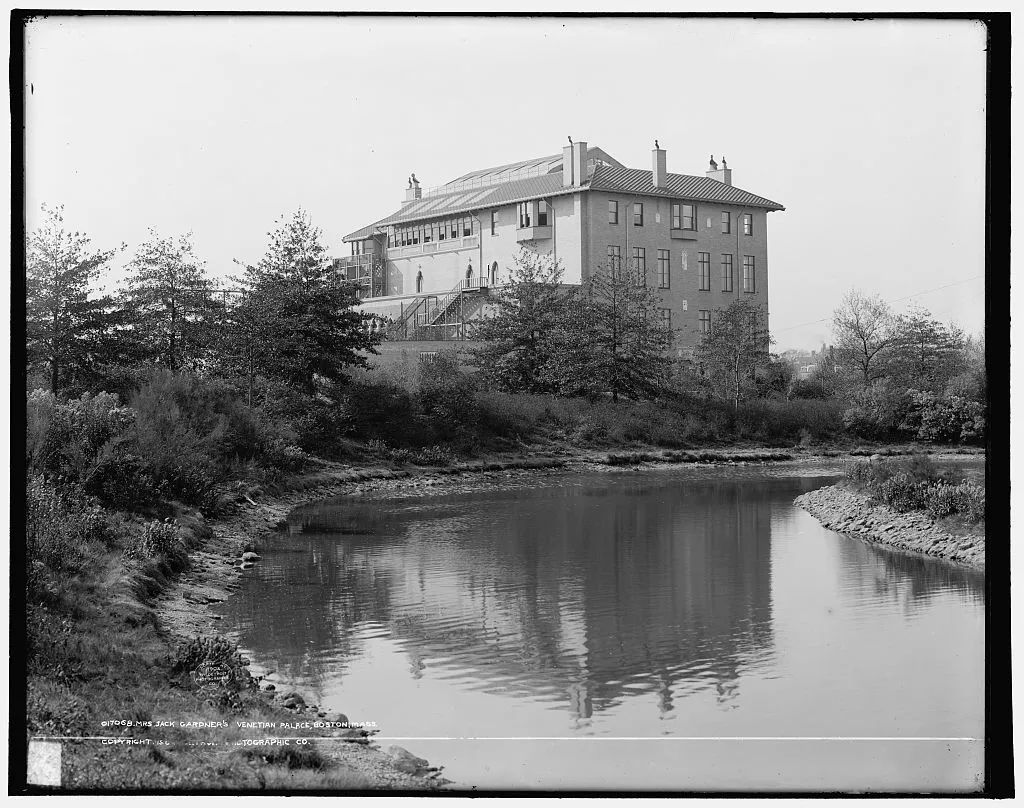
The historical photograph below shows the museum in 1904, long before the burglary. The Library of Congress identifies it as a Detroit Publishing Company image of Gardner's Venetian-style building. Its broad exterior view cannot explain the thieves' route or identify the people responsible. It does, however, place the case in a cultural institution that already had a long history before one night came to dominate its public story.[4]
Recognition remains part of recovery
FBI investigator Geoff Kelly described the search in that same interview as an effort to locate missing objects, with publicity intended to help someone recognize them. He acknowledged that investigative theories could be wrong. Statements about suspected movements of the art are therefore leads and assessments, not a verdict identifying a thief. The distinction is especially useful in a case that attracts elaborate public theories.[3]
The museum's current theft page continues to describe the investigation as active and unresolved. It publishes images and names of the missing works and directs information to its security staff. For readers, that object-by-object record is more useful than treating the crime as an unsolvable legend. The frames make the missing art visible to visitors; the inventory gives people elsewhere something specific to recognize.[1]
Sources and references
Locators identify the relevant sections or speakers. Thirteen stolen works are not described as thirteen paintings, and no suspect is presented as an adjudicated thief.
- Isabella Stewart Gardner Museum Theft · Museum's current theft account and stolen-object inventory
Used for the official inventory, locations and current unresolved status. Reward terms and tip instructions should be checked directly with the museum.
- The Five Frames Left BehindMarch 15, 2022; updated March 2025 · Holly Salmon, museum conservation account
Documents the frames' physical histories and distinguishes observed details from unanswered questions.
- Inside the FBI: The Isabella Stewart Gardner Museum HeistJune 23, 2023 · FBI interview transcript with Geoff Kelly and Anthony Amore
Statements are attributed to the speakers in this dated interview. Investigative hypotheses are not presented as adjudicated facts.
- Mrs. Jack Gardner's Venetian Palace, Boston, Mass.Copyright 1904 · Library of Congress, Detroit Publishing Company photograph record
Historical exterior view, not an image of the theft or its aftermath.
The museum's theft page describes the case as active and unresolved. Sources checked October 3, 2026; the FBI interview is separately dated 2023.