Michigan / Investigative history
The Nassar referral that did not arrive
On September 4, 2015, the FBI’s Indianapolis office told USA Gymnastics that the allegations against Larry Nassar had been transferred to its Detroit office. The Justice Department’s inspector general later found that the transfer had not happened. The gap between an assurance and a received case file became one of the clearest findings in the 2021 review of the FBI’s response.
Read the original court record ↓A jurisdiction question did not end the danger
USA Gymnastics had reported allegations involving three athletes to the Indianapolis office in July 2015. During the weeks that followed, agents interviewed one athlete by telephone and considered whether the alleged conduct could support a federal case. The office did not formally open an investigation or assessment. The inspector general located handwritten notes and messages, but not the formal investigative record that should have documented the work.[1]
Officials concluded that Indianapolis lacked a connection to the alleged conduct and questioned federal jurisdiction. Those were questions about which authority should act. They did not establish that no abuse had occurred. The prosecutor advised transferring the matter to the FBI’s Lansing office, where Nassar’s Michigan work made the location relevant. The report found no completed transfer and no warning to state or local authorities.[1]
What the missing paperwork meant
The supervisor later told investigators that he had completed and forwarded a complaint form. The inspector general found that no such form reached Lansing, and neither the supervisor nor other FBI reviewers could locate it. Lansing learned of the allegations more than a year after the original report, through Michigan State University police. A statement that another office was handling the matter had obscured the absence of a receiving investigator.[1]
Documentation failed in another way. The interview summary for the athlete questioned in September 2015 was drafted seventeen months later. The inspector general found that it contained materially false information and omitted important details. That is more consequential than a missing date or untidy file: a late and inaccurate summary can change the account available to people who were not present for the interview.[1]
The report did not treat every office alike
The Los Angeles office received the allegations in May 2016 and took substantial investigative steps, including interviews. The inspector general explicitly distinguished that response from Indianapolis’s. It nevertheless criticized Los Angeles for failing to notify local law enforcement or Lansing promptly, or otherwise address the continuing danger. Investigative activity and protective coordination were separate responsibilities.[1]
The report also kept criminal outcomes distinct from the review of the FBI. It described Nassar’s guilty pleas and state and federal sentences, while drawing its account of additional abuse during the delay from civil allegations. Those categories cannot be collapsed into one undifferentiated finding. The review evaluated the agency’s handling of warnings; it was not a new trial of every reported assault.[1]
A recommendation built around receipt
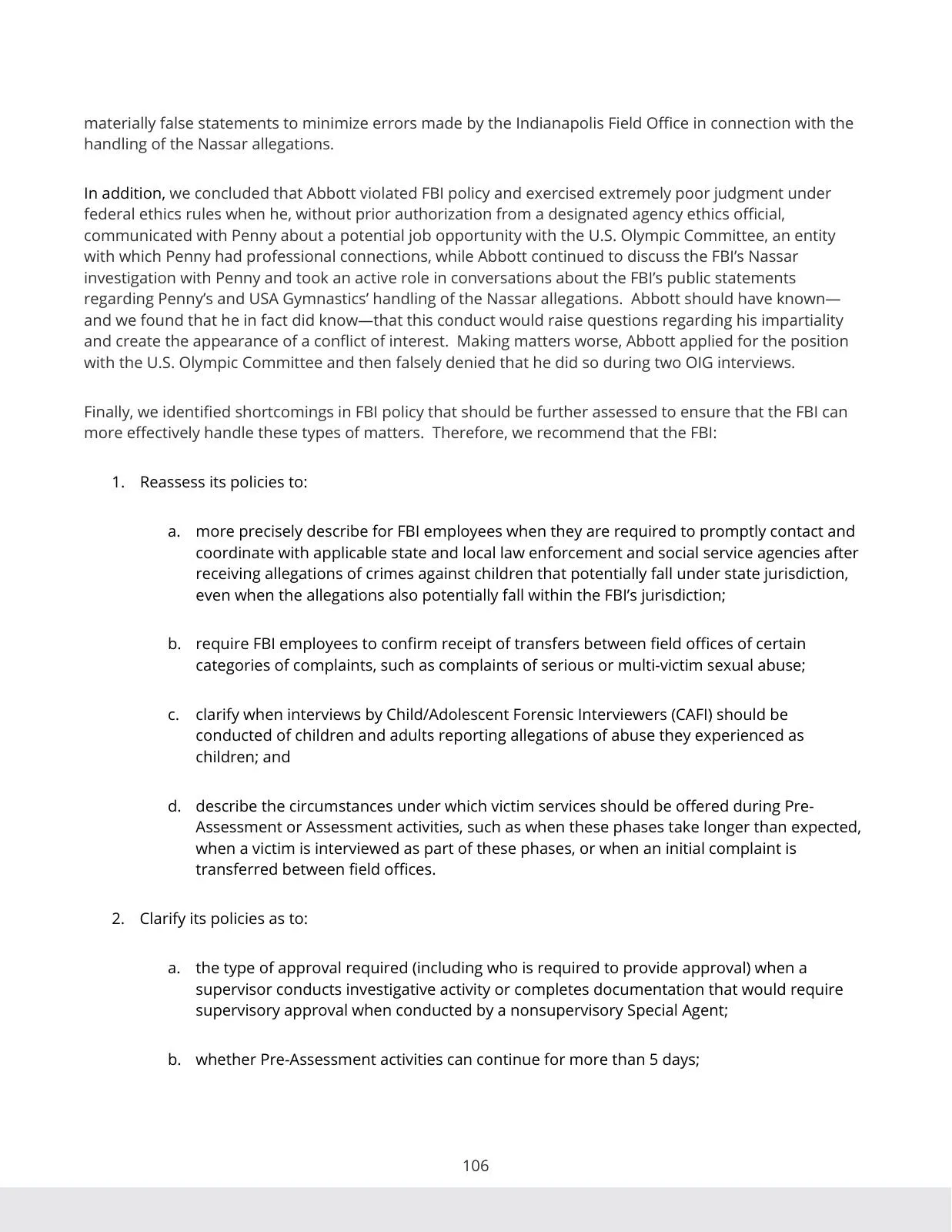
Among the recommended changes was a requirement that employees confirm receipt when certain serious complaints move between field offices. Other recommendations addressed local referrals, victim services, interviews and the preservation of early investigative information. The FBI’s written response accepted the recommendations. That response records an institutional commitment in July 2021, rather than proving that every promised safeguard has worked in every later case.[1]
In April 2024, the Justice Department announced settlements resolving 139 administrative claims alleging inadequate FBI investigation, for a total of $138.7 million. Those settlements are a later part of the institutional aftermath, separate from Nassar’s convictions. The missing referral remains a useful point of entry into that history because it identifies a concrete failure: responsibility was described as transferred before anyone established that it had arrived.[2]
Sources and references
Independently researched companion article, written from the linked primary records.
- DOJ Inspector General Report 21-093: FBI handling of Nassar allegationsJuly 2021 · Original federal inspector general investigation
Complete 119-page report, including findings, recommendations and FBI response. Contains sensitive descriptions of abuse.
- Justice Department announces settlement of Nassar-related administrative claimsApril 23, 2024; updated February 6, 2025 · Official settlement announcement
139 claims, rather than a claim about the number of separate agreements.
The article examines the 2021 oversight findings and the specified 2024 settlement announcement. It does not treat an oversight finding as a separate criminal conviction of an FBI employee.