
Minnesota / Aftermath and reform
After Duluth: a law that put responsibility on the jailer
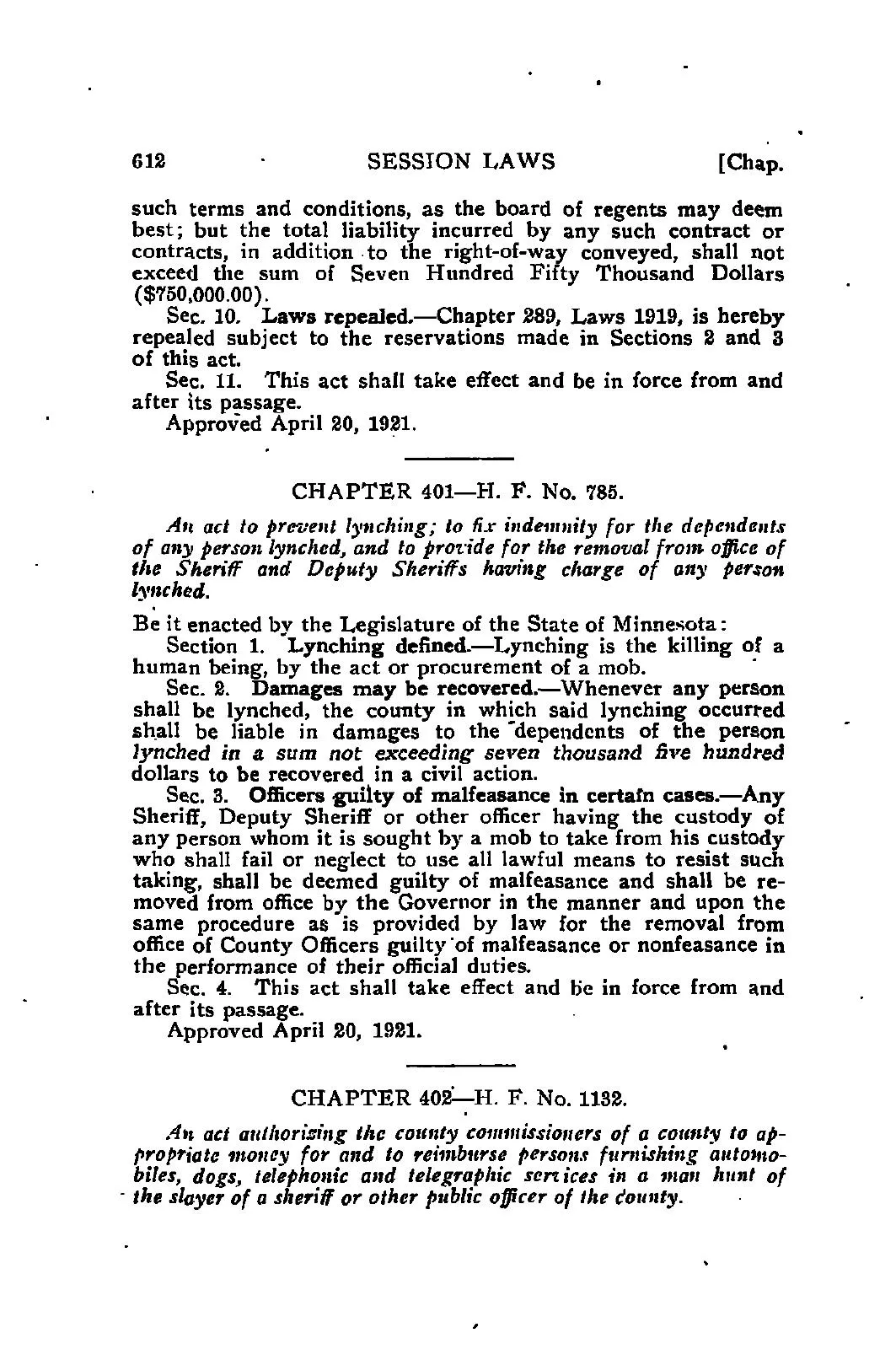
The Minnesota law fits into less than a page. Approved in April 1921, it defined lynching, created a claim for dependents and threatened removal of officers who failed to use lawful means to protect a prisoner from a mob. Its brevity makes the choices unusually visible. After the murders of Elias Clayton, Elmer Jackson and Isaac McGhie in Duluth, responsibility could not stop with the people who seized them.
Read the original court record ↓The aftermath was organized
The three Black circus workers were lynched on June 15, 1920. The Minnesota Historical Society’s record of the prosecutions shows the limited result: three white men were convicted of rioting, and no one was convicted of murder. A criminal prosecution of individual participants had not produced a murder conviction for any of the deaths.[3]
Minnesota’s Black community pressed for further action. Nellie Francis led the campaign for a state anti-lynching law. A short notice in the Minneapolis Messenger of May 7, 1921, credited her with the bill’s introduction and reported that she had been honored at a public gathering in St. Paul. Read beside the statute, the notice preserves the organizing work that formal legislative language leaves unnamed.[2]
Two different forms of accountability
Section 2 made the county where a lynching occurred liable to the victim’s dependents for damages up to $7,500, recoverable in a civil action. The amount was a statutory ceiling, not a valuation announced for Clayton, Jackson or McGhie. Nor does the text show that their families received that sum. It established a route for dependents to seek damages under the new law.[1]
The next section addressed an officer who had custody of a person a mob sought to take. If the officer failed or neglected to use all lawful means to resist, the act treated that failure as malfeasance and required removal by the governor through the established removal procedure. The law therefore linked custody to an affirmative responsibility to resist the mob.[1]
Those provisions did different work. A civil claim concerned dependents and the county. Removal concerned the officer’s fitness to remain in public office. Neither was a substitute murder verdict against a particular participant in a lynching. Reading the remedies separately avoids turning the law into a promise that it did not contain.[1]
The wording has boundaries
Section 1 defined lynching as a killing carried out by a mob or at its procurement. Section 3 used “all lawful means,” not an unrestricted permission to use any force an officer wished. It also specified a removal process. The compact text addressed a terrible failure of protection without eliminating the need to determine the facts or follow the procedure it incorporated.[1]
The official session-law page records approval on April 20, 1921. Some later historical summaries give different April dates. For the approval date, the enacted record is the firmer reference. The copy linked here is the legislature’s complete one-page file; it includes the surrounding fragments of neighboring chapters exactly as the official scan supplies them.[1]
A record of what people demanded
The act is part of the aftermath, not proof that the earlier murders were fully redressed. The prosecution record and the legislative record answer separate questions: what punishment followed the mob’s acts, and what obligations reformers wanted enforced in future cases. Keeping both in view preserves the gap between a new rule and justice for those already killed.[3]
Francis’s campaign brought that second question into law. The short newspaper notice celebrates a public achievement; the statute shows its substance. Together they let a reader move beyond the spectacle of the mob toward the demands of the people who insisted that a person in government custody must receive protection.[2]
Sources and references
Independently researched companion article, written from the linked primary records.
- Minnesota Session Laws 1921, chapter 401Approved April 20, 1921 · Original enacted statute
Historical legislation, not a statement of current Minnesota law. Complete one-page official file.
- Minneapolis Messenger: Anti-Lynching Bill PassedMay 7, 1921 · Contemporary newspaper notice preserved by Minnesota Historical Society
The brief notice credits Nellie Francis and records public recognition of her work.
- Minnesota Historical Society: Duluth legal proceedingsInstitutional archive interpretation · Archive context and prosecution outcomes
The distinction between riot convictions and absence of murder convictions.
- Minnesota Historical Society: AfterwardsInstitutional archive interpretation · Archive context for the reform campaign
Used for the campaign context. The statute’s own approval date controls this article.
This article examines the original 1921 act. It does not state present law, claim that damages were paid to the Duluth victims’ families or treat later reform as a substitute for accountability for the murders.