Missouri / Investigative history
After the Kansas City Massacre: what Congress put in writing
The attack outside Kansas City’s Union Station on June 17, 1933, killed four law officers and the prisoner they were escorting, Frank Nash. Its institutional aftermath appears in a surprisingly short document: an act approved on June 18, 1934. In a few lines, Congress gave members of the Justice Department’s Division of Investigation explicit powers to make certain arrests and carry firearms.
Read the original court record ↓A crisis and a change in authority
The FBI identifies the massacre as one of the crimes that prompted the anti-crime legislation of May and June 1934. Its historical timeline describes the earlier dependence on citizen’s arrests or assistance from marshals and local police to take suspects into custody. The change concerned the legal basis for action, not the creation of investigative work from nothing.[3]
The organization’s name on the statute is another useful detail. Congress wrote Division of Investigation, not Federal Bureau of Investigation. The familiar FBI name became official in July 1935. Reading the older name keeps the sequence clear: the institution’s expanded powers preceded the name by which most readers now know it.[1][3]
Read the conditions as well as the power
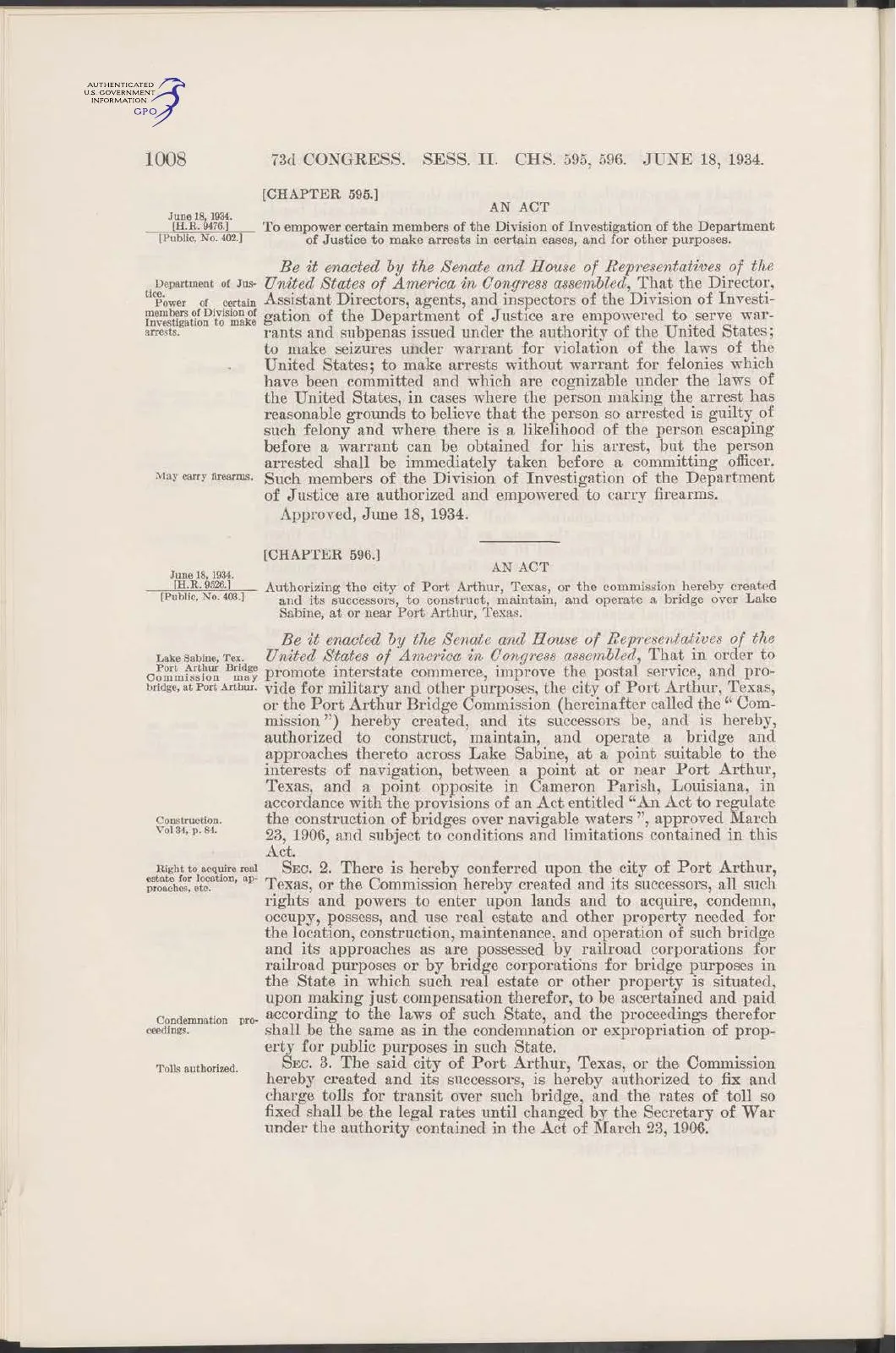
Chapter 595 names the director, assistant directors, agents and inspectors. It authorizes service of warrants and subpoenas issued under United States authority and seizures under warrant for violations of federal law. These are concrete procedural tools. The text does not simply announce that the organization may investigate any wrong wherever it occurs.[1]
Its warrantless-arrest provision is more specific still. It concerns felonies already committed and recognized under federal law. The arresting official must have reasonable grounds to believe the person guilty, and there must be a likelihood of escape before a warrant can be obtained. Those requirements belong to the historical grant and should stay attached when it is summarized.[1]
The sentence then requires the arrested person to be taken immediately before a committing officer. That final clause joins speed in apprehension to a next procedural step. The power is not described as a free-standing permission to seize someone and leave the detention without that required presentation.[1]
A second sentence authorizes those officials to carry firearms. The brevity is striking beside the detailed arrest conditions. Both appear in the same enacted paragraph, but they perform different jobs: one defines specified enforcement powers and the other supplies express firearms authority. The page preserves both without needing a later dramatic retelling.[1]
The statute does not settle every story about the attack
The FBI’s own account describes officers carrying weapons at Union Station in 1933. That is a useful check against an easy but misleading shorthand: the 1934 law does not mean nobody in the earlier escort had a gun. The agency history and the enacted text answer different questions, one about the event and the other about statutory authority.[2][1]
Nor should the massacre be made the only cause of the legislative program. The FBI timeline places it among crimes that drove the wider response. The statute itself names no gangster and offers no narrative of the shooting. It records the powers Congress enacted, leaving the investigation’s factual claims to their own sources.[3][1]
A compact record of institutional aftermath
The complete official page is reproduced below. Chapter 595 occupies its upper portion; the next act concerns an unrelated Texas bridge. That ordinary legislative setting is part of the document’s value. A crime remembered through a sudden burst of violence also left a quieter record: precise verbs describing what federal investigators could do, the conditions for doing it and the next step after an arrest.[1]
Sources and references
Independently researched companion article, written from the linked primary records.
- Act of June 18, 1934, chapter 595, 48 Stat. 1008June 18, 1934 · Enacted federal statute, official Statutes at Large
Complete official one-page file. Chapter 595 is complete; the beginning of the following unrelated act remains visible.
- Kansas City Massacre and “Pretty Boy” FloydFBI institutional case history · Official agency historical account
Used for date, casualties and armed escort context. This article does not adjudicate disputed identifications of the gunmen.
- FBI historical timeline1932-1935 entries · Official agency chronology
Read the June 18, 1934 legislation entry and July 1, 1935 naming entry in their surrounding chronology.
This article describes the 1934 statute in its historical setting. It is not a statement of current arrest law or a claim that the Kansas City attack was the sole cause of federal law-enforcement reform.