
Montana / Inside the court record
Diren Dede’s case: when an observation became expert testimony
In the trial for the killing of Diren Dede, a detective described blood on a vehicle in the garage where Dede was shot. He then explained what different blood patterns meant about speed, movement and the shooting. Montana’s Supreme Court drew a line between those two tasks. Seeing a mark and interpreting its scientific significance were not the same kind of testimony, even when the same experienced officer did both.
Read the original court record ↓The issue inside a larger appeal
Dede was killed in Markus Kaarma’s Missoula garage in the early hours of April 27, 2014. Kaarma fired four shotgun rounds after seeing an intruder on a security camera and going outside to the garage opening. He claimed that he feared an attack. A jury convicted him of deliberate homicide in December 2014, and the court sentenced him to seventy years in prison in February 2015.[1]
The appeal raised several questions, including instructions on defensive force, publicity and the selection of jurors. The blood-pattern issue was narrower. It concerned the way Detective Baker had been presented to the jury as an ordinary, or lay, witness, rather than as an expert whose qualifications and specialized opinions could be challenged in advance.[1]
What the detective added to his observations
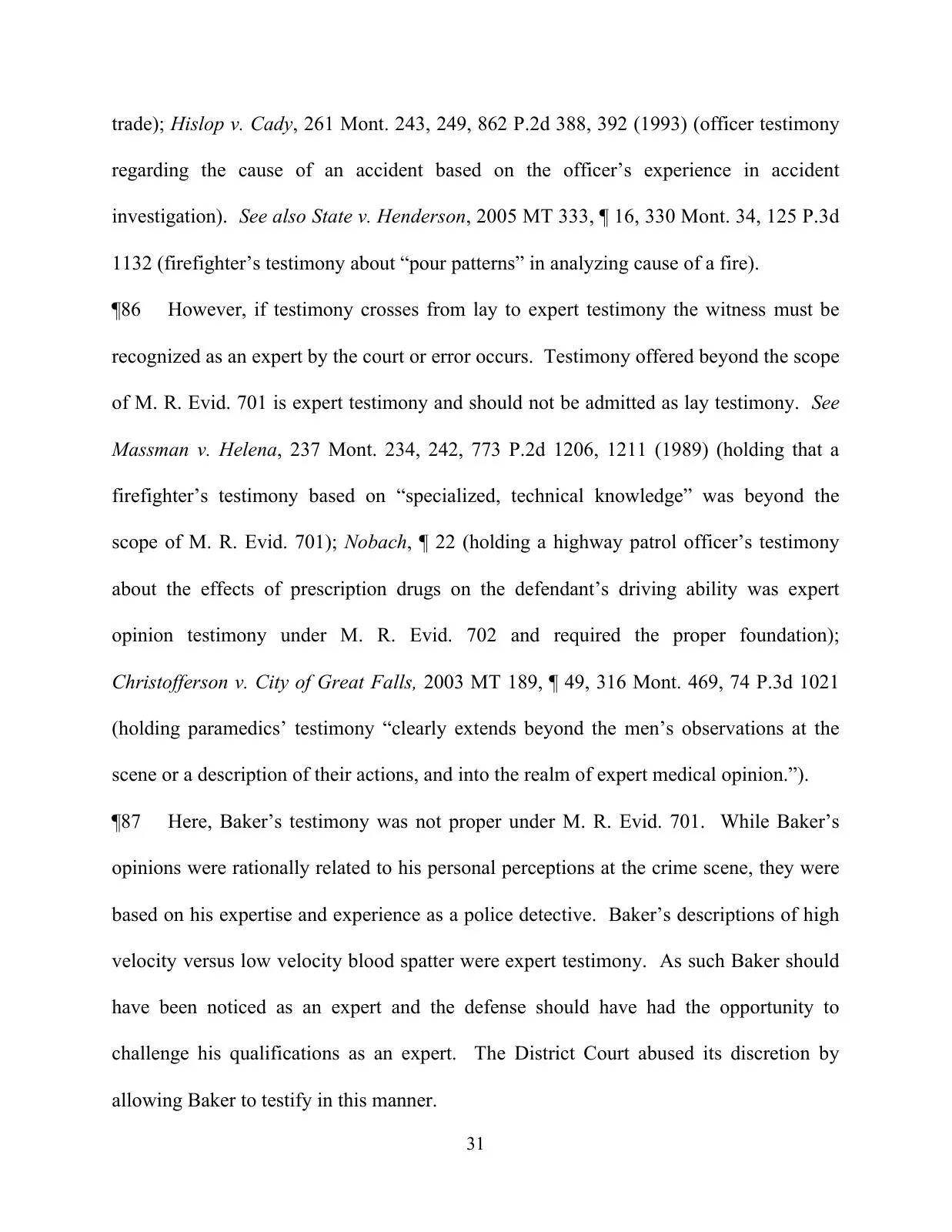
Baker described marks on the rear bumper of a Buick and interpreted a sequence of movement within the garage. His explanation used the relationship between the size of blood spots and the velocity of the force producing them. The court reproduced part of this testimony, making it possible to see where a description of visible evidence became an explanation based on specialized knowledge.[1]
The prosecution pointed to Baker’s years as a police officer, crime-scene experience and training. The defense objected that he was offering expert testimony without having been identified as an expert. That distinction affected preparation: the defense said that advance notice would have allowed it to obtain a rebuttal witness. Cross-examination at trial did not erase the question of whether the testimony had been admitted under the correct rule.[1]
The Supreme Court agreed that the line had been crossed. An officer’s professional title did not determine the category of every statement he made. A person could testify under either the lay or expert rule, but the particular testimony had to satisfy the appropriate requirements. Baker’s explanation of high- and low-velocity blood patterns was expert testimony and should have been treated that way.[1]
Why finding an error did not undo the verdict
That finding did not finish the appeal. The court next asked whether the error could have contributed to the conviction. It classified the problem as an error during the presentation of evidence and examined the other evidence that established the same facts. This second inquiry concerned the effect of the mistake in this trial, not whether the original ruling had been correct.[1]
A state crime-laboratory examiner had also testified about Kaarma’s position when he fired. The opinion said that the examiner, Baker and the defense expert’s report agreed with Kaarma’s account of where he stood. It further concluded that the blood-pattern evidence and his location were not central points in the trial. Given the qualitatively similar admissible evidence, the court found the error harmless and affirmed the conviction.[1]
Readers can therefore hold two conclusions together: the detective’s scientific interpretation was admitted improperly, and the court did not find that mistake grounds for a new trial. Calling the entire blood evidence invalid would go beyond the decision. Saying the court approved everything the detective did would also misread it.[1]
Read the finding at its actual scale
Later proceedings did not stop at this 2017 appeal. A federal order dated March 8, 2022 recounts the denial of state postconviction relief and itself denies Kaarma’s federal habeas petition. The present article focuses on the earlier evidentiary ruling; it does not describe the 2017 decision as the end of all litigation.[2]
The useful question in the record is what a witness is being asked to establish. A mark can be observed; a reconstruction connects that mark to a proposed sequence of events. In Dede’s case, the court required that distinction to remain visible, even though its conclusion about the effect of the error left the murder conviction in place.[1]
Sources and references
Independently researched companion article, written from the linked primary records.
- State v. Kaarma, 2017 MT 24, DA 15-0214February 8, 2017 · Original Montana Supreme Court opinion, unmodified Justia-hosted copy
Complete 34-page court PDF. Hosting is a legal archive mirror, not the issuing court’s server.
- Kaarma v. Salmonsen, order denying habeas corpus, No.9:21-cv-00075March 8, 2022 · United States District Court order, official GovInfo copy
Pages 4 and 26-27 used for later procedural history and disposition.
The article explains one 2017 evidence ruling and notes the 2022 federal order. It does not evaluate current parole eligibility or supply practical instructions for interpreting blood patterns.