Nebraska / Inside the court record
Brandon Teena: why the county could not shift the blame
In the civil case brought after Brandon Teena’s murder, the trial court found that Richardson County had failed to protect him. It then reduced an award for his pain and suffering by 85 percent because of the killers’ intentional acts and by another 1 percent for supposed negligence by Brandon. Nebraska’s Supreme Court rejected both reductions. The arithmetic exposed a larger question: what becomes of a duty to protect someone if the very violence it was meant to prevent can be used to reduce responsibility?
Read the original court record ↓The civil case followed the murder prosecutions
Brandon, Lisa Lambert and Philip DeVine were found murdered at Lambert’s rural Humboldt home on December 31, 1993. John Lotter and Thomas Nissen were convicted of the murders. Brandon’s mother, JoAnn Brandon, pursued a different kind of proceeding against Richardson County and Sheriff Charles Laux, seeking damages connected to the failure to protect Brandon and the sheriff’s treatment of him.[1]
The civil opinion uses Brandon’s legal name in its caption and historical pronouns in its text. This article refers to him as Brandon Teena. The focus is the court’s 2001 review of civil liability, not a new determination of the murderers’ guilt or an attempt to put a monetary value on a person’s life.[1]
What the percentages did
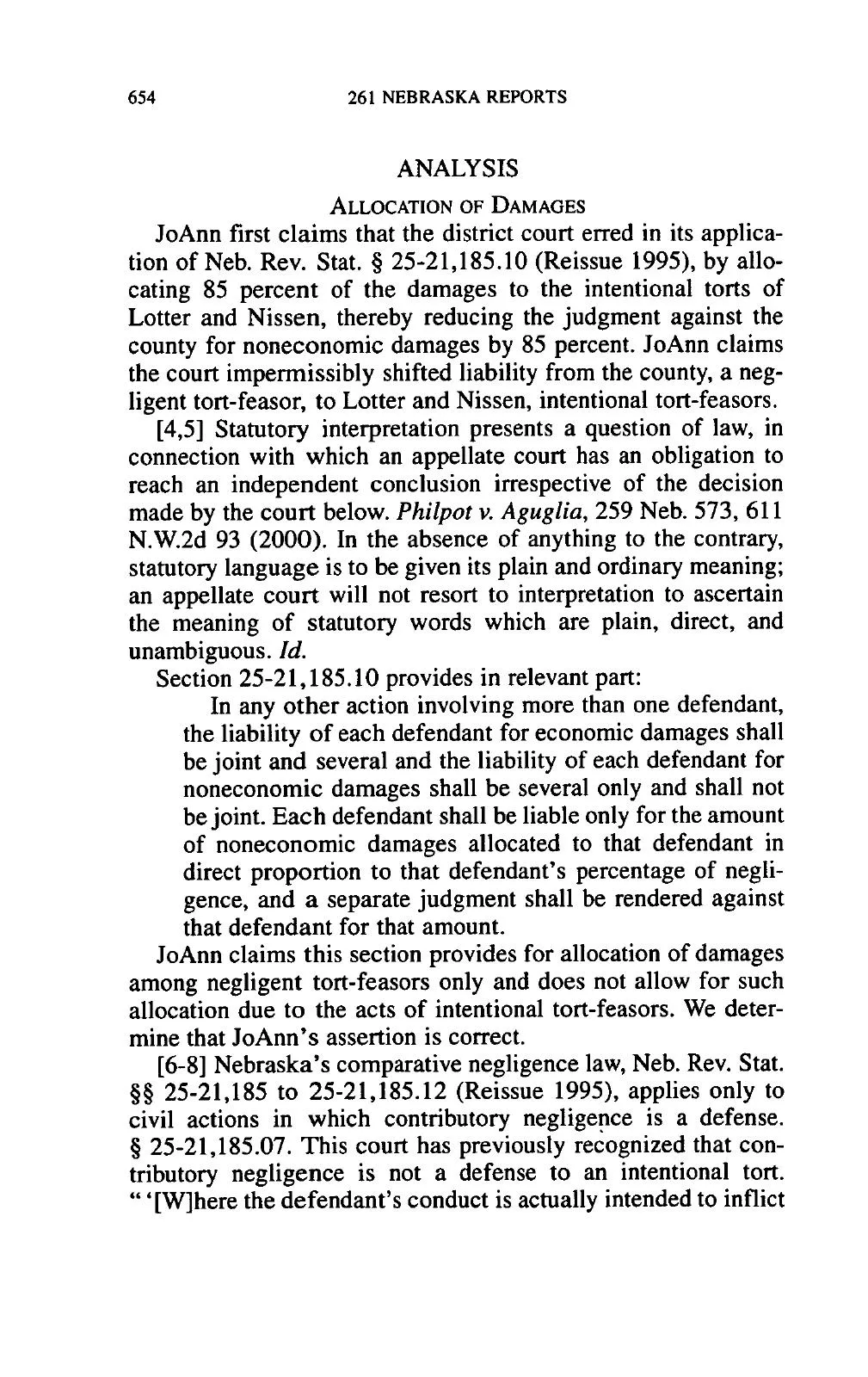
The trial court awarded $80,000 for Brandon’s pain and suffering before death, alongside economic damages. Its reductions left the county responsible for 14 percent of the noneconomic award. JoAnn challenged the way the court had used Nebraska’s comparative-negligence law to allocate 85 percent to Lotter and Nissen, whose conduct was intentional rather than negligent.[1]
The Supreme Court agreed with her reading of the statute. The law spoke of allocating noneconomic damages according to percentages of negligence; it did not authorize the allocation made here to intentional wrongdoing. The court also explained the practical problem: allowing a negligent failure to protect to shrink because an intentional attack occurred would work against the purpose of the protective duty itself.[1]
That conclusion did not minimize the killers’ responsibility. Their murder convictions stood outside this calculation. The court was asking whether the county could reduce its own civil liability by treating those intentional acts as another share of negligence. Keeping the two proceedings separate helps explain why a court could reject the percentage calculation without shifting guilt away from the men convicted of killing Brandon.[1]
The unsupported one percent
The smaller reduction received its own review. The county argued that Brandon had not provided complete information, kept the sheriff’s office informed of his whereabouts or returned for another interview. The Supreme Court found no evidence supporting contributory negligence. It noted that the sheriff knew about threats to Brandon’s life, and that the county had no plan to protect him regardless of his location.[1]
The record also explained an absence that might otherwise look like a lack of cooperation. When Brandon arrived at the courthouse for the later interview, Lotter and Nissen were outside, so he did not enter. The court did not treat that circumstance as proof that he had helped cause the county’s failure to protect him. Context changed the meaning of what could have been described simply as a missed interview.[1]
A duty with a specific basis
The decision did not announce that police are automatically civilly liable whenever they fail to prevent a crime. It identified a special relationship arising from Brandon’s agreement to assist law enforcement and testify in the prosecution. Investigating the reported assault did not, by itself, discharge the separate duty to protect him from the known threat. The court upheld the finding of county negligence.[1]
The April 20, 2001 ruling left further work for the trial court, including consideration of emotional-distress damages and damages for the loss of companionship. It directed that those awards and the $80,000 award must not be reduced by allocating responsibility to the killers’ intentional acts or to unsupported negligence by Brandon. The opinion is a remand with instructions, not a complete statement of the final amount ultimately paid.[1]
The percentages are worth reading because they make an institutional failure visible. A finding that a duty existed would offer little protection if the damages could then be reduced mainly because the threatened harm happened. In this record, the Supreme Court required the county’s duty and the damages analysis to be considered together.[1]
Sources and references
Independently researched companion article, written from the linked primary records.
- Brandon v. County of Richardson, 261 Neb.636, 624 N.W.2d 604 (2001)April 20, 2001 · Nebraska Supreme Court opinion in the judicial branch’s scanned bound reports
The link opens the complete 515-page volume part. The opinion occupies printed pages 636-671, PDF pages 117-152. The source contains historical naming, misgendering and disturbing interview material.
This article examines the 2001 civil appellate ruling and its remand instructions. It does not report a final settlement, payment amount or present custody status.