
Nevada / Inside the court record
Brianna Denison’s case: the jury asked 99 questions
The jurors in James Biela’s trial did not only listen. They submitted questions, ninety-nine by the defense’s later count. One question about a gun prompted a motion for a mistrial. Years after Brianna Denison’s death, the Nevada Supreme Court’s account preserves a useful distinction: an awkwardly framed question can raise a serious concern without proving that its author has already reached a verdict.
Read the original court record ↓A trial involving three victims
Nineteen-year-old Brianna Denison was abducted from a friend’s home near the University of Nevada, Reno, on January 21, 2008. Her body was found weeks later. Investigators linked Biela to her killing and to attacks on two surviving women. Those crimes were tried together. The jury found him guilty, and the penalty phase resulted in a death sentence.[1]
The survivors testified, and the prosecution presented forensic evidence and telephone records. The defense challenged the DNA analysis. Against that background, the jury’s questions offered a glimpse of what its members wanted clarified. But a criminal trial cannot simply turn into an unrestricted conversation among witnesses and jurors. Questions must still pass through the court’s procedures.[1]
The question marked MM
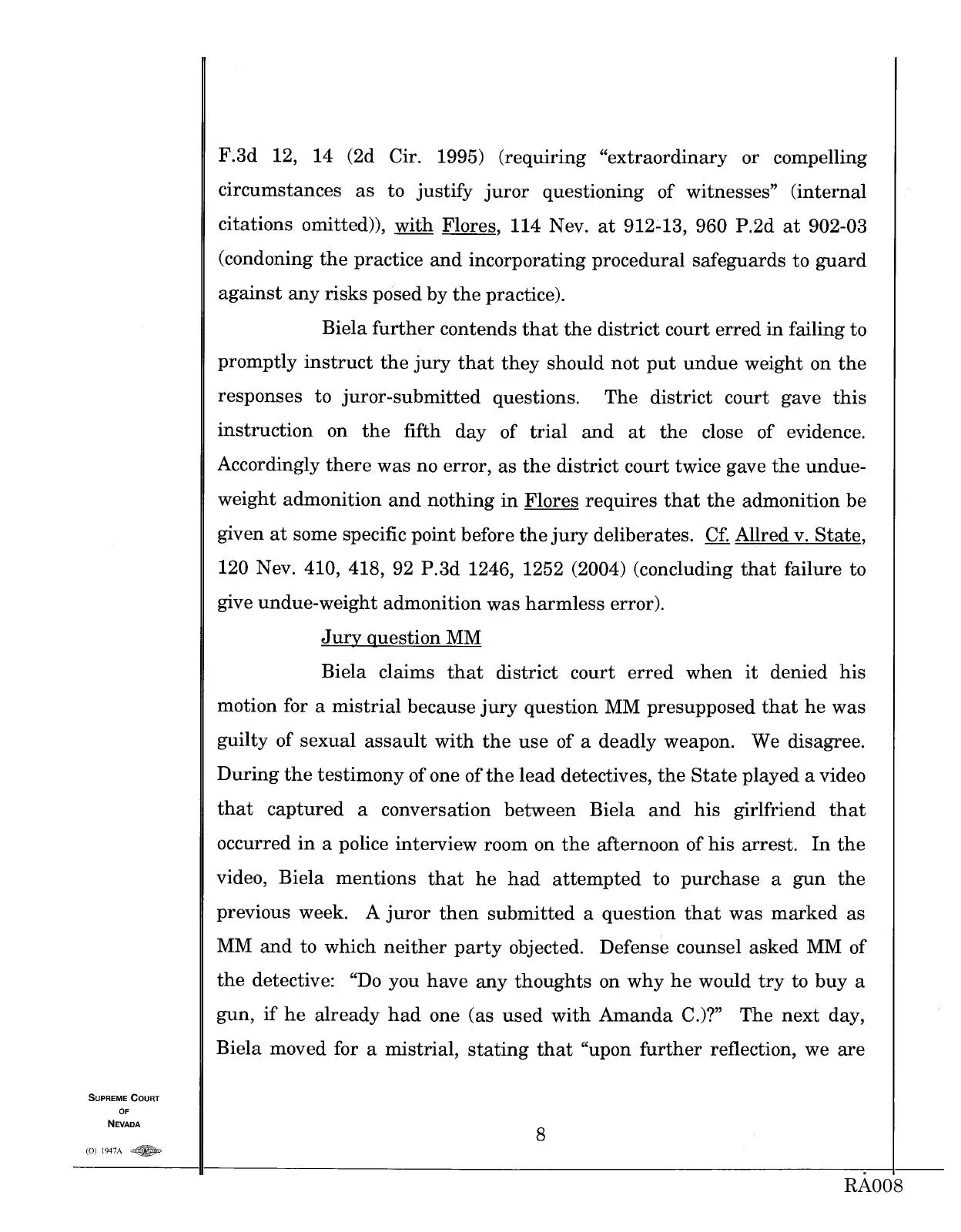
The disputed question followed a recording of Biela speaking with his girlfriend in a police interview room on the day of his arrest. In it, he mentioned trying to buy a gun the previous week. A juror asked why he would try to buy one if he already had a gun, referring to the weapon used in one survivor’s assault. Neither side initially objected, and defense counsel put the question to the detective.[1]
The next day, the defense argued that the wording assumed Biela had committed that assault. The concern was straightforward: jurors were supposed to keep an open mind until the evidence and arguments were complete. A question that treated an accusation as an established fact might suggest that the juror had moved ahead of the trial.[1]
The judge held a hearing and asked the juror whether she had prematurely decided guilt on that count. She said she had not. Both sides declined to ask further questions. The trial court treated the question as a request for factual information and denied the mistrial request. On appeal, the Supreme Court found no abuse of discretion in that response.[1]
Quantity was not enough to establish prejudice
Biela also challenged the overall number of questions and the decision to permit them in such a prominent case. Nevada’s court recognized that juror questions could carry risks, while also helping jurors understand evidence. It had left the decision to the trial judge’s discretion. In this appeal, it noted both the defense’s agreement to the procedure and the lack of a trial objection to the number of questions.[1]
The court did not conclude that more questions are always better. It addressed this record and the errors claimed. The jury had twice been instructed not to give undue weight to answers produced by its own questions, once on the fifth day of trial and again at the close of evidence. The appellate court rejected the argument that the timing of those instructions required reversal.[1]
The same number took on another meaning later in the opinion. While reviewing the death sentence for arbitrary influence, the justices pointed to the questions, along with the mitigation findings, as evidence of an attentive jury. The defense and the court had read the same feature differently. Neither interpretation can be understood from the number ninety-nine alone.[1]
What the record actually resolved
On August 1, 2012, the Nevada Supreme Court affirmed the judgment. The opinion also found inaccurate language in two penalty-phase instructions, but did not find grounds for reversal under the applicable review. A later state postconviction decision generated a separate petition to the United States Supreme Court, which declined review on December 9, 2019. That later denial is not a fresh trial verdict.[1][2]
For a reader following the trial, the most revealing moment is the short hearing about question MM. Instead of assuming that the wording was either harmless or conclusive, the judge put its meaning to the juror and allowed the lawyers to follow up. The appeal’s account lets us examine that response without claiming access to the juror’s private thoughts.[1]
Sources and references
Independently researched companion article, written from the linked primary records.
- Biela v. State, No.56720, Order of AffirmanceAugust 1, 2012; copy filed November 7, 2019 · Complete Nevada Supreme Court order in respondent’s Supreme Court appendix
The original 17-page appendix contains a cover, contents page and the complete 15-page judicial order. It contains discussion of sexual violence; the article avoids graphic detail.
- U.S. Supreme Court docket 19-6204: Biela v. NevadaDecember 9, 2019 disposition · Official Supreme Court docket
Separate petition following the April 22, 2019 state decision.
This article concerns the handling of juror questions in the 2012 direct appeal. It does not claim that later litigation ended with that decision or report current execution status.