Nevada / Evidence and investigation
Harvey's casino: the work after the blast
The explosion at Harvey's Resort Hotel and Casino on August 27, 1980, tore through the Stateline building without killing or injuring anyone. That outcome mattered enormously. It did not mean the crime was over. Once the immediate danger had passed, investigators still faced a damaged casino, scattered evidence and the task of proving who had put the bomb there.
Explore the original accounts ↓Two very different measures of the outcome
Men posing as office-equipment delivery workers brought the device into the casino the previous morning. Its creator, John Birges Sr., demanded $3 million. Specialists studied the device before attempting to disable it, but that effort ended in the explosion. The FBI's historical account attributes the absence of casualties to evacuation. The attempt to save the building failed; the removal of people from danger succeeded.[1]
Retired FBI Special Agent Chris Ronay recalled people watching from a safe distance and cheering when the blast occurred. His account then turns immediately to processing the scene. For spectators, the explosion could look like a dramatic ending. For investigators, it created another stage of work, with material displaced and damaged across a site much larger than the device they had first examined.[2]
A casino was also a room full of property
Ronay described a complication specific to the setting: money, casino chips and coins were mixed into the damaged premises. Those items had to be recovered while investigators searched for evidence. The FBI's accompanying historical photographs show sifting stations in use. Searching the debris therefore involved both tracing a crime and accounting for property that had been scattered by it.[2]
The business also wanted to reopen undamaged gambling space. According to Ronay, a wall with a large viewing window separated that area from the continuing investigation, allowing patrons to watch the work for weeks. His recollection is useful precisely because it is so ordinary beside the explosion: a crime scene had to remain workable while the surrounding business tried to resume operating.[2]
Evidence had to establish participation
The 1984 appeal shows that responsibility was contested in different ways. Birges admitted building the bomb but testified that he had acted under coercion. Terry Hall said he had believed the delivery was a joke and had not known the package contained a bomb. These were defense accounts presented at trial, not conclusions adopted by the appellate court.[3]
In examining Hall's knowledge, the court considered conduct surrounding the delivery, including a false motel registration, efforts to remove fingerprints and the use of a stolen license plate. The issue was not merely whether he had helped move a heavy object. It was whether the evidence supported the required criminal intent. The court found sufficient evidence to sustain his convictions for conspiracy and transporting explosives across state lines.[3]
Hall had been acquitted on two other counts. The appellate court did not treat those acquittals as automatically canceling the guilty verdicts. It examined whether the convictions had sufficient evidentiary support. Reporting only that Hall was convicted, without identifying what the jury had accepted and rejected, would flatten a more specific result.[3]

Why the surviving model needs a careful caption
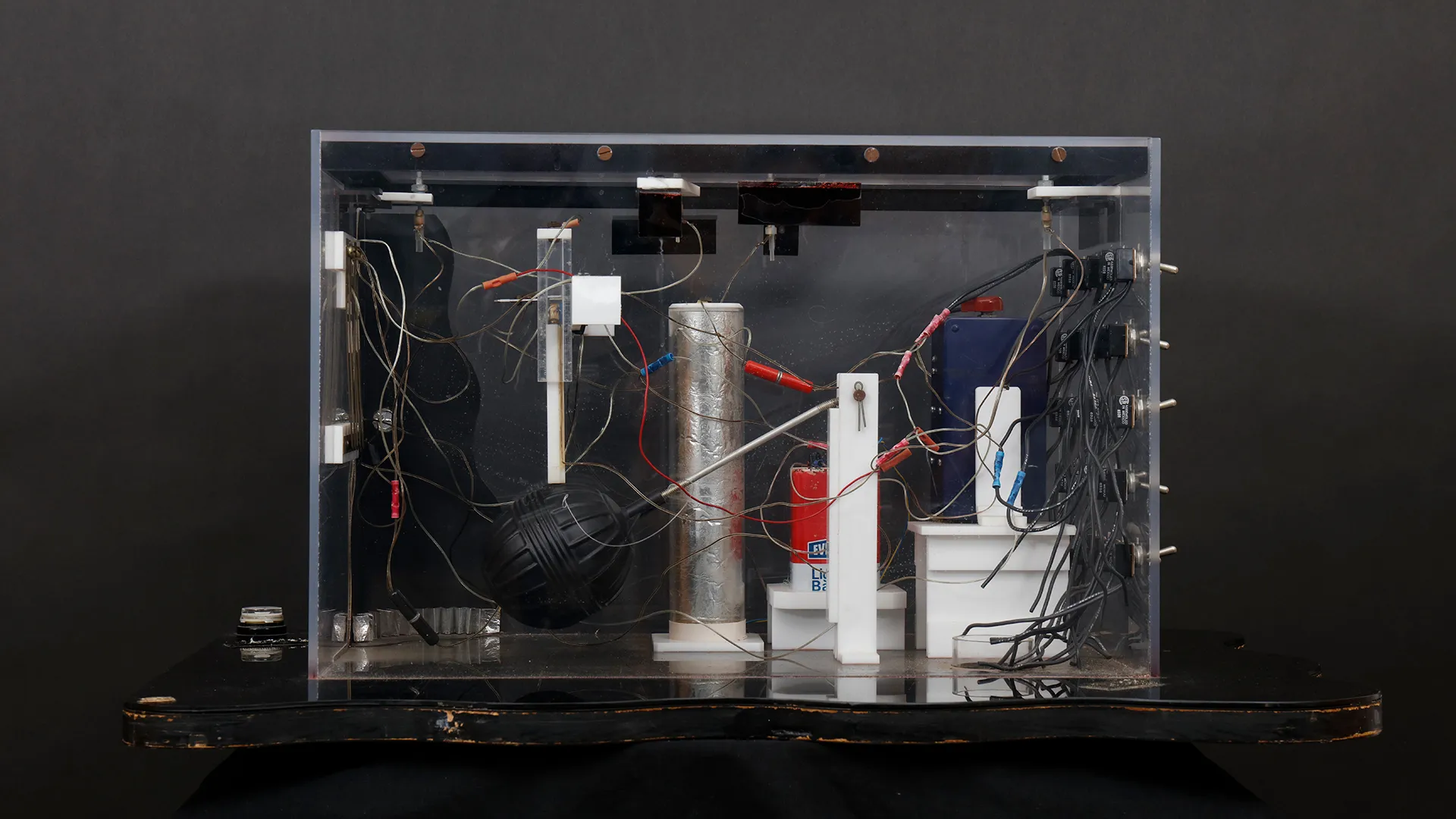
The transparent object in the photograph below is a model made for the trial. It is not the device recovered intact after the explosion. The FBI's historical account describes the model's later use in training. Keeping that distinction visible prevents an illustration from quietly changing the story: an explanatory exhibit can survive even when the original object was destroyed.[1]
On January 10, 1984, the Ninth Circuit affirmed the convictions appealed by Birges and Hall. Read alongside Ronay's recollection, the opinion shows three separate tasks: protect people, examine the aftermath and test individual responsibility in court. None can stand in for the others. The absence of casualties does not make the threat harmless, and the scale of the damage does not by itself prove every participant's state of mind.[3]
Sources and references
Original analysis of the investigation after the explosion, with recollection, historical summary and judicial findings kept distinct.
- Harvey's Casino Bomb · FBI historical account and archival photographs
Used for the August 26 delivery, August 27 explosion, evacuation and trial model. The body dates the explosion August 27; one image alternative-text field mistakenly says August 26.
- Harvey's Casino Bomb: Chris Ronay interview · Recorded recollection by a retired FBI explosives examiner, with transcript
The interview is attributed testimony about the investigation. It is not a contemporaneous log or a complete evidence inventory.
- United States v. Birges, 723 F.2d 666January 10, 1984 · Ninth Circuit opinion, public text mirror
Paragraph numbering follows this linked version. The convictions, defense accounts and appellate findings are distinct.
This article examines the 1980 investigation and 1984 appeal. It makes no claim about present-day casino operations or the current use of the trial model.