
New Jersey / Inside the court record
The blanket in the Timothy Wiltsey case: a clue with limits
The blanket did not disappear from the case when Michelle Lodzinski’s conviction was overturned. In its December 2021 decision, New Jersey’s Supreme Court accepted that a reasonable jury could connect the blanket found near Timothy Wiltsey’s remains to his mother’s apartment. The dispute was about the next step: whether that connection, considered with the rest of the evidence, proved that she purposely or knowingly caused her five-year-old son’s death.
Read the original court record ↓An object and a long interval
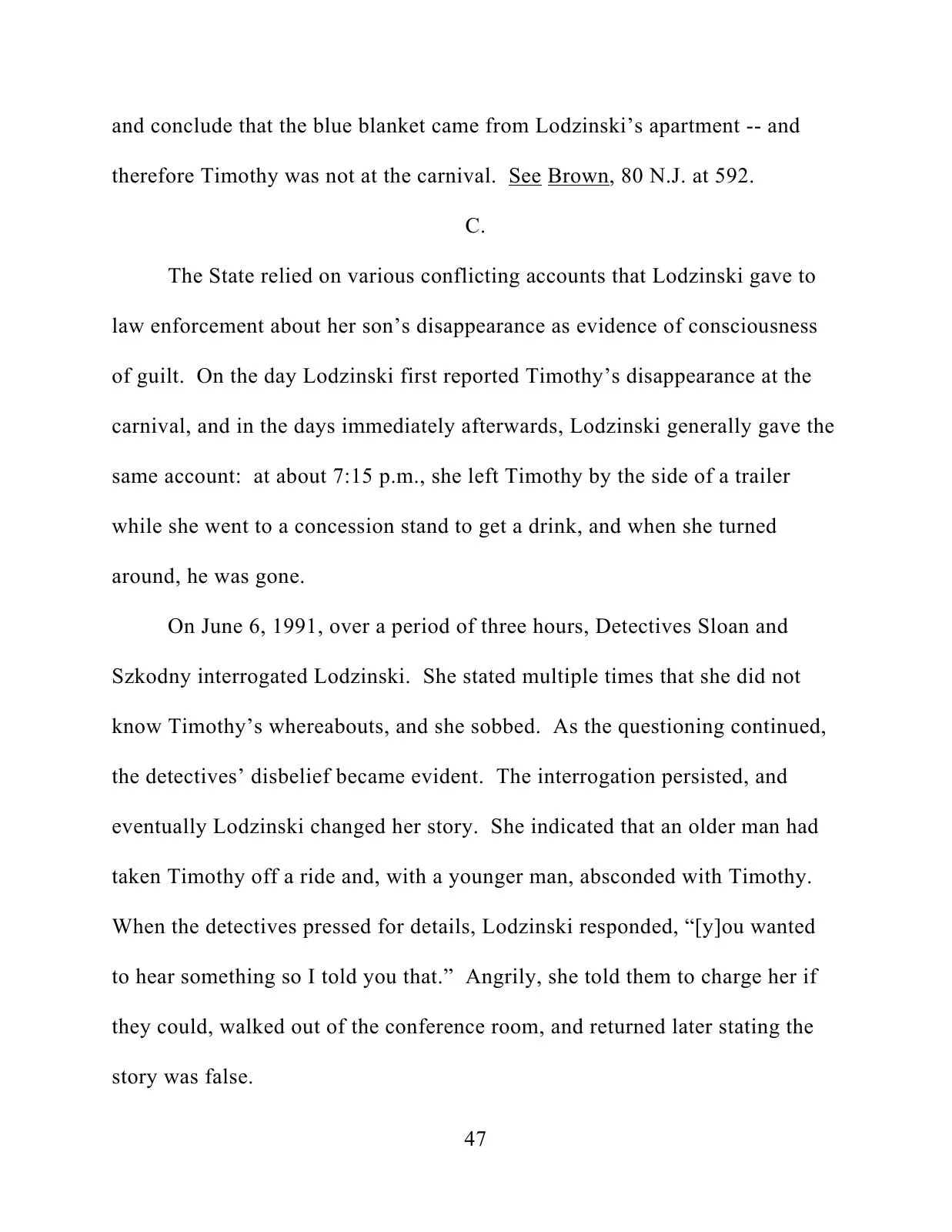
Timothy disappeared in 1991. Lodzinski reported that he had vanished during a carnival in Sayreville. His remains were later found at Raritan Center, where a blue blanket was recovered nearby. Three former babysitters eventually identified it as an item they remembered from Lodzinski’s apartment. The identifications became important evidence at her 2016 murder trial.[1]
The majority described reasons to question those identifications: the passage of more than two decades, publicity, conflicting recollections and the absence of a forensic link to the apartment. Yet it expressly set those doubts aside for the legal analysis. Reviewing the sufficiency of the evidence required giving the prosecution the benefit of favorable testimony and reasonable favorable inferences.[1]
Accepting a clue does not settle every question
That is the decision’s useful surprise. The court did not have to declare the blanket identification worthless to find the proof inadequate. It accepted that the jury could believe the babysitters and infer that Timothy had not been at the carnival. It also accepted that Lodzinski’s inconsistent accounts could support an inference that she was concealing wrongdoing.[1]
But the charge required proof of purposeful or knowing murder. For the majority, evidence suggesting involvement in a disappearance or death did not establish the required state of mind. A story could be false without identifying exactly what event it concealed. The difference mattered because negligent, reckless and intentional acts are not interchangeable.[1]
The medical evidence did not supply that missing distinction. The State’s expert classified the manner of death as homicide but could not determine its cause or say how, when or where Timothy died. The majority held that even accepting the expert’s homicide classification did not establish that Lodzinski purposely or knowingly caused the death.[1]
The disagreement was substantial
Three dissenting justices saw the combined evidence differently. They emphasized the location of the remains near a former workplace, the blanket, contradictory accounts, conduct after the disappearance, motive evidence and the expert’s conclusion. In their view, the majority had substituted its assessment for inferences the jury was entitled to draw.[1]
The dissent also cautioned against treating the expert’s refusal to pronounce guilt as a defect. An expert should not decide the defendant’s guilt for the jury. The opposing opinions therefore show a real disagreement about the cumulative force of the evidence, rather than a simple contest between judges who valued evidence and judges who did not.[1]
The majority did not announce that circumstantial evidence is inherently weak. It specifically acknowledged that such evidence can support a conviction. Its conclusion concerned this record and the absence of a rational evidentiary basis for the particular mental state required by the murder charge.[1]
What the decision actually did
The court entered a judgment of acquittal and vacated Lodzinski’s murder conviction. It did not merely order another trial. The complete opinion includes the dissent, allowing readers to examine the competing arguments. A recognizable object can be a genuine clue while still leaving an essential question unanswered. In this case, the majority held that the unanswered question could not be supplied by speculation.[1]
Sources and references
Independently researched companion article, written from the linked primary records.
- State v. Michelle Lodzinski, reconsideration decisionDecember 28, 2021 · New Jersey Supreme Court opinion; complete copy preserved by Centurion
89-page file: 6-page clerk’s syllabus, 60-page majority opinion and 23-page dissent. The mirror host was an amicus; the judicial text is the source.
The December 2021 decision entered an acquittal and vacated the conviction. This article distinguishes the majority’s holding from the dissent’s interpretation; it does not accuse an acquitted person of murder.