New Mexico / Places and memory
Lincoln’s buildings tell a story beyond the gunfight
The building remembered as Lincoln’s courthouse began as a store. That change of use is one of the most revealing details in the National Park Service’s historic-district record. A place associated with Billy the Kid’s escape also belonged to the commercial rivalry that preceded it. The preservation file makes it possible to read Lincoln as a town with changing buildings, rather than as a backdrop frozen at the moment of violence.
Read the original court record ↓A store before a courthouse
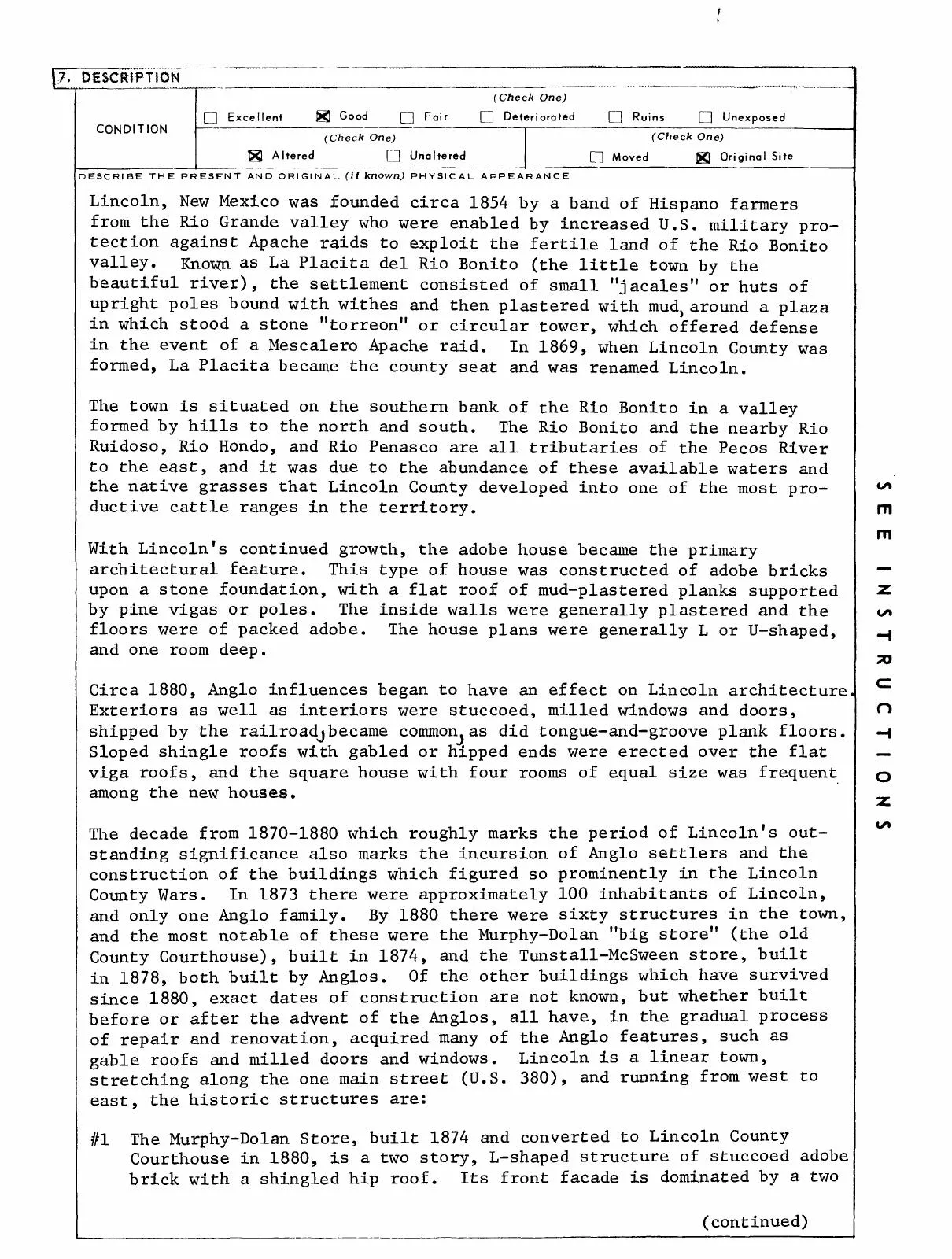
The 1975 nomination, prepared by National Park Service historian Richard Greenwood, describes the Murphy-Dolan store as a two-story adobe building constructed in 1874 and converted to a courthouse in 1880. It identifies the rival Tunstall-McSween establishment at the other end of town. Their separation along Lincoln’s main street gives physical form to the competing interests associated with the 1878 conflict.[1]
The courthouse’s later use is familiar from the story of William Bonney, known as Billy the Kid. After his conviction for killing Sheriff Brady, he was returned to Lincoln and escaped from confinement, killing two guards. The same structure therefore appears in different episodes for different reasons. Calling it simply the courthouse throughout the town’s history conceals that earlier commercial role.[1]
Surviving does not mean unchanged
The file is particularly useful when it distinguishes restoration from survival. It describes the former store and courthouse as restored, identifies a nonhistoric addition at the Tunstall store and calls the Wortley Hotel a reconstruction. These are not interchangeable descriptions. Each tells a reader something about the relationship between the visible structure and the period being interpreted.[1]
The McSween house offers a different kind of evidence. The nomination records that it burned in 1878 and that a marker identified the site when the survey was made. An absent building can be essential to understanding a conflict. The historic district includes both standing fabric and places where the fabric no longer survives.[1]
The survey also notes gradual changes that are less dramatic than destruction: milled doors and windows, pitched roofs added over earlier flat roofs, and altered houses still used as homes. Those observations prevent a preserved town from becoming an imaginary untouched set. Maintenance and reuse are part of its later history.[1]
The street contains more than famous names
The inventory includes residences, a schoolhouse later used as a church, shops and a mill alongside the buildings associated with armed factions. Its opening description traces the settlement to Hispano farmers in the Rio Bonito valley before the county seat was named Lincoln. That wider account gives the town a life before and beyond its most heavily retold crime stories.[1]
The nomination is itself a dated document. Conditions it labels good or deteriorating describe the survey period, not a current inspection. Its historical narrative also uses the assumptions and language of its era. The safest use of the file is specific: identify what its author observed, separate observation from retrospective interpretation, and avoid converting a 1970s condition report into a claim about today.[1]
Buildings and paper records answer different questions
For the underlying legal history, New Mexico’s State Records Center and Archives supplies a separate research guide. It lists criminal cases, a death warrant, an escape certificate and correspondence about reward payments. Those listed records are not reproduced in this article. The guide is a route to them, while the nomination is evidence of how the historic place was documented and preserved.[2]
Together, the two routes encourage a more exact visit to the past. A building can show where activities overlapped and how a place changed. It cannot, by itself, settle guilt or recreate a witness’s account. Lincoln becomes more legible when the commercial building, later courthouse, surviving house and reconstructed hotel keep their distinct histories.[1]
Sources and references
Independently researched companion article, written from the linked primary records.
- Lincoln Historic District nomination and continuation sheets1975 nomination with later boundary material · National Park Service historical and architectural survey
Complete 11-page official file linked at NPS. Descriptions concern the survey period, not present conditions.
- Billy the Kid research resourcesNew Mexico State Records Center and Archives guide · Official archival finding guide
Lists primary records; the linked guide is not itself the original trial file.
This article examines a historical preservation record. It does not report current building conditions or claim to have examined every original criminal record listed by the state archive.