New York / Inside the court record
Rudolf Abel: the hollow nickel and the fight over the evidence
A nickel broke open in Brooklyn. Four years later, a Soviet spy was in custody. The court record shows how investigators connected the evidence, and why four Supreme Court justices objected to the searches.
Read the original court record ↓A coin that would not give up its secret
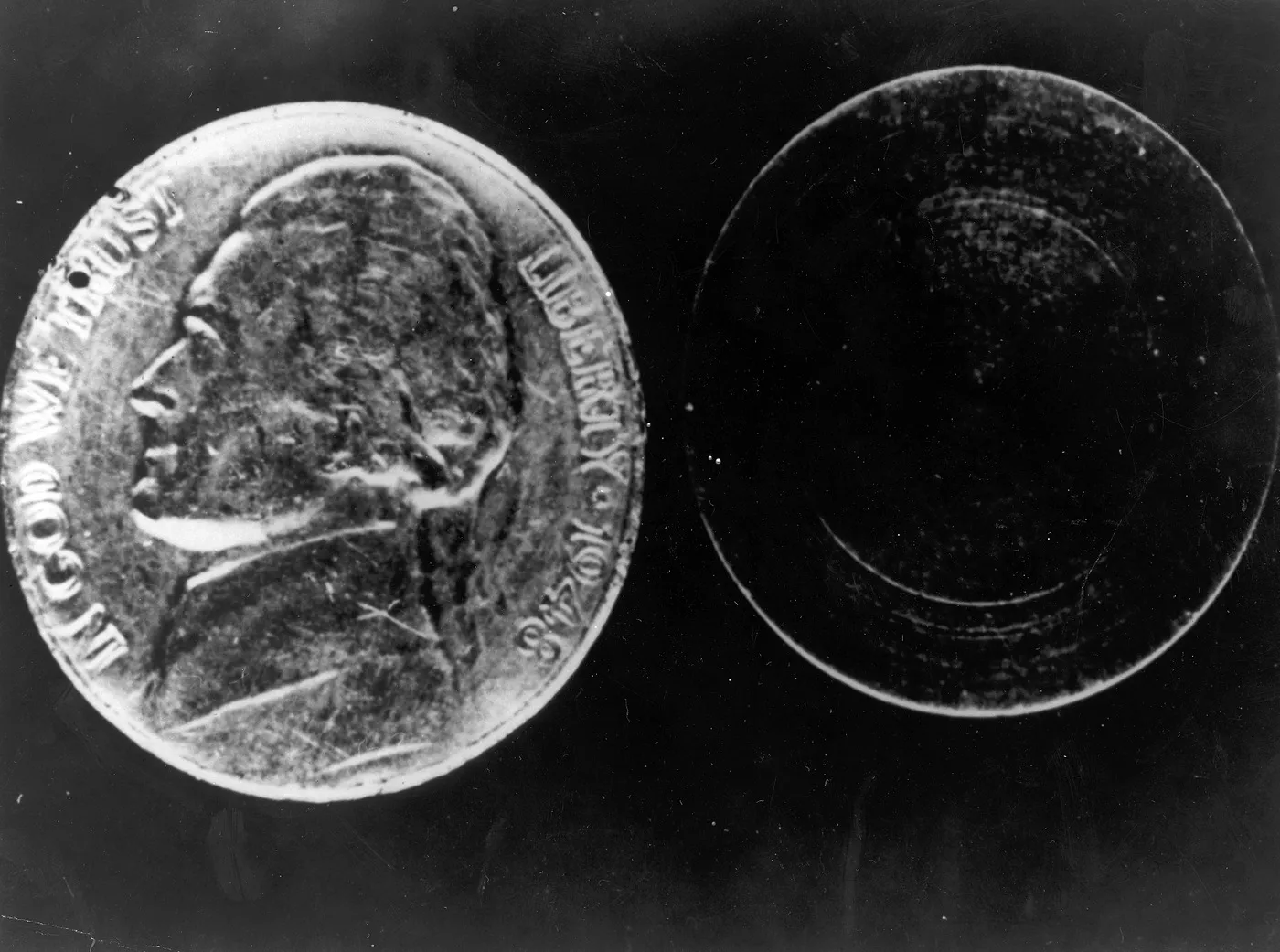
The nickel looked ordinary enough to pass from hand to hand. On June 22, 1953, a Brooklyn newspaper delivery boy dropped it, and the coin came apart. Inside was a tiny photograph covered with columns of numbers. The FBI received the discovery through New York police. Its laboratory examined a container made from two different nickels, with a small hole through the letter R in TRUST that allowed it to be opened.[1]
The object supplied a mystery before it supplied a suspect. Investigators could see that someone had built a device for carrying a concealed message, but they could neither read the numbers nor identify the sender. The break came in 1957, when Soviet intelligence officer Reino Hayhanen approached American officials in Paris. His information enabled the FBI to decipher the message, which concerned his own arrival and work in the United States. He also described a superior he knew as Mark.[1]


What the prosecution had to prove
Mark was the man prosecuted as Rudolf Abel. At his arrest he was living at the Hotel Latham in Manhattan and renting an artist's studio in Brooklyn. His identities included Emil Robert Goldfus, the name of a child who had died, and Martin Collins. Hayhanen became the government's principal trial witness. He described meetings, payments, concealed message drops and instructions from Abel, giving prosecutors an account of coordinated espionage work rather than a collection of unexplained gadgets.[2]
The Second Circuit's opinion also states a limit that belongs in the story: the trial record did not show that Abel or his associates had successfully transmitted national-defense information to the Soviet government. The charges concerned conspiracy, so the prosecution did not have to prove that the agreed plan had succeeded. The appeals court upheld the verdict after examining the evidence of the agreement and its purpose. That distinction separates the offense the jury found from larger claims about secrets the network actually delivered.[2]
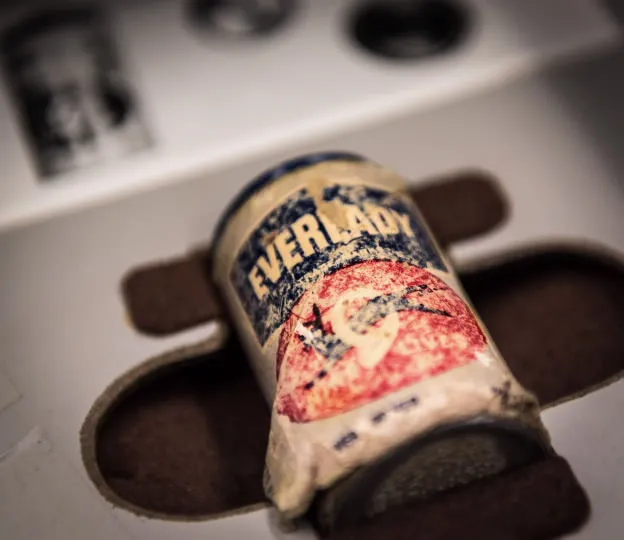
The surviving equipment makes the concealment methods tangible. An FBI artifact photograph shows a flashlight battery hollowed out to hold objects such as film. The Bureau identifies it as equipment found in Abel's apartment. The Bureau says that a simulated message remains inside on film. The photograph documents the device; it does not show the contents of a recovered intelligence report.[3]
An arrest for deportation, followed by searches
On June 21, 1957, FBI agents approached Abel in his hotel room before immigration officers served their warrant. According to the Supreme Court's account, the agents wanted his cooperation. At that stage Hayhanen was refusing to testify publicly, and the Justice Department had concluded that it lacked enough evidence for an espionage arrest and indictment. Immigration officials had separately decided to begin deportation proceedings over Abel's unlawful status. The warrant they carried was an administrative arrest warrant, not a judicial search warrant.[4]
After Abel declined to cooperate on espionage, the immigration officers arrested him and searched his belongings. They took a forged Collins birth certificate. While he packed, an officer seized a piece of numbered graph paper that Abel was trying to conceal in his sleeve. A later search of his luggage at immigration headquarters produced another birth certificate, a vaccination certificate and a bank book. These documents mattered because they supported the evidence that he maintained false identities.[4]
The FBI then searched the room with the hotel management's permission, after Abel had paid his bill and left. From the wastebasket came a hollow pencil holding microfilms and a block of wood concealing a cipher pad. Those two objects completed the seven disputed items that reached the Supreme Court. The famous nickel and the photographed battery were part of the wider investigative story; neither appears on the Court's list of these seven challenged exhibits.[4]
.jpg)
Five justices accepted the searches. Four dissented.
Abel's lawyers argued that immigration procedure had been used to obtain evidence for a criminal prosecution without the safeguards of a search warrant. The trial judge rejected that account, finding that immigration officials acted in good faith. The Second Circuit sustained the finding. In March 1960, Justice Felix Frankfurter's Supreme Court majority accepted it too, while expressly condemning the use of an administrative warrant as a device to evade criminal-law restrictions.[4]
The majority upheld the searches connected with the immigration arrest under the precedents it applied. It treated the wastebasket evidence separately: Abel had vacated the room and discarded the objects, and the hotel had consented to the FBI search. The Court also declined to consider his broader attack on the validity of the administrative arrest warrant because his lawyers had expressly conceded the arrest's legality in the lower court. The decision rested on those facts and procedural limits.[4]
The dissenters read the danger differently. Justice William O. Douglas, joined by Justice Hugo Black, saw the immigration operation as a means for the FBI to do police work without obtaining a search warrant. Justice William J. Brennan Jr., joined by Chief Justice Earl Warren, Black and Douglas, objected to extending broad searches incident to arrest into this administrative setting. Their disagreement concerned the government's methods and constitutional restraints, not a finding that the espionage evidence was fabricated.[4]
A conviction that survived, and a sentence cut short
The jury convicted Abel on all three conspiracy counts on October 25, 1957. His concurrent prison terms amounted to thirty years, with fines totaling $3,000. The Supreme Court's five-to-four decision left the conviction standing. His eventual departure from American custody came through a prisoner exchange on February 10, 1962, involving captured U-2 pilot Francis Gary Powers and American student Frederick Pryor.[1][4][5]
James Donovan, the lawyer who had argued Abel's case, later helped negotiate the exchange, working with CIA lawyer Milan Miskovsky. The diplomatic ending did not erase the trial. Read together, the court decisions preserve both the evidence of the conspiracy and the constitutional disagreement recorded in the dissents over how the government had obtained seven of its exhibits.[6][4]
Sources and page references
Page references in the article use printed document pages unless marked “PDF.” Briefs state a party's position; the majority opinion records the Court's holding.
- FBI: Hollow Nickel / Rudolf AbelHistorical case account; checked October 2, 2026 · Investigating agency retrospective
Discovery, decoding, investigation, verdict and concurrent sentences. Used as the agency account, with legal findings checked against the opinions.
- United States v. Abel, 258 F.2d 485July 11, 1958 · Second Circuit opinion, reproduced by Justia
Describes trial evidence, conspiracy charges and the search challenge. The opinion gives July 11 as the decision date; October 13 is the later grant of Supreme Court review.
- FBI artifact: Rudolf Abel and the Hollow Nickel CaseJune 2017 · Agency artifact description
Identifies the hollow battery and its simulated display message. For the sentence, this article follows the Supreme Court record and the FBI case history: thirty years because the terms ran concurrently, rather than the forty-five-year total stated on this artifact page.
- Abel v. United States, 362 U.S. 217March 28, 1960 · Official U.S. Reports scan, Government Publishing Office
Complete 40-page case report: syllabus, majority opinion and both dissents, printed pages 217-256. The majority governs the judgment; the dissents explain the opposing constitutional analysis.
- Foreign Relations of the United States: Editorial Note 153Exchange dated February 10, 1962 · State Department historical documentary series
Confirms the exchange involving Abel, Powers and Pryor. This article does not treat the exchange as a reversal of the conviction.
- CIA: The NegotiatorJune 16, 2017 · Agency historical profile
The James Donovan section describes his defense work and cooperation with Milan Miskovsky in negotiating the exchange.
Records and image provenance checked October 2, 2026. This article explains the historical prosecution and 1960 ruling. The two photographs depict actual case objects, with their specific roles and the battery display reconstruction identified in the captions.