
North Carolina / Archives and aftermath
The Wilmington commission’s instructions: descendants, documents and a public report
In July 2000, North Carolina created a thirteen-member commission to study the white supremacist violence and overthrow of Wilmington’s government in 1898. Its instructions occupy less than two pages near the end of a much larger law. Read closely, they describe more than a topic to investigate: they specify who would appoint the investigators, whose testimony could enter the record, and how the work would reach the public.
Read the original court record ↓A mandate inside a larger law
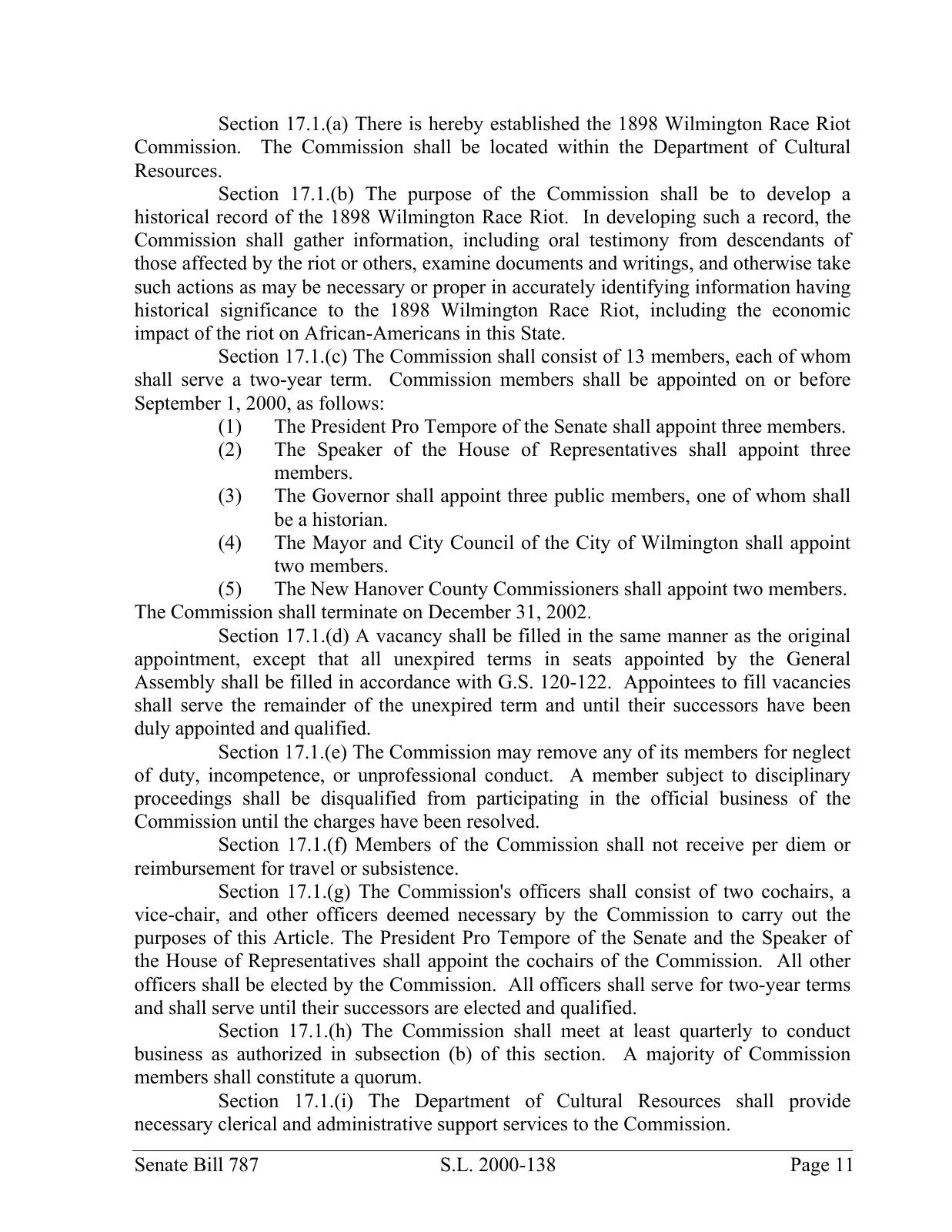
Part XVII of Session Law 2000-138 establishes the 1898 Wilmington Race Riot Commission within the Department of Cultural Resources. The official PDF contains twelve pages, most devoted to unrelated studies and commissions. Its final page records approval on July 21, 2000. The commission’s older statutory name is retained here to identify the body created by that act.[1]
The people and evidence it was asked to hear
The statute directs the commission to develop a historical record by gathering information, examining documents and writings, and taking other necessary steps to identify historically significant material accurately. It specifically includes oral testimony from descendants of people affected by the violence, as well as from others. The instruction puts inherited family accounts inside the research assignment.[1]
That is an instruction to collect evidence, not to treat every account as interchangeable. A family recollection, contemporary document and later written history have different relationships to the event. Bringing them together permits comparison: what a record says, what a family preserved, and where a question remains unanswered. The law’s emphasis on accuracy gives that comparison a purpose.[1]
One subject is singled out within that broad mandate: economic impact on African Americans in the state. The act does not prescribe a result or insert a financial total. It makes economic consequences a question the commission is required to investigate. That difference between a research instruction and a finding is easy to miss when the founding law and the later report are discussed together.[1]
Who would do the work?
The original act provides for thirteen members appointed through several state and local authorities. It requires meetings at least quarterly and assigns administrative support to the Department of Cultural Resources. These provisions turn a broad desire to remember into an institution with people, meetings and a reporting obligation.[1]
The appointments were divided: three from the Senate’s president pro tempore, three from the House speaker, three public members from the governor, two from Wilmington’s mayor and council, and two from New Hanover County’s commissioners. One gubernatorial appointee had to be a historian. The law therefore identifies both the appointing authorities and a particular kind of expertise.[1]
Other clauses make the practical arrangements visible. Members were to receive neither per diem payments nor travel or subsistence reimbursement. The legislature’s leaders selected the two cochairs, while members elected other officers. Administrative support came from the department. These details distinguish who participated in the commission from the institution expected to support its work.[1]
The department records that the commission held public hearings and examined primary and secondary written sources. A draft report appeared in December 2005; the final report followed in May 2006 after public comment. Those are the reported publication dates. The December 2002 deadline printed in the original act describes its initial timetable, not when the completed report actually appeared.[2][1]
Recognition was part of the assignment
The act allows the final report to recommend a permanent marker or memorial and consider historic-site designation. Its verbs matter: the commission could suggest forms of remembrance. This provision did not itself erect a memorial, decide an individual damages claim or issue a criminal judgment. Research and recommendation were the powers described here.[1]
The founding law and completed report serve different purposes. The first records the assignment and the machinery for carrying it out; the second presents the work that followed. Starting with those original instructions lets a reader ask a concrete question of the later investigation: how did its evidence, public participation and recommendations answer the charge the state had given it?[1]
Sources and references
Independently researched companion article, written from the linked primary records.
- Session Law 2000-138, Part XVII: Wilmington commissionJuly 21, 2000 · Enacted North Carolina session law
Complete 12-page enacted law. Commission provisions appear on pages 11-12; the file is labeled S.L. 2000-138 despite its bill-style URL.
- 1898 Wilmington Coup and history of the commissionNorth Carolina Department of Natural and Cultural Resources · Official institutional history
Context and documented report process; the article distinguishes it from the original statutory mandate.
This article examines the commission’s founding mandate and documented publication process. Its statutory name is retained where identifying the commission, while the event is described as a coup. The full report is linked for further reading, not presented as newly audited here.