
Ohio / Inside the court record
The press table inside Sam Sheppard’s courtroom
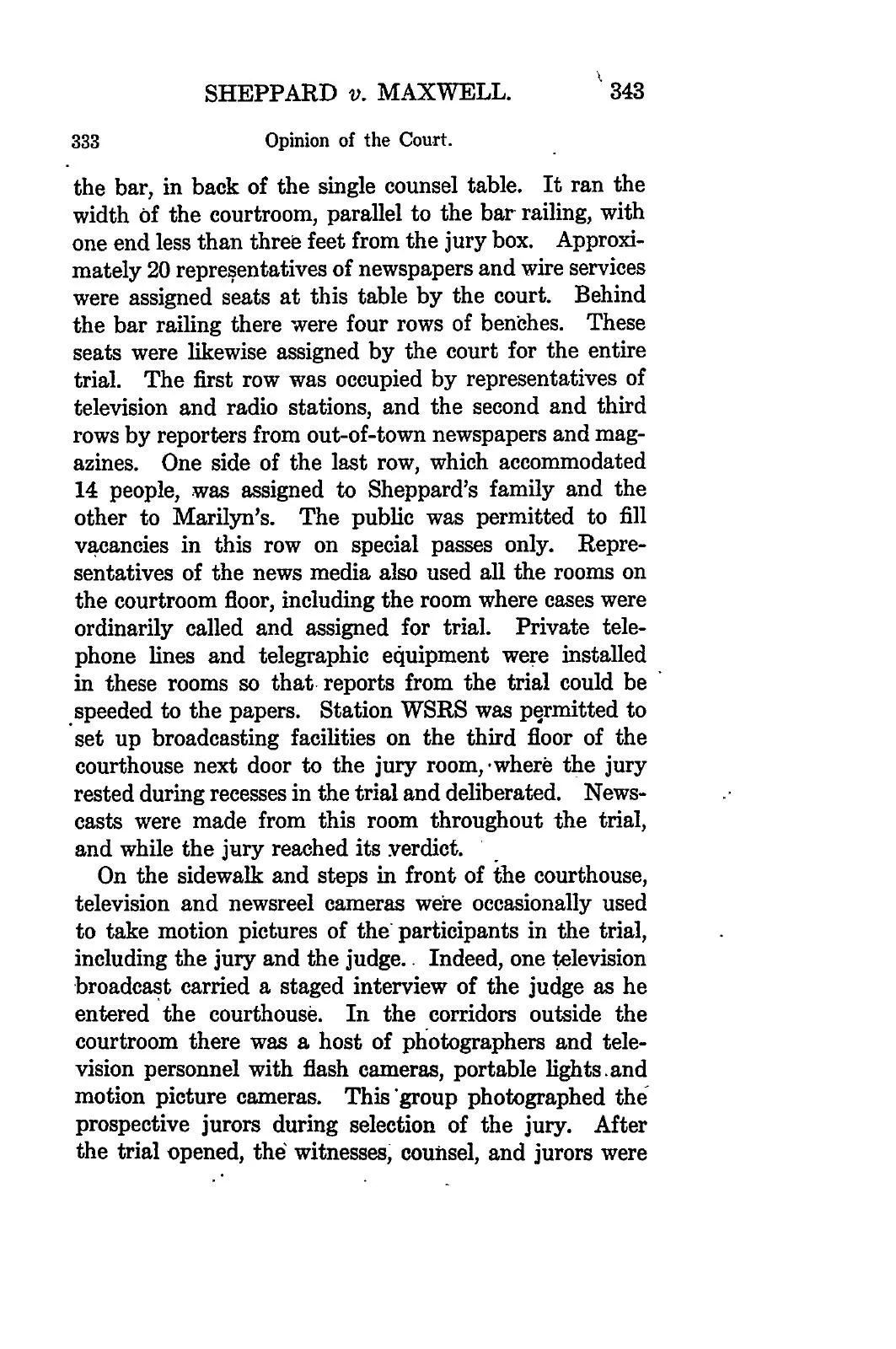
The room measured 26 by 48 feet. Inside it, a temporary table for about twenty reporters ran behind the lawyers’ table, with one end less than three feet from the jury box. That arrangement in Sam Sheppard’s 1954 murder trial was not a passing detail. Twelve years later, the Supreme Court used it to explain how a courtroom could become so crowded with publicity that the ordinary work of a defense became difficult.
Read the original court record ↓A public trial with very little public space
Marilyn Sheppard was killed in the couple’s Bay Village home on July 4, 1954. Her husband was convicted of second-degree murder that December. By the time the case reached the Supreme Court as Sheppard v. Maxwell, the question was whether he had received a fair trial. The justices were reviewing the conditions under which the verdict had been reached, not conducting a new inquiry into who killed Marilyn.[1]
The seating plan reveals the priorities inside the room. Television and radio representatives occupied the first row behind the railing. Out-of-town newspaper and magazine reporters occupied the next two. The final row was divided between the two families; ordinary spectators could fill vacancies only with special passes. The courtroom was open, but much of its limited space had effectively become a workplace for the news media.[1]
When proximity changes the proceedings
The Supreme Court described reporters moving in and out so frequently that witnesses and lawyers were sometimes hard to hear despite a loudspeaker. Their proximity made private conversation between Sheppard and his lawyers almost impossible. The lawyers had to leave the courtroom to confer. Even the judge’s anteroom became crowded with reporters seeking the substance of discussions held away from the jury.[1]
A press table therefore mattered for more than appearances. The area inside the courtroom railing normally gave lawyers room to handle exhibits and consult clients, while separating jurors and witnesses from distractions. In this trial, the Court said, that protected working area had been compromised. A proceeding can be formally open to scrutiny while still needing physical boundaries that allow its participants to do their jobs.[1]
The exposure extended outside the room. Before trial, newspapers printed the names and addresses of prospective jurors, who then received calls and letters about the case. A radio station operated beside the jury room. Jurors were repeatedly photographed. These were separate forms of pressure, and the opinion evaluated them together with the material published while the trial was underway.[1]
The Court did not ask for a secret trial
Justice Tom Clark’s opinion expressly recognized the press as a safeguard against miscarriages of justice. Reporting on police, prosecutors and courts could expose failures that would otherwise remain hidden. The problem was the failure to protect the trial from outside influence while preserving that scrutiny. The opinion’s praise for responsible reporting belongs beside its criticism of the circumstances in Cleveland.[1]
The suggested remedies were concrete: regulate reporters’ courtroom access and conduct, protect witnesses from outside accounts of testimony, and control prejudicial statements by people involved in the case. The Court also discussed postponement, moving a trial and separating jurors from outside publicity. It did not need to decide which sanctions could be imposed on a defiant press, because it found that measures within the court’s existing control could have protected the proceedings.[1]
Two different decisions in 1966
On June 6, 1966, the Supreme Court ordered relief from the conviction unless Ohio tried Sheppard again within a reasonable time. Justice Black dissented without a separate explanation in the reported decision. The ruling required a fair proceeding; it did not return an acquittal. A new jury acquitted Sheppard later in 1966, as the Cleveland State University repository for the trial materials records.[1][2]
That later acquittal is a separate outcome from the constitutional ruling. What makes the earlier opinion especially revealing is its attention to mundane arrangements: a table, a doorway, a row of seats and the distance between a reporter and a juror. In the Court’s account, those details helped determine whether lawyers could speak privately and whether the jury could hear the case through the evidence presented to it.[1]
Sources and references
Independently researched companion article, written from the linked primary records.
- Sheppard v. Maxwell, 384 U.S. 333 (1966)June 6, 1966 · Complete Supreme Court opinion, Library of Congress scan
Original pagination preserved; includes discussion of murder and prejudicial historical reporting.
- County Prosecutor Donates Sam Sheppard Trial Collection to Law LibrarySeptember 28, 2012 · Cleveland State University, custodian’s collection announcement
The case-history paragraph records the 1966 acquittal.
This article distinguishes the June 1966 fair-trial decision from the acquittal at the subsequent retrial. It makes no finding about the identity of Marilyn Sheppard’s killer.