Oklahoma / Inside the archive
Greenwood: reading a federal report against its own evidence
An official report can preserve evidence and misunderstand it at the same time. That is the uncomfortable lesson inside the Justice Department’s review of the Tulsa Race Massacre. Its investigators returned to a federal agent’s report written days after Greenwood was destroyed in 1921. They found both a deeply misleading explanation and information too important to discard.
Read the original court record ↓The document that survived
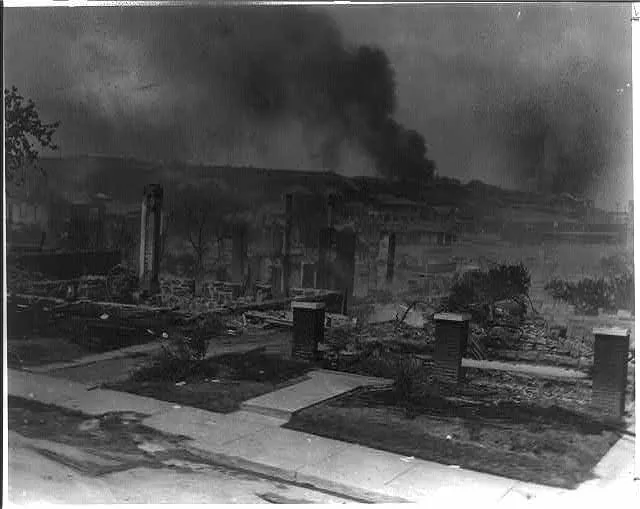
The massacre unfolded on May 31 and June 1, 1921. White attackers destroyed homes and businesses in Greenwood, Tulsa’s prosperous Black community. The modern Justice Department review describes violence that developed into a coordinated assault, including participation by local law enforcement. Its account is not simply a longer version of the contemporary federal assessment. It challenges that assessment’s central explanation.[1]
Bureau of Investigation agent T. F. Weiss sent a preliminary telegram on June 2 and completed an eight-page report on June 6. The bureau was a predecessor of the FBI. Weiss portrayed events as a confrontation that had expanded spontaneously, discounted racial motivation and concluded that no federal violation appeared. Those conclusions traveled under official authority, even though the investigation was described as informal.[1]
Whose account received a name?
Weiss claimed to have spoken to more than 100 witnesses, both Black and white. Yet the report summarized five identified interviews, all with white men. Black witnesses were grouped together in a brief account of shots, burning houses and flight. That imbalance matters. Naming one speaker while blending many others into a general statement gives readers very different opportunities to judge what each person saw.[1]
The 2025 investigators did not solve that problem by treating every surviving recollection as interchangeable. They consulted survivor and family interviews, older recorded accounts, Red Cross and National Guard records, legal filings and other primary material. Their methods section makes the reconstruction visible. A reader can ask which records corroborate an event, which were produced afterward and whose perspective a particular document represents.[1]
Evidence inside a flawed account
One interview Weiss preserved was especially consequential. Tom Dyer described a police officer recruiting white men outside Tulsa for a raid. Dyer also reported that the officer later boasted of killing Black people. These were reported allegations, not convictions or facts established in a trial. The modern review nevertheless identified them as important leads that did not fit Weiss’s reassuring conclusion.[1]
The review also retained an identification problem. Weiss recorded the officer’s surname without establishing his full identity. Later records offered possible connections, but the report did not turn an uncertain name into certainty. That restraint is useful when reading an archive: an account may expose a serious failure while still leaving questions about exactly who did what.[1]
A correction is not a prosecution
The department concluded that a federal prosecution was no longer possible. It explained the deaths of potential defendants, expired limitations periods and the difficulty of proving a criminal case with witnesses who could no longer be cross-examined. The applicable law also had to be considered as it existed at the time. Modern hate-crime statutes could not simply be applied backward to 1921.[1]
That legal conclusion did not validate Weiss’s account. Nor did the newer report establish that prosecutors in 1921 had examined and rejected every possible charge; it acknowledged that the record of their decision was unclear. Its achievement was different: making the old federal record available, identifying what it left out and explaining why its own evidence demanded a more searching reading. A document’s official status tells us who created it. It does not relieve us of the work of checking it.[1]
Sources and references
Independently researched companion article, with paragraph-level references to the records examined.
- Department of Justice, Review and Evaluation: Tulsa Race Massacre2025; corrected version currently supplied by DOJ · Primary institutional record
Original complete DOJ report, linked at its official source. The source file includes its original accessibility-report attachments; this site does not redistribute a modified or stripped copy.
This article addresses the specific historical record described here; it is not a complete account of every proceeding.