
Oregon / Inside the court record
Woodburn: when earlier words became evidence of motive
The Woodburn bank bombing left two police officers dead in December 2008. Years later, one part of the appellate argument concerned words spoken long before the explosion. Bruce Turnidge challenged the use of earlier statements about government, police and political violence. The Oregon Supreme Court’s answer turned on what those statements could help explain about this particular crime.
Read the original court record ↓The connection the defense disputed
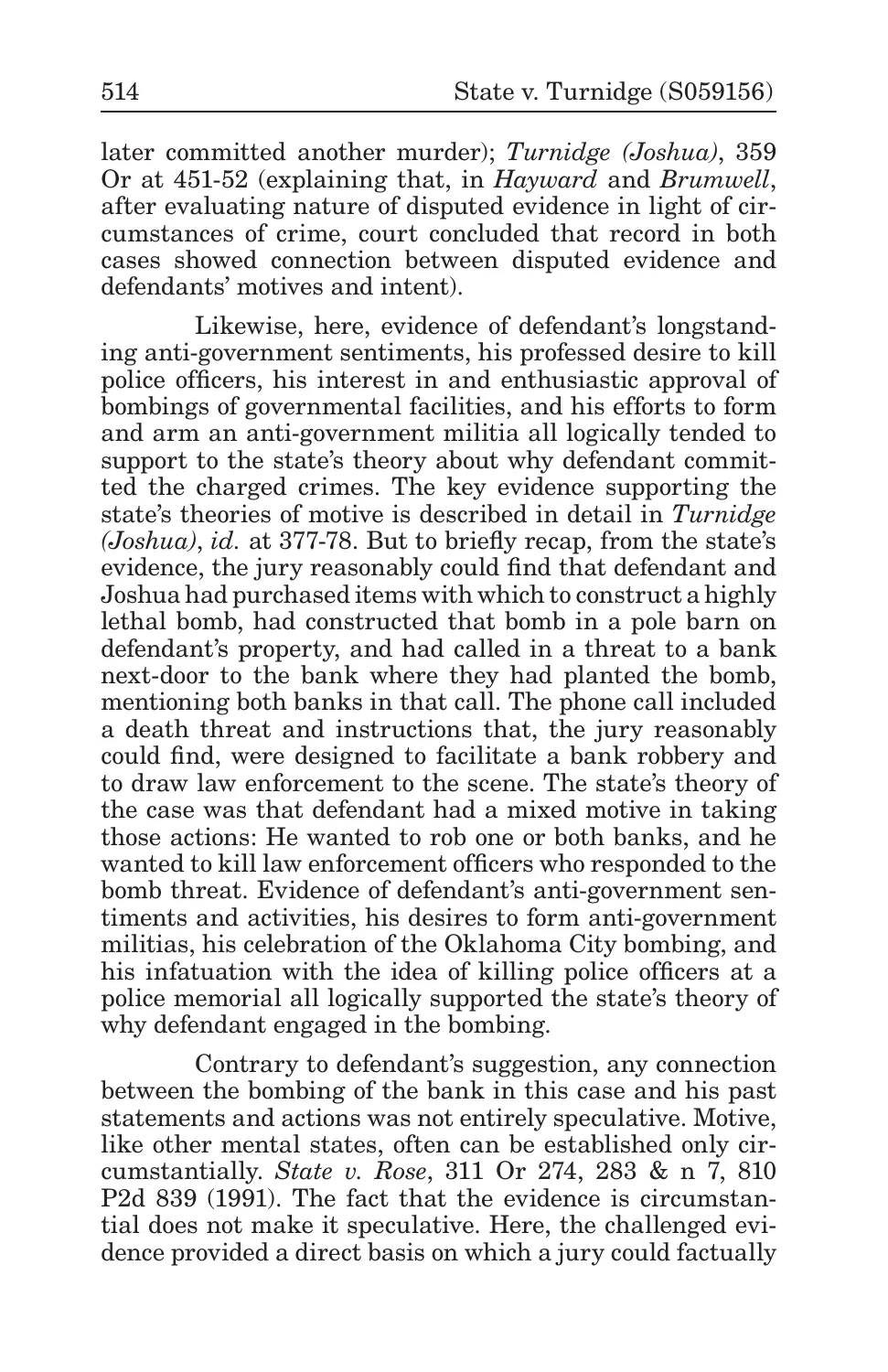
Turnidge and his son, Joshua, were tried together and convicted. In Bruce’s appeal, the disputed material included expressions of approval for the Oklahoma City bombing, statements about harming police and plans for an armed militia. Some statements were decades old. The defense argued that their distance from the charged events made them irrelevant, and that hostility toward government did not explain an attack on a privately owned bank.[1]
That objection identified a real evidentiary question. A jury’s dislike of a person’s beliefs is not the same thing as proof of an offense. The court therefore examined the prosecution’s claimed connection. The state argued that the scheme combined an effort to obtain money with a desire to kill responding officers. Earlier statements mattered, it said, because they supported those proposed motives.[1]
A low threshold, with a specific purpose
The rule under review was Oregon Evidence Code 401, the rule of relevance. It asks whether evidence tends to make a consequential fact more or less probable. The court described that threshold as low. Evidence need not force one interpretation to have relevance; it can qualify when the jury could reasonably draw a material inference from it. That is different from deciding whether the prosecution proved guilt.[1]
In applying the rule, the justices did not stop at the label “anti-government.” They considered the statements alongside evidence of the threatening call, the circumstances drawing officers to the bank and the prosecution’s robbery theory. The court concluded that the earlier words supported an inference about motive. It rejected the argument that an inference became speculation merely because it rested on circumstantial evidence.[1]
What that ruling did not decide
A footnote sets an important boundary. Although the defense had mentioned other evidence rules below, its appellate argument developed relevance rather than distinct objections under Rules 403 or 404. The court consequently addressed the relevance argument. This passage should not be enlarged into a ruling that every potential objection to political-belief evidence had been fully argued and rejected.[1]
The opinion later considered a separate penalty-phase argument concerning the prosecutor’s references to Turnidge’s beliefs. There, too, the court distinguished abstract beliefs from evidence connected to violent conduct and future dangerousness. The two discussions concerned different stages of the trial. Their shared concern was a demonstrated connection, rather than permission to punish an unpopular political identity.[1]
A decision within a longer history
In 2016, the court affirmed Bruce Turnidge’s judgment and death sentences. That is the disposition printed on the opinion, not a description of Oregon’s death row today. Governor Kate Brown later commuted all seventeen remaining death-row sentences to life without parole, effective December 14, 2022. Commutation changes punishment; it does not turn the original convictions into acquittals.[1][2]
The evidentiary dispute helps explain one part of how the case was tried: why a jury heard earlier statements as well as evidence from the investigation. The ruling required a reason tied to the charged events. Its narrow focus makes the difference between an offensive statement and a relevant one visible, without treating either as a substitute for the rest of the prosecution’s case.[1]
Sources and references
Independently researched companion article, with paragraph-level references to the records examined.
- State v. Turnidge, 359 Or 507 (2016)May 5, 2016 · Primary institutional record
Complete Oregon Reports opinion preserved by Oregon Appeals; archived court text, not a publisher’s case summary.
- Governor Kate Brown commutes Oregon’s death rowDecember 13, 2022 · Primary institutional record
Official announcement of the statewide change to life without parole.
This article addresses the specific historical record described here; it is not a complete account of every proceeding.