Rhode Island / Inside the court record
The Cianci verdict: why acquittals did not erase the conspiracy count
The jury did not give prosecutors everything they sought in the Providence corruption trial. Its verdict included many acquittals, alongside a racketeering-conspiracy conviction for Mayor Vincent Cianci. That combination became an appellate question of its own. Could evidence connected to rejected charges still support the surviving conspiracy count? The court’s answer depended on the different work each part of the verdict performed.
Read the original court record ↓Reading the boxes in context
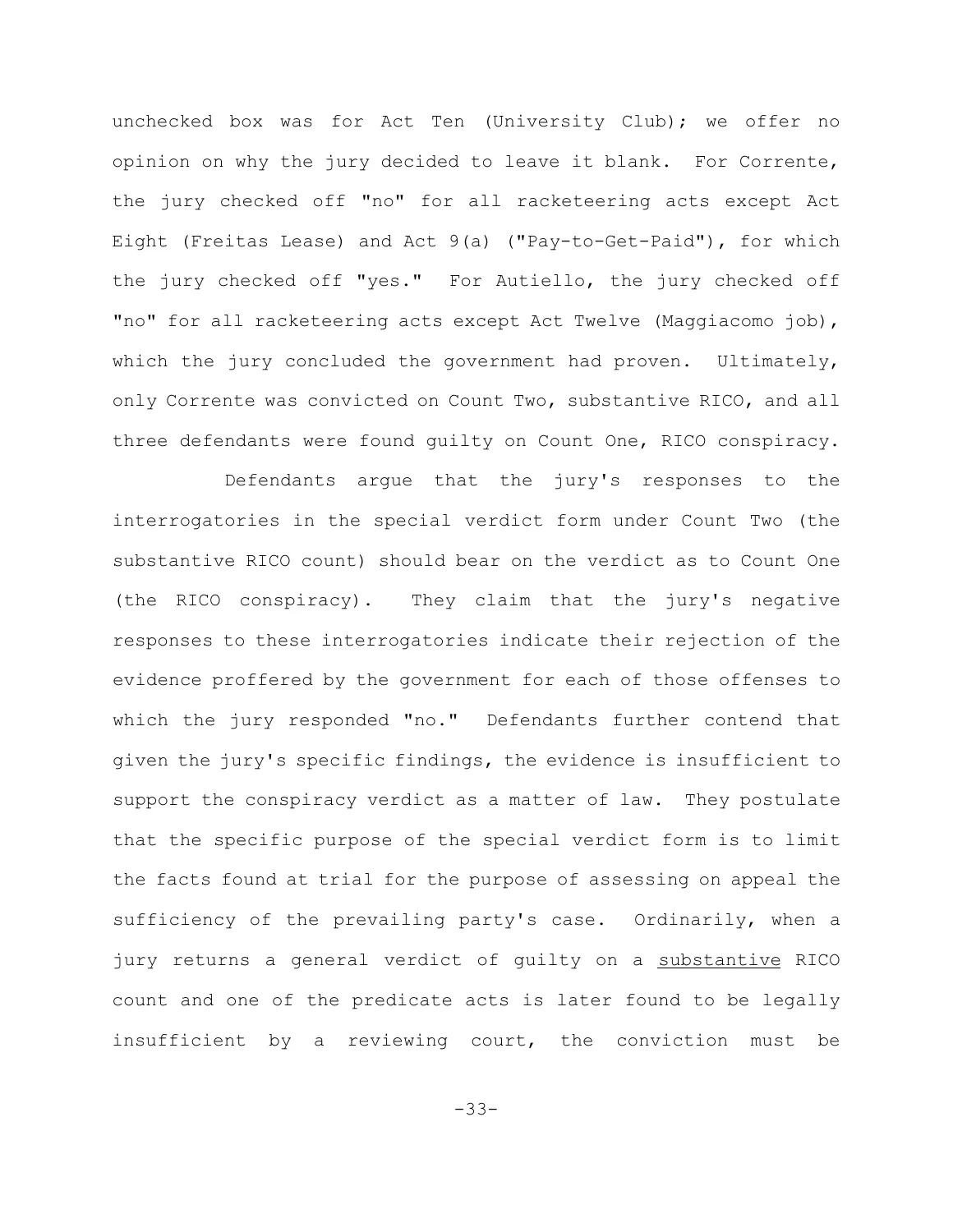
Cianci, administration director Frank Corrente and Richard Autiello were tried together in 2002. The appellate opinion reports the trial’s counts and outcomes collectively, so those totals should not be mistaken for Cianci’s personal charge sheet. All three were convicted of RICO conspiracy, but only Corrente was convicted of the separate substantive RICO offense. Other guilty verdicts concerned Corrente and Autiello.[1]
Under the substantive RICO count, the jury received questions about particular alleged racketeering acts for each defendant. For Cianci, it marked those acts unproved except for one question left unanswered. The defense argued that these answers restricted the evidence available when reviewing the conspiracy conviction. Otherwise, it argued, the appeal would disregard factual decisions the jury had expressly recorded.[1]
Agreement and completed acts
The majority distinguished the offense of conspiracy from committing the substantive offense. A RICO-conspiracy defendant need not personally commit the two underlying acts required for a substantive RICO violation. The issue was whether the defendant agreed to further a criminal undertaking that, if completed, would satisfy the offense. An agreement could be inferred from words, actions and the relationships among participants.[1]
The court also relied on the rule that an acquittal on one count does not ordinarily dictate the sufficiency analysis for another count in the same trial. Jurors may reach mixed outcomes for reasons a reviewing court cannot reliably reconstruct. The safeguard remains an independent examination of whether the surviving conviction has adequate evidentiary support. That reasoning did not authorize changing an acquittal into a conviction.[1]
The limits of an unproved act
In the majority’s view, failing to establish every element of an alleged racketeering act did not necessarily make all evidence about that transaction useless. Combined with other evidence, it might still illuminate an enterprise or an agreement. The special questions had been attached to the substantive RICO count. The court declined to treat their answers as a complete catalog of facts forbidden from consideration on conspiracy.[1]
Judge Jeffrey Howard disagreed with the result on the RICO charges. He questioned the treatment of the jury’s answers, but his developed objection went further: he found the proof inadequate to establish the particular enterprise prosecutors had charged. In his view, showing that officials used municipal bodies as tools did not establish that those bodies formed the alleged association with a shared unlawful purpose.[2]
A conviction affirmed, with distinct questions remaining
The majority affirmed the convictions in August 2004. That opinion expressly deferred sentencing and forfeiture issues for additional briefing. Its conclusion should therefore not be described as a final resolution of every matter on appeal. Both volumes, the separate opinion and the court’s later errata belong with the historical record, rather than a shortened excerpt containing only the winning argument.[2][3]
The dispute is useful because it preserves two truths at once. The acquittals remained acquittals, and the conspiracy conviction survived review. Understanding why requires reading the verdict by charge and by legal element, rather than treating the number of guilty or not-guilty boxes as a vote on one overall story. Howard’s disagreement shows that affirmance did not eliminate serious argument about the prosecution’s theory.[1][2]
Sources and references
Independently researched companion article, with paragraph-level references to the records examined.
- United States v. Cianci: official opinion, volume IAugust 10, 2004 · Primary institutional record
Complete first volume, pages 1-49. RICO conspiracy and special-verdict discussion at pages 31-38.
- United States v. Cianci: official opinion, volume IIAugust 10, 2004 · Primary institutional record
Complete second volume: cover plus printed pages 50-86. Includes conclusion and Judge Howard’s separate opinion.
- United States v. Cianci: official errataAugust 13, 2004 · Primary institutional record
The court’s two-page correction notice, preserved separately without silently editing the original opinions.
This article addresses the specific historical record described here; it is not a complete account of every proceeding.