
South Carolina / Inside the court record
The Columbia sit-in: a criminal rule changed after the event
The chain went up after the students sat down. That small detail in the Supreme Court’s account of a Columbia lunch-counter protest became part of a much larger question: could a court expand a criminal statute and apply the new meaning to conduct that had already happened? The 1964 decision in Bouie v. City of Columbia answered through the constitutional requirement of fair warning.
Read the original court record ↓An invitation with a racial boundary
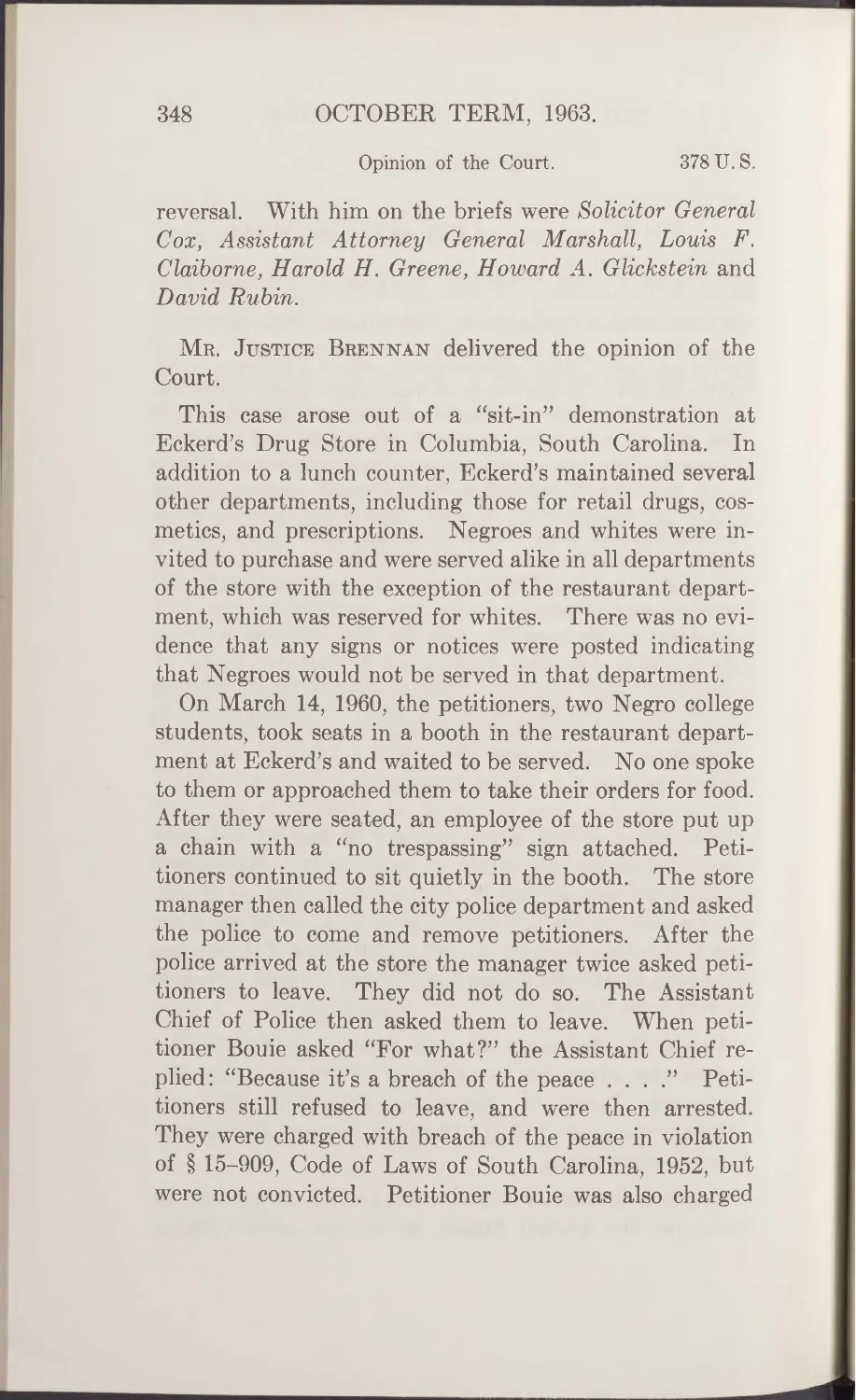
On March 14, 1960, two Black college students entered Eckerd’s Drug Store and sat in a restaurant booth. The store served Black customers in its other departments but reserved restaurant service for white customers. No posted sign had warned the students against entering that department. After they sat down, an employee placed a chain bearing a no-trespassing sign. The students remained quietly seated.[1]
The manager called police and asked the students to leave. They refused and were arrested. Several charges followed, but the Supreme Court reviewed their convictions under a particular criminal statute: one prohibiting entry onto another person’s land after notice forbidding entry. The order of events mattered because the warning came after entry, not before it.[1]
Two acts the statute treated differently
South Carolina’s highest court had interpreted the statute to cover remaining after an order to leave as well as entering after a warning to stay out. Applied that way, the record supported the convictions: the students had declined to leave. Justice William Brennan’s majority opinion did not dispute that sequence. It asked whether the broader interpretation could fairly be imposed after the sit-in.[1]
The majority examined more than the statutory words. Earlier South Carolina decisions had treated notice before entry as necessary. Cases allowing a property holder to remove an unwanted visitor involved different principles, including civil liability and the use of reasonable force. The Court refused to assume that conduct giving rise to a civil remedy necessarily satisfied this criminal statute.[1]
The warning had to exist in law
The city could point to the students’ willingness to face arrest. The majority found that insufficient. Fair warning depended on the statute and the relevant law, rather than an individual defendant’s expectations. A person’s readiness to accept arrest for a protest could not supply a missing criminal prohibition. The opinion also observed that they had not been convicted on the separate breach-of-the-peace charge.[1]
Justice Hugo Black dissented, joined by Justices John Harlan and Byron White. They considered the state court’s reading predictable in light of the longstanding rule that an invited visitor becomes a trespasser by refusing an owner’s demand to leave. The disagreement was therefore concrete: whether that general understanding supplied adequate warning under the specific criminal law being enforced.[1]
The ground on which the convictions fell
The Court reversed on due-process grounds. It did not decide the separate equal-protection argument. Its reasoning compared an unforeseeable judicial enlargement of a crime to a legislature’s retroactive criminal law, while identifying the Due Process Clause as the limit on the court’s action. South Carolina could not obtain through a new interpretation the retroactive punishment it could not impose through a new statute.[1]
The decision leaves the sequence unusually clear. Entry preceded the sign; the sit-in preceded the expanded interpretation; punishment followed both. Restoring those intervals explains why the dispute was more than an argument over a technical word. The state had to identify a criminal rule that fairly covered the students’ conduct when they acted, not create that coverage afterward.[1]
Sources and references
Independently researched companion article, with paragraph-level references to the records examined.
- Bouie v. City of Columbia, 378 U.S. 347 (1964)June 22, 1964 · Primary institutional record
Complete U.S. Reports majority opinion, participation statements and dissent. The dissent starts on printed page 363.
This article addresses the specific historical record described here; it is not a complete account of every proceeding.