South Carolina / Evidence and investigation
Walter Scott: what the video settled, and what the judge still had to decide
Feidin Santana recorded part of the encounter in which North Charleston police officer Michael Slager killed Walter Scott. The recording became a crucial check on Slager’s account. It did not show every moment. The later sentencing appeal is useful precisely because it explains both the video’s force and the work that testimony, admissions and credibility findings still had to do.
Read the original court record ↓The conviction and the sentencing question
On April 4, 2015, Slager stopped Scott over a defective brake light. Scott fled, and Slager pursued him. Slager later admitted in his federal plea that he willfully used unreasonable deadly force while Scott was unarmed and running away. The state murder trial had ended in a hung jury. Under the eventual plea agreement, South Carolina dismissed that charge and agreed not to retry it.[1]
The federal conviction was for depriving Scott of his civil rights under color of law. To calculate the sentence, the judge had to identify the underlying conduct through a sentencing-guideline cross-reference. Prosecutors argued for second-degree murder; Slager argued for voluntary manslaughter. Calling the result a federal murder conviction would blur the distinction between the offense of conviction and the guideline used at sentencing.[1]
What the camera could establish
The video showed Scott standing and running away when Slager fired. It also showed Slager retrieving his Taser from behind the position where he had fired, contradicting his earlier description of its location. These were concrete points against which the court could compare an account. The recording was more than an illustration attached to testimony.[1]
But it did not clearly show the disputed period when the two men were on the ground. Santana’s observations therefore mattered separately from his recording. The court compared his accounts to investigators and in court, found them consistent, and credited his description of that interval. The written opinion makes the distinction visible: a witness can have seen something that the camera did not clearly capture.[1]
Slager’s accounts changed across interviews and testimony. The court identified later-added claims that Scott had been on top of him, punched him and used the Taser against him. Slager attributed gaps to uncertain memory. The district judge found his evolving versions unpersuasive, while the appellate court concluded that the record supported that credibility assessment.[1]
An expert possibility was not a definitive answer
The defense also offered reconstruction, audio and fiber evidence. A three-dimensional reconstruction could not show who actually held the Taser during the disputed period. Enhanced audio required interpretation. An analyst’s examination of melted polyester fibers could not definitively establish whether a Taser had caused the marks on Slager’s shirt.[1]
That last distinction is easy to lose in retelling. A possible explanation that cannot be excluded is different from an identified cause. The sentencing judge did not have to treat an inconclusive test as confirmation of Slager’s version. The appellate court upheld the decision not to give those qualified opinions the weight he sought.[1]
The judge found that Scott had not taken the Taser and was fleeing when shot. The appeals court held that the findings and Slager’s own admissions supported the second-degree-murder guideline. It also rejected the claim that the facts established adequate provocation for a heat-of-passion reduction. Those conclusions followed from the particular record the court accepted.[1]
One ruling had a narrower basis
The sentence also included an obstruction adjustment for false statements to investigators. Slager argued that the statements were unsworn and had not significantly impeded the inquiry because investigators already possessed the video. He had not raised that objection below, so the appellate court applied the more limited plain-error review.[1]
Other federal courts had disagreed about the relevant guideline question. The Fourth Circuit therefore found no obvious error justifying reversal on that record. It did not announce that every unsuccessful attempt to mislead investigators necessarily warrants the same adjustment. On January 8, 2019, it affirmed the twenty-year sentence.[1]
The opinion shows a recording doing two jobs: establishing visible events and testing claims about what happened. It also shows the limits of treating footage as the whole case. Witness credibility, the limits of expert methods and the precise rules of appellate review remained part of the explanation for the sentence.[1]
Sources and references
Original analysis of the sentencing appeal. The federal civil-rights conviction, murder guideline and obstruction adjustment are distinct. Testimony and laboratory possibilities are attributed at the level supported by the record.
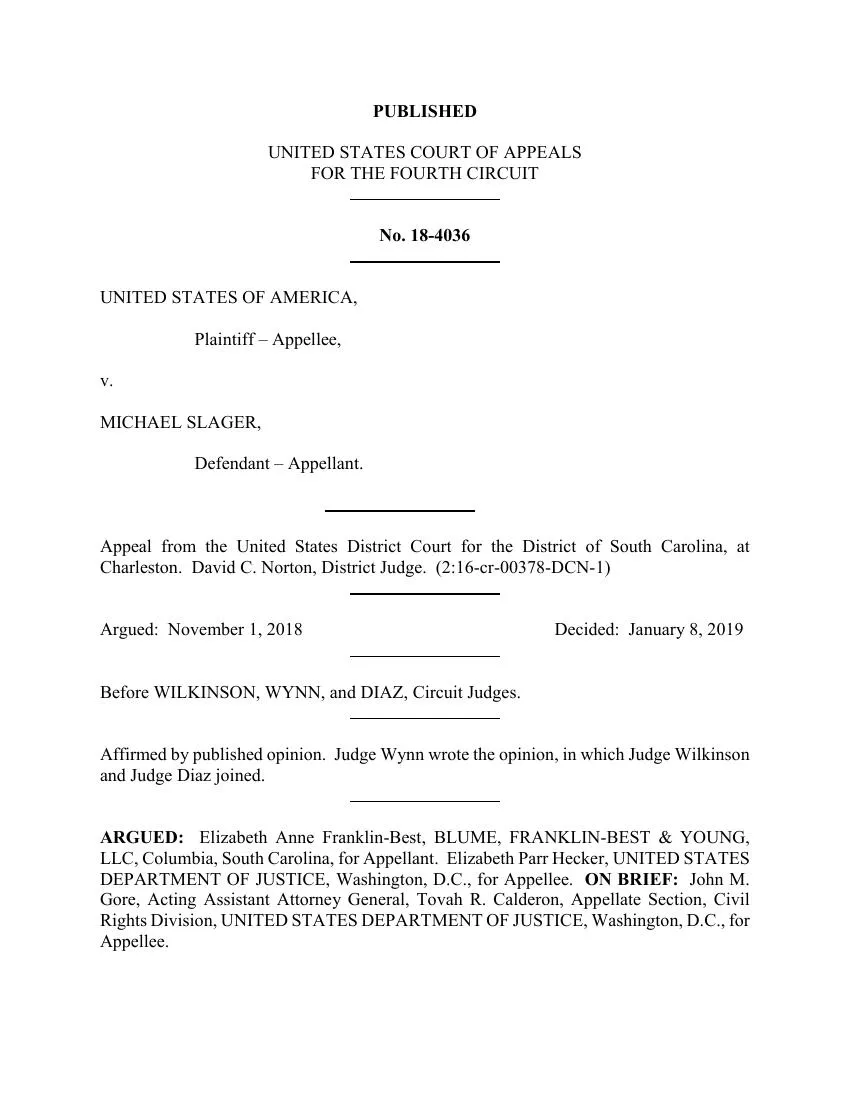
- United States v. Slager, No. 18-4036January 8, 2019 · Published Fourth Circuit sentencing opinion
Complete official 24-page PDF. Pages 14-17 examine credibility and expert evidence; pages 22-24 explain the narrower plain-error ruling on obstruction.
This article examines the January 2019 sentencing appeal. It does not calculate a current release date or treat the sentence imposed as a guarantee of time actually served.