
Tennessee / Reading the court record
Ed Johnson: the court order a lynch mob could not erase
A stay of execution is meant to preserve the possibility of a decision. In Ed Johnson’s case, a mob destroyed that possibility by killing him while his appeal was pending. The Supreme Court’s first United States v. Shipp opinion confronted a stark argument: could the people accused of defying its order avoid responsibility by saying the Court never should have taken the case?
Read the original court record ↓An appeal that required a living appellant
Johnson, a Black man convicted of rape in Hamilton County, sought federal habeas corpus relief in 1906. His petition alleged unlawful exclusion of Black people from the juries and a defense constrained by fear of mob violence. It claimed that fear had obstructed challenges to the trial, a request for a different venue and efforts to seek further review. These were constitutional claims, not merely a request for more time.[1]
After the federal circuit court denied relief, Justice John Marshall Harlan allowed an appeal. On March 19 the Supreme Court ordered proceedings against Johnson stayed and directed that he remain in custody pending the appeal. Sheriff Joseph Shipp received notice by telegraph before six that evening. Johnson was taken from the jail and lynched that night.[1]
The resulting contempt proceeding concerned interference with that order. Prosecutors alleged that Shipp and others had helped the mob prevent the Court from hearing Johnson’s appeal. The December 1906 opinion addressed preliminary legal objections. Its description of those charges was not yet a finding that every accused person had committed the alleged acts.[1]
Who could decide whether the Court had authority?
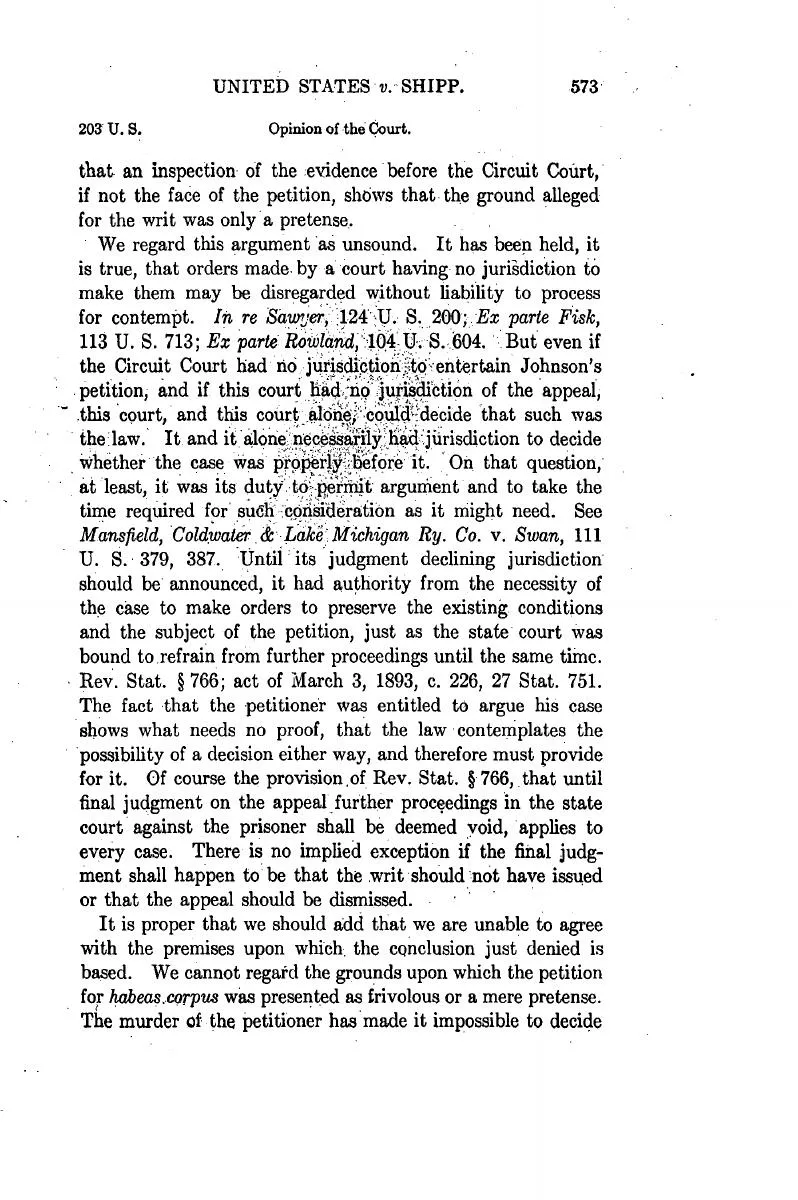
The defendants argued that the habeas case did not genuinely present a constitutional question. If the lower federal court lacked jurisdiction, they reasoned, the Supreme Court also lacked authority over the appeal. An order issued without authority could not support punishment for contempt. That was their proposed route from attacking the appeal to defeating the contempt case.[1]
Justice Oliver Wendell Holmes’s answer concerned who would decide that issue. The Court had authority to determine whether the case was properly before it. Reaching that decision required argument and time. Until it ruled, it could preserve the conditions necessary for review. Johnson could not exercise an appeal after a mob had killed him.[1]
The opinion did not announce that jurisdiction never matters. It recognized earlier decisions involving orders made without jurisdiction, then explained why this situation was different. Nor did Holmes dismiss Johnson’s constitutional claims as a sham. He said they deserved serious consideration, while acknowledging that Johnson’s murder had made deciding his case impossible.[1]
A sworn denial could not finish the case
The defendants raised another objection: their sworn answers denied involvement, and they argued that those answers should end the contempt proceeding. If the denials were false, a separate perjury prosecution could follow. The Court refused to let that proposed procedure replace a hearing about observable conduct.[1]
Holmes distinguished a disputed intention behind an ambiguous act from evidence of people’s presence and actions. Witnesses could testify about the alleged conduct. General denials could not make that inquiry disappear. The Court also rejected the idea that the justices were personally aggrieved parties; the proceeding concerned enforcement of the law. The trial would go forward.[1]
The later judgments must be read separately
In May 1909, the Court found six defendants guilty of contempt and discharged three others still before it. In November, it sentenced Shipp, Luther Williams and Nick Nolan to ninety days in jail, and Jeremiah Gibson, Henry Padgett and William Mayse to sixty days. These were contempt judgments, not murder convictions. The 1906 preliminary decision should not be cited as though it had imposed those sentences.[2][3]
Johnson’s own conviction remained a separate matter. Tennessee’s 2016 memorial resolution records that Judge Doug Meyer overturned it in 2000. That later action does not change the central loss described in Shipp: Johnson was denied a living opportunity to pursue his appeal. The order’s purpose had been to keep that opportunity open while the Court decided what it could hear.[4][1]
Sources and references
Original analysis of the 1906 opinion, checked against the later disposition and sentencing judgment. Historical source documents retain their original language; the article does not reproduce racial slurs or graphic imagery.
- United States v. Shipp, 203 U.S. 563December 24, 1906 · U.S. Reports, Supreme Court opinion and preceding arguments
The Court’s opinion begins at printed page 571, PDF page 9. Earlier pages contain the syllabus and lawyers’ arguments, not the Court’s reasoning. The scan includes historical racial language.
- United States v. Shipp, 214 U.S. 386May 24, 1909 · Supreme Court findings and disposition
The majority’s disposition appears on printed pages 424-425, PDF pages 39-40. The linked scan also contains dissents and later material; those are distinct from the 1906 preliminary ruling.
- United States v. Shipp: the 1909 findings and sentencesMay 24 and November 15, 1909 · Supreme Court sentencing judgment
The short sentencing judgment identifies the six defendants and their sixty- or ninety-day terms. The earlier findings are in 214 U.S. 386, with the disposition at pages 424-425; that original volume is linked below.
- Tennessee House Joint Resolution 701: memory of Ed Johnson2016 · Legislative memorial resolution
Page 2 records the later overturning of Johnson’s conviction. For the sequence and meaning of the Supreme Court proceedings, this article relies on the judicial opinions themselves.
The 1906 decision settled preliminary issues in the contempt proceeding. The 1909 judgments and the later overturning of Johnson’s conviction are identified separately.