Utah / Evidence and investigation
Bradley Perry: the dollar bill that outlasted a cold case
The item that helped revive Bradley Perry’s murder investigation was ordinary enough to pass from hand to hand without notice: a one-dollar bill. Two customers noticed blood on it and contacted police. More than twenty years later, a DNA comparison mattered because the bill had been preserved, and because records could explain where the tested piece had come from.
Read the original court record ↓Change from a stranger at the station
Early on May 26, 1984, two Utah State University students stopped at a Texaco station in Perry, Utah. A man offered to pump their gas even though the pump was self-service. When one student wanted cigarettes, the man retrieved them himself. He handed back four one-dollar bills as change. One appeared to have fresh blood on it.[1]
The students called 911 and waited for officers, who collected the bills. Police later found Bradley Perry, the station’s clerk, dead inside a locked storage room. Investigators gathered material from the station, including hairs from vacuumed debris. The 2016 appellate opinion recounts this trial evidence in the light favorable to the jury’s verdict; it is not a transcript of every witness’s account.[1]
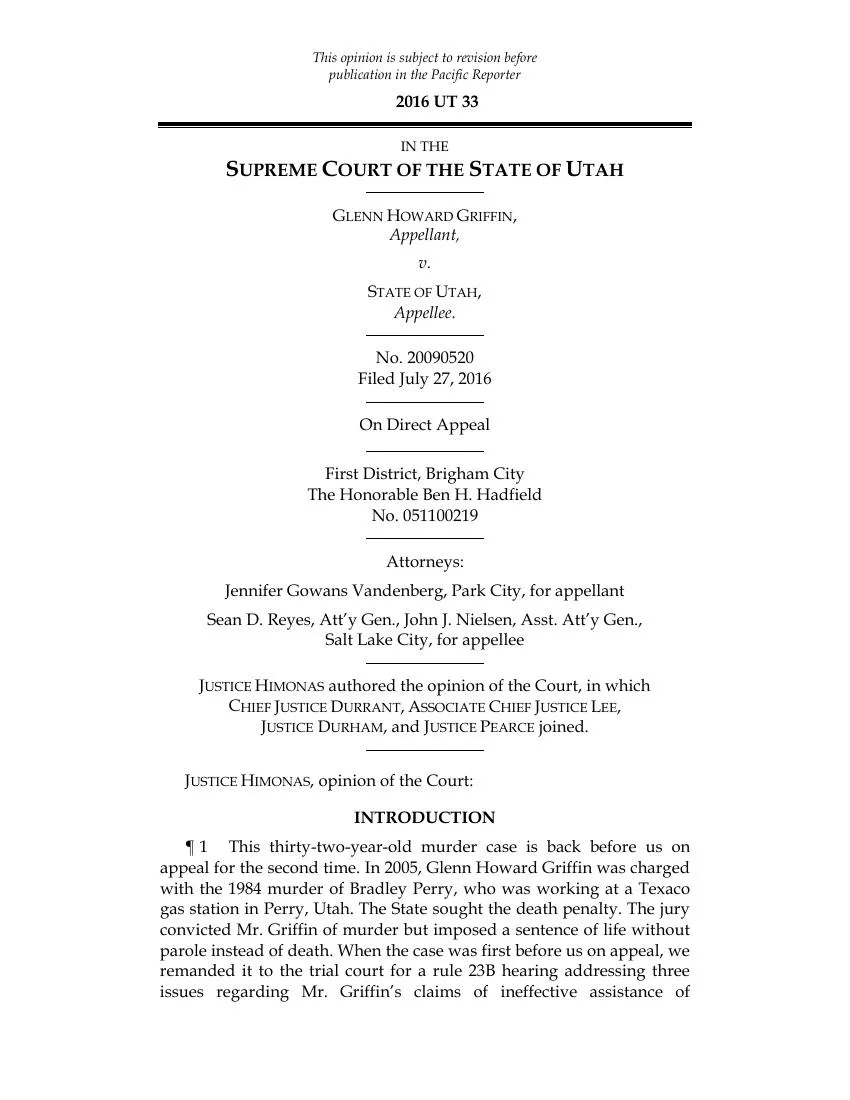
In 2005, the Utah State Crime Lab matched DNA from blood on the bill to Glenn Howard Griffin’s profile in a database. Hair testing followed. Griffin was charged, and a jury convicted him of murder. Although prosecutors sought death, the jury selected life without parole. His appeal challenged, among other things, whether the biological evidence should have reached that jury.[1]
The laboratory result needed a documented route
By trial, two officers involved in the original handling of the bills had died. The prosecution relied on more than recollection. Detective Alan Beard’s field notes documented receipt of the bills and their entry into evidence. A laboratory receipt documented Detective Bruce King’s delivery. Other witnesses authenticated the handwriting, and the analyst who received the material testified about that transfer.[1]
The lab cut out the portion containing the bloody mark. According to the findings recounted in the opinion, it kept that cutting continuously in an evidence freezer from 1984 through the 2005 DNA testing. The chain of custody therefore involved a preserved cutting, not a claim that an untouched whole bill simply emerged from storage twenty-one years later.[1]
Griffin argued that the early handling left gaps and that contamination had not been excluded. The trial judge found sufficient evidence that the tested blood was the blood the students had seen. Under the rule applied in this case, the State did not have to eliminate every imaginable alteration. The defense could still use weaknesses in the documented chain to challenge the evidence’s weight before the jury.[1]
Two kinds of DNA, two different descriptions
The blood and the hair should not be compressed into a single statement that DNA identified Griffin. The blood supplied a nuclear-DNA match. The mitochondrial-DNA analysis of hair did not identify him uniquely. The expert testified that 99.94 percent of the population could be excluded as a source, while Griffin could not. That percentage was an exclusion estimate, not the probability that he was guilty.[1]
The defense disputed the hair evidence’s reliability, statistical basis and handling. The Supreme Court upheld its admission while emphasizing that the jury had heard its limitations and the defense’s challenges. The opinion also distinguishes acknowledging a possibility of contamination from conceding that this evidence actually was contaminated. Neither side’s claim should be substituted for the finding the court made.[1]
The quiet work behind the breakthrough
The notes generated their own legal dispute because Beard could not be cross-examined. The Supreme Court treated these particular records as routine documentation of evidence handling, rather than accusations prepared against Griffin. It rejected the confrontation challenge and the related hearsay objection to using the notes for the preliminary admissibility decision. It did not say that every police statement is exempt from those rules.[1]
The Utah Supreme Court affirmed the conviction on July 27, 2016. Its evidence discussion gives the laboratory breakthrough a longer history: customers who preserved suspicious change, officers who recorded its receipt, and a lab that retained a cutting for later testing. The result depended on both an improved means of comparison and the ability to connect that comparison to the original case.[1]
Sources and references
Original analysis of the 2016 appellate record. Nuclear-DNA matching, mitochondrial-DNA exclusion and proof of sample handling are described separately.
- State v. Griffin, 2016 UT 33July 27, 2016 · Utah Supreme Court opinion
Court-issued PDF reproduced by Justia. Paragraphs 23-37 address blood evidence; paragraphs 38-59 address mitochondrial DNA. Later sections concern other appellate issues.
- Griffin v. State: later post-conviction appeal record2024 · BYU law-library catalog of an appellate brief
Documents a separate later appeal from dismissal of a post-conviction petition, No. 20210332. A party’s brief is not a court decision; no outcome is inferred from this catalog entry.
Later post-conviction filings are listed among the sources. This article examines the 2016 evidence ruling and does not claim that it ended all litigation or establish present custody status.