
Utah / The aftermath
Sherry Black’s legacy: the distance between a DNA lead and an arrest
A family-tree connection can give investigators a name to examine. It cannot, by itself, tell the whole story of a crime. The investigation of Sherry Black’s 2010 murder helped make that distinction a public issue in Utah. The legislation associated with her legacy addressed both the power of genetic genealogy and the work that must follow its leads.
Read the original court record ↓A case that outlasted its first DNA search
The Sherry Black Foundation’s case history describes a full DNA profile that produced no match in the criminal justice database in 2011. Investigators later used genetic genealogy, followed family connections and obtained a sample from a suspect for comparison. The sequence shows why a database search and an identification are separate steps. The family history supplied direction; the investigators still needed evidence tied to an individual.[3]
The Salt Lake County District Attorney reported that Adam Durborow received a sentence of life without parole on February 23, 2022, for Black’s murder. The foundation links the later “Sherry Black Bill” to her legacy. The legislature’s official history supplies the precise enactment dates: the governor signed Senate Bill 156 on March 23, 2023, and it took effect on May 3.[4][3][2]
A search with conditions attached
The enacted 2023 text defined qualifying investigations to include violent felonies and the identification of missing or unknown people. Its ordinary investigative route required a suitable forensic profile, an unsuccessful routine search of any eligible CODIS profiles, and consultation among police, the forensic bureau and prosecutors. It also required a commitment to continue investigating if genealogy produced useful information. Paying for a search was only one part of the process.[1]
That consultation requirement addresses a practical risk: a promising result could otherwise be treated as an endpoint. Genealogy identifies potential biological relationships. Investigators must work out whether the resulting lead fits the evidence and circumstances of the case. The statute made that follow-up obligation explicit instead of assuming the database would do the entire job.[1]
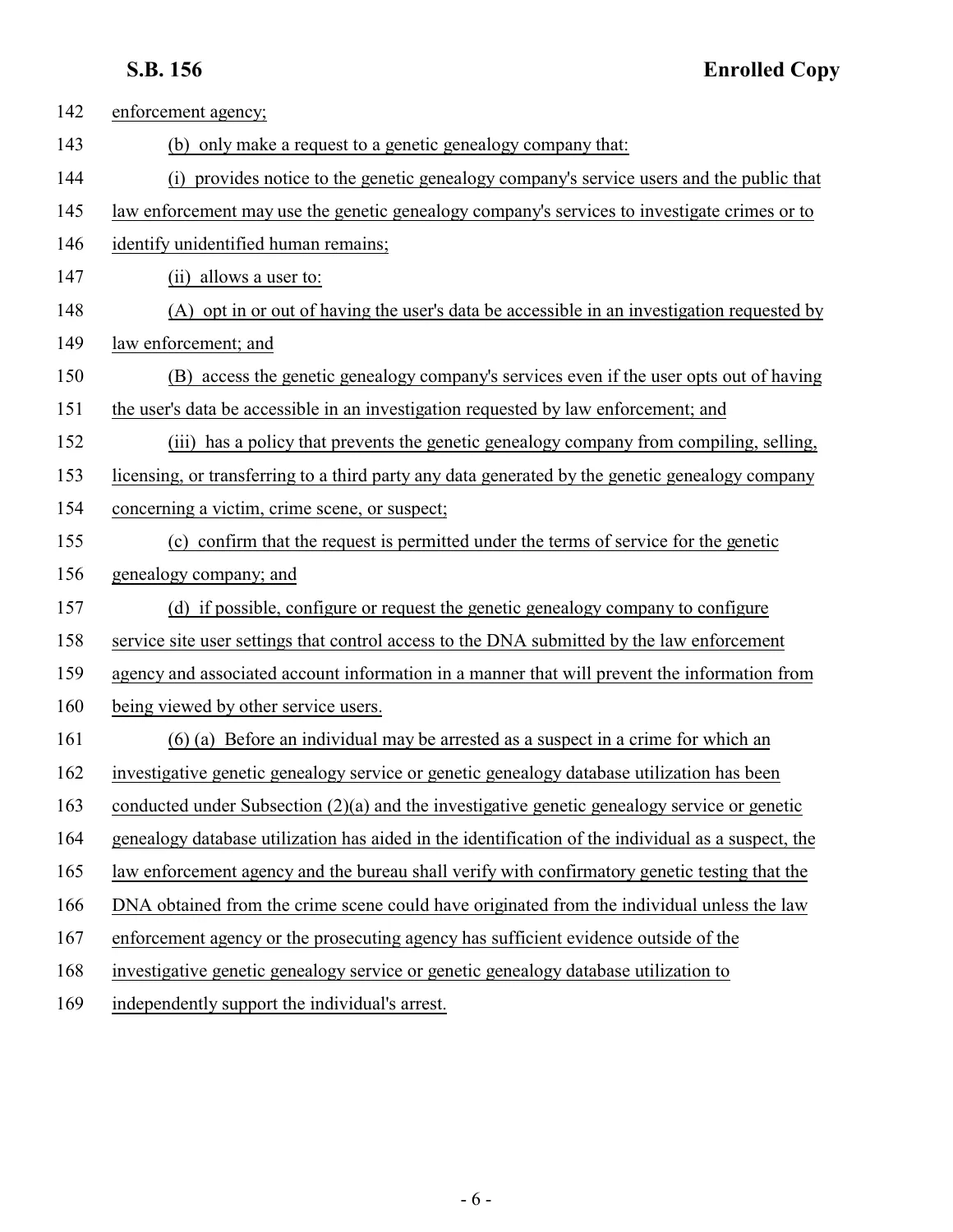
The relatives are not automatically suspects
The law separately addressed DNA from a person who was not a likely suspect. It required prosecutor consultation and either informed voluntary consent or, when seeking consent would compromise the investigation, authorization for covert collection. The latter still had to comply with law, including a warrant when necessary. This was a qualified process, not an unrestricted invitation to collect relatives’ DNA.[1]
The company supplying genealogy services also mattered. The 2023 provisions required notice of potential police use and allowed customers to choose whether investigators could access their information without losing the underlying service. Those protections concern people whose interest may have been family history. Their participation in a genealogy database did not make them participants in a criminal investigation by default.[1]
Confirmation and the surviving record
Before an arrest based on a genealogy-assisted identification, the law called for confirmatory genetic testing, unless sufficient evidence independent of the genealogy work supported the arrest. The exception matters as much as the rule. The statute did not declare DNA the only possible basis for arrest, and it did not equate a family-tree lead with a conclusive match.[1]
After a charge, the text addressed obtaining and retaining the relevant information for prosecution and later judicial proceedings, while requesting its removal from the company where applicable. Preservation and privacy therefore sat beside identification in the same law. This historical look at the 2023 enactment shows the broader legacy of Black’s case: an effort to make a powerful investigative tool usable, accountable and open to examination.[1]
Sources and references
Independently researched companion article, with paragraph-level references to the records examined.
- Utah Senate Bill 156, enrolled 2023 textSigned March 23, 2023 · Primary institutional record
Complete enacted bill; the article analyzes the historical 2023 provisions, not a current legal compliance guide.
- Utah Legislature: 2023 Senate Bill 156 status2023 legislative session · Primary institutional record
Enactment, effective date and session-law chapter.
- Sherry Black Foundation: Sherry’s CaseUndated case history · Primary institutional record
Family foundation’s investigation timeline and account of the law’s legacy. Official sources control sentencing and enactment dates.
- Salt Lake County: sentencing in the Sherry Black caseFebruary 23, 2022 · Primary institutional record
Contemporaneous prosecutor notice of the sentence.
This article addresses the specific historical record described here; it is not a complete account of every proceeding.