
Vermont / Fraud and accountability
After the Jay Peak fraud: what Vermont’s successful appeal actually decided
The Jay Peak fraud produced more than a criminal prosecution. It also threatened the Vermont Regional Center, the state-run organization through which investment projects participated in the EB-5 immigration program. A short federal decision from March 2021 captures a difficult question after a financial crime: how should officials weigh the wrongdoing against work being done to repair its consequences?
Read the original court record ↓A promise involving both money and immigration
The AnC Vermont project proposed a biotechnology facility in Newport. It sought $110 million from 220 immigrant investors. Under the program rules described in the criminal proceedings, each $500,000 investment needed to support ten jobs for an investor to qualify for permanent residence. Financial projections therefore concerned more than a possible return: the promised jobs were tied to immigration benefits.[3]
Approximately 169 investors supplied about $85 million, plus roughly $8 million in administrative fees, between 2012 and 2016. The facility was never built. The federal sentencing account describes two connected problems: misleading claims about jobs and revenue, and the diversion of money away from its stated purpose. Those are distinct from an honest business forecast that simply fails to come true.[2]
The regional center faced a separate decision
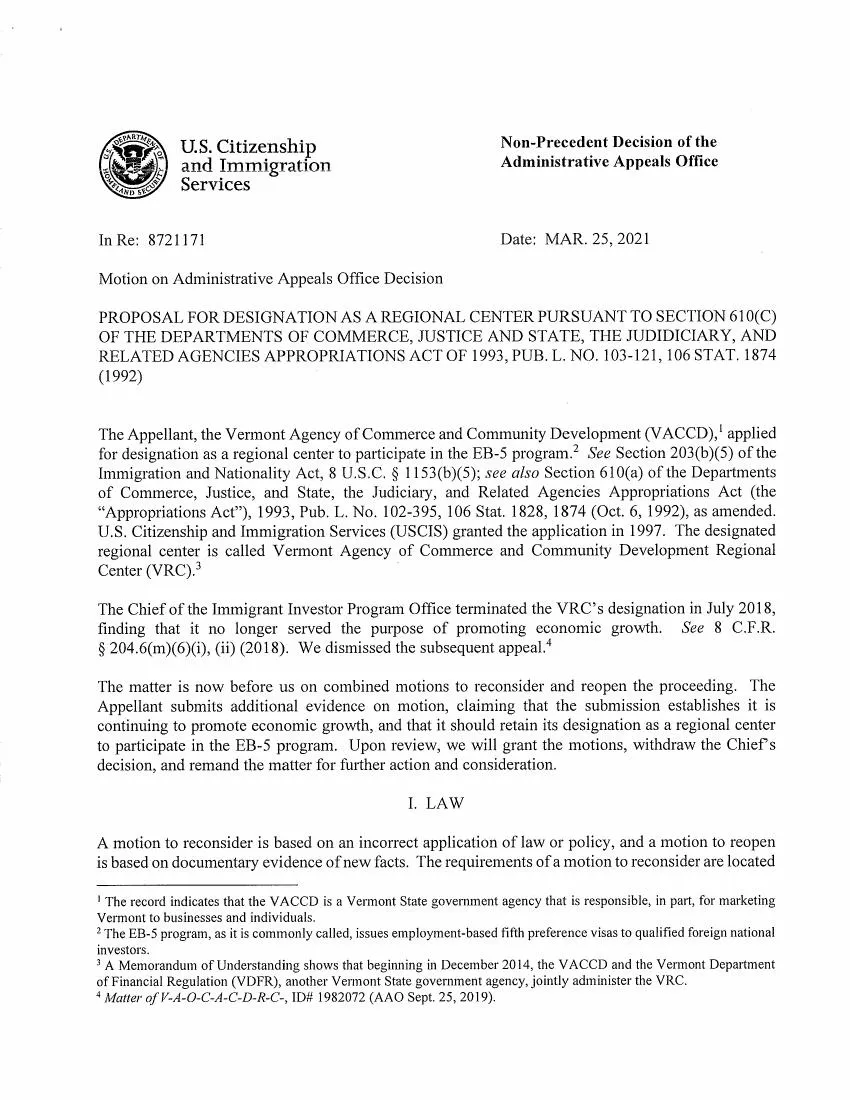
USCIS had designated the Vermont Regional Center in 1997. In July 2018, its Immigrant Investor Program Office terminated that designation, finding that the center no longer served the purpose of promoting economic growth. An administrative appeal failed. Vermont then asked the Administrative Appeals Office to reconsider and reopen the matter, supplying additional evidence.[1]
This was not an appeal from a criminal conviction. The applicant was the state agency responsible for the regional center, and the question concerned the center’s designation. The March 25, 2021 decision acknowledged the fraud and Quiros’s guilty plea. It also recorded that a court-appointed receiver had taken control of the affected businesses in April 2016.[1]
The governing assessment, as the appeals office described it, included both positive and negative factors. Investment, jobs and economic activity belonged on one side; mismanagement, theft, fraud and risks to investors belonged on the other. Corrective action also mattered. Treating the original fraud as serious did not remove the need to examine what had happened afterward.[1]
New evidence, rather than a clean bill of health
Vermont submitted material about projects outside Quiros’s control, including the Trapp Family Lodge brewery and restaurant and two Mount Snow projects. It also supplied information about continued operations and construction under the receiver at the affected resorts. These were submissions offered to support continued economic activity, not findings that every investor had recovered money or obtained immigration status.[1]
The appeals office concluded that the program chief had not had an opportunity to consider the new material. It withdrew the termination decision and sent the case back for another decision. The direction was to consider all relevant evidence, including whether failed oversight had been corrected and further investment and job creation had occurred.[1]
That result is called a remand. It required a fresh assessment; it did not pronounce the earlier conduct harmless. Nor did this non-precedent administrative decision determine the fate of every investor’s individual application. Reading its final order alongside its discussion of fraud keeps a procedural victory from becoming a much broader claim than the document supports.[1]
Accountability continued in the criminal case
The criminal proceedings had their own outcomes. In April 2022, Ariel Quiros received a sixty-month prison sentence after pleading guilty to wire-fraud conspiracy, money laundering and concealment. William Stenger received eighteen months after pleading guilty to knowingly submitting false documents. Their offenses should be named separately rather than collapsed into a claim that everyone was convicted on the same counts.[2][3]
Together, the records show why recovery and punishment are different tasks. A criminal sentence addresses established offenses. The regional-center proceeding examined whether an organization could still perform its economic role after fraud and corrective efforts. Neither document, standing alone, tells the full story of what the investors lost or ultimately recovered.[1]
Sources and references
Original analysis of a federal administrative decision and official accounts of criminal plea admissions and sentencing. Agency submissions, procedural orders and criminal convictions are identified separately.
- In Re: 8721171, Vermont Regional CenterMarch 25, 2021 · USCIS Administrative Appeals Office non-precedent decision
Federal administrative decision, not a criminal court judgment. The state-hosted copy contains a cover letter and the complete four-page decision.
- Ariel Quiros sentenced to 60 monthsApril 29, 2022 · U.S. Attorney’s Office sentencing announcement
Official account of the plea admissions and sentence, used with attribution rather than as a transcript of the hearing.
- William Stenger sentenced to 18 monthsApril 14, 2022 · U.S. Attorney’s Office sentencing announcement
Identifies Stenger’s false-document conviction and distinguishes his plea from broader sentencing facts.
This article explains the March 2021 remand and the specified April 2022 sentences. It does not report current custody, individual immigration outcomes or total recovery in the wider receivership.