Virginia / From the archive
How Hillsville became a picture story in 1912
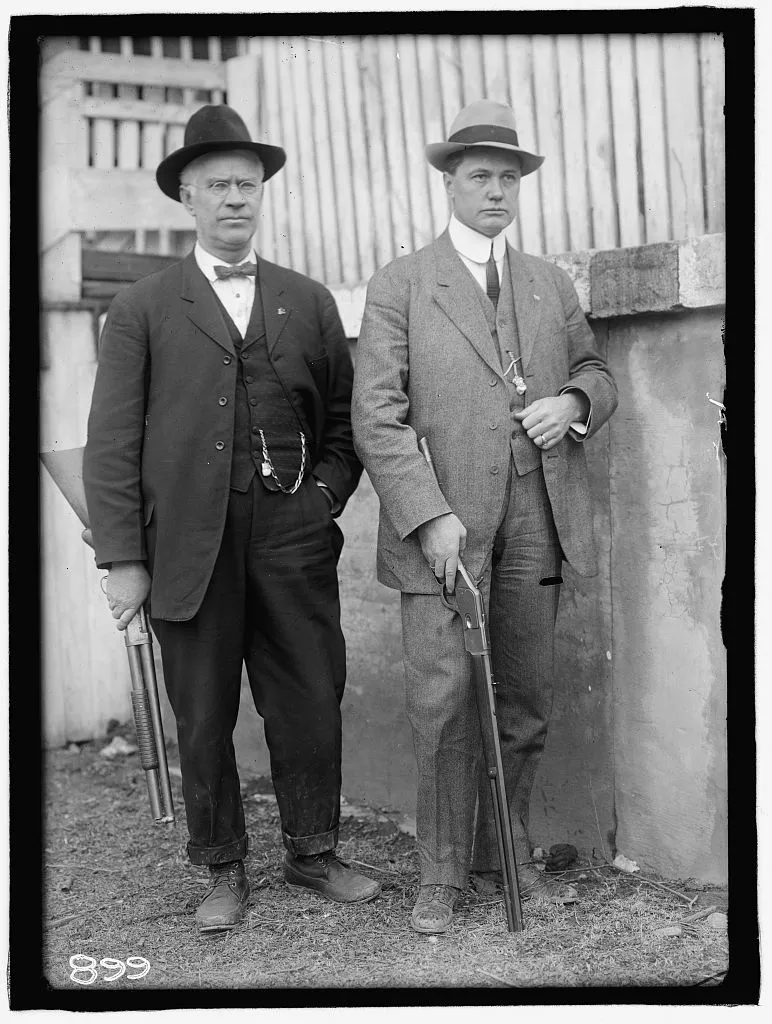
Two men stand outside in suits and hats, each holding a long gun. The photograph belongs to the visual record surrounding the Hillsville courthouse killings. What made it compelling in 1912 still makes it compelling now: an ordinary-looking portrait contains the unmistakable possibility of violence.
Read the original court record ↓A posed moment, not the shooting
The Harris & Ewing image preserved by the Library of Congress is strikingly still. Both men face the camera. A wooden fence and masonry wall form the background. Their clothes, the deliberate stance and the firearms occupy almost the entire frame. Nothing visible places a viewer inside a courtroom or shows a confrontation in progress.[1]
That distinction matters to this particular picture. Its catalog title begins with the word “Feud” and describes scenes at a Virginia mountain-town trial. The Library notes that the title comes from unverified caption information supplied with the negatives. The title is part of the photograph’s history, rather than an independently established identification of the men or their actions.[1]
The story already had a vocabulary
The courthouse violence occurred on March 14, 1912. Hillsville’s historic-district nomination records five deaths: the judge, sheriff, Commonwealth’s attorney, a juror and a spectator. It also records injuries and the subsequent murder convictions of Floyd Allen and his son Claude. Those consequences stand apart from the dramatic labels used to sell the story.[3]
The Library of Virginia’s newspaper survey shows how quickly a regional case became a national spectacle. Papers reached for the language of outlaws, moonshiners and mountain clans. The Chicago Day Book described the moment of violence in theatrical detail. Such accounts supplied readers with a ready-made setting and cast before they could examine the evidence behind particular assertions.[2]
What the surviving negative preserves
The photograph offers something different from the newspaper’s rushing narrative: surfaces that can be examined slowly. The man at left wears spectacles and a bow tie; the man at right wears a necktie and has a chain or fob across his waistcoat. Their guns are held down toward the ground. It is a portrait organized for the camera, not a sequence from which the first shot can be reconstructed.[1]
Even the number written at the bottom carries a trace of the archive’s work. The catalog says the negative number was changed from 897 to 899. It places the image among a group of Harris & Ewing negatives and dates the scene to 1912. That information helps locate the object without turning a broad historical association into a precise claim about who is pictured.[1]
A picture story with gaps
The archive’s note connects the group to photographs made between March and May 1912 and cites a contemporary Washington Post identification. It does not give the two men’s names in this item record. Calling them the killers, victims, detectives or jurors would therefore go beyond the evidence supplied with this image. The uncertainty belongs in the caption, where readers encounter the photograph first.[1]
Hillsville’s newspaper coverage and this surviving portrait reveal two parts of the same public encounter with the case. Words made the mountain setting ominous; photographs gave distant readers people and objects to look at. The image remains valuable without a guessed identity. It shows how the aftermath was presented to a camera, while leaving the courtroom’s disputed actions to other records.[1][2]
Sources and references
Independently researched companion article, with paragraph-level references to the records examined.
- Harris & Ewing photograph associated with the 1912 Hillsville proceedings1912; catalog notes updated later · Primary institutional record
Read the item’s unverified-caption warning and identification notes.
- Library of Virginia: “Hillsville Massacre” in the NewsMarch 26, 2012 · Primary institutional record
Newspaper excerpts and images, with cataloger’s analysis.
- Hillsville Historic District nominationJune 5, 2001 · Primary institutional record
Section 8, page 15, gives the courthouse-shooting summary.
This article addresses the specific historical record described here; it is not a complete account of every proceeding.