
Virginia / Courts and public attention
Yeardley Love’s case: why the sentencing was not televised
By the time George Huguely faced sentencing for murdering Yeardley Love, their case had already received extensive publicity. A Charlottesville television station wanted viewers to see that final stage of the trial. The judge refused. The station’s appeal produced a decision about how a court can remain a subject of public reporting without becoming a televised event.
Read the original court record ↓The request came after the verdict
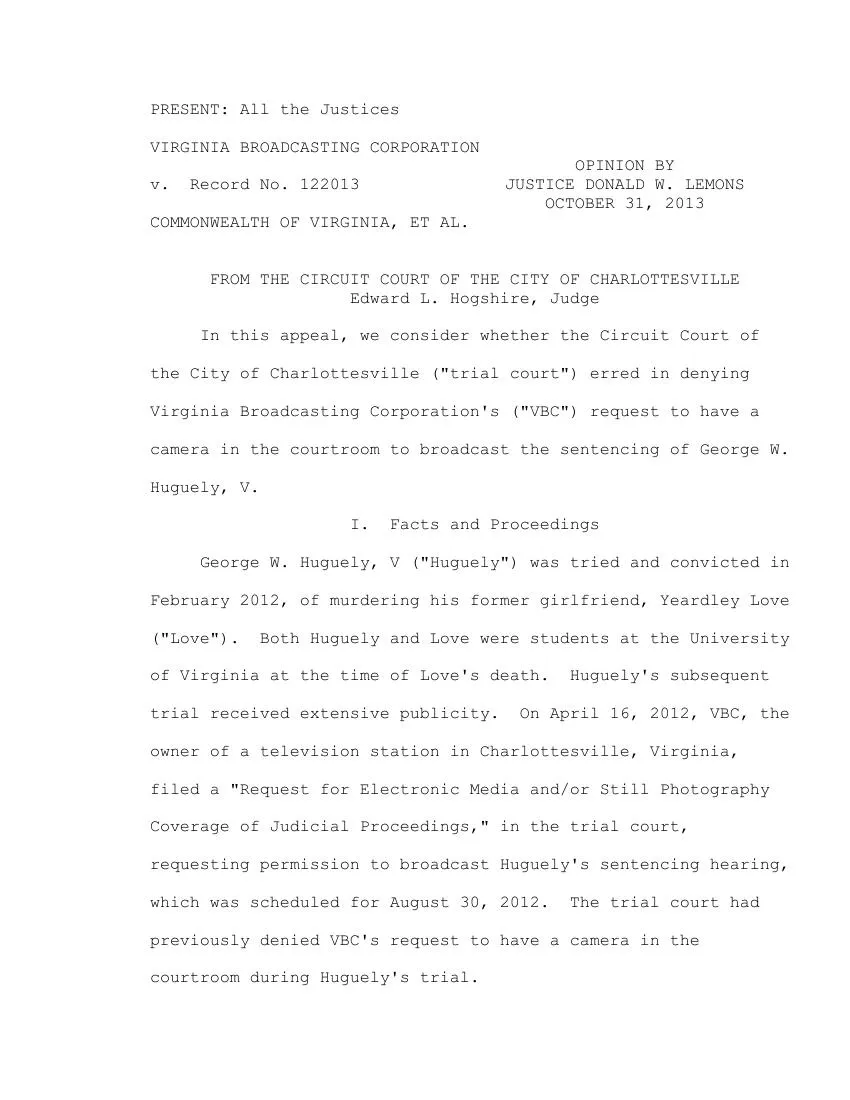
Huguely and Love were University of Virginia students when she died. After his February 2012 murder conviction, Virginia Broadcasting Corporation requested permission to broadcast the sentencing scheduled for August 30. The judge had previously refused cameras during the trial. The station argued that sentencing changed the circumstances because the jury had already decided guilt.[1]
Both the prosecution and the defense opposed the request. They raised concerns about the effect of broadcasting on witnesses. The judge also considered the possible effect on witnesses and jurors in a separate civil lawsuit brought by Love’s family. The station answered that concerns and predictions were not evidence showing that cameras would cause prejudice.[1]
This disagreement should not be mistaken for a dispute over whether the murder conviction was valid. The broadcaster was challenging restrictions on its reporting equipment. The resulting appeal placed the television station, rather than Huguely’s criminal defense, at the center of the legal question.[1]
Two phrases in the same statute
The Virginia statute gave a court discretion to permit photographs and broadcasting. It also contained guidelines allowing a judge to prohibit or restrict coverage for good cause. The station argued that the latter requirement governed the refusal of its request. The Supreme Court of Virginia acknowledged that the statute’s two formulations created a real interpretive problem.[1]
The court looked at how the law developed. Before 1987, Virginia generally prohibited courtroom cameras. An experimental program then allowed coverage in six courts, subject to guidelines. In 1992, the legislature expanded the power to allow cameras while retaining those guidelines. That sequence became central to the court’s reading of the statute.[1]
The court distinguished the initial decision to admit a camera from a later decision to restrict coverage already allowed. Under its interpretation, the good-cause requirement applied to the second situation. Here, the judge had never granted permission. The court therefore rejected the station’s argument that opponents first had to prove good cause for excluding cameras.[1]
Discretion still had limits
The Commonwealth made a broader argument: because the statute assigned the decision solely to the trial judge, no appellate review was available. The Supreme Court rejected that position. It compared other statutes that expressly removed judicial review and found no such language here. The judge’s decision remained reviewable, although under a highly deferential standard.[1]
Applying that standard, the court accepted the judge’s consideration of intense publicity, young witnesses and the pending civil action. It held that these reasons did not amount to an abuse of discretion. This was a ruling about the decision made on that record, not a finding that every witness had actually been deterred from testifying.[1]
Why hear an appeal after the hearing was over?
By the time of appellate review, the sentencing had already happened without a television broadcast. Ordinarily, a court avoids deciding a dispute that is no longer live. Here, the station was likely to seek cameras in future cases, while short proceedings could finish before an appeal was heard. The court treated that recurring timing problem as a reason to decide the issue.[1]
On October 31, 2013, it affirmed the refusal of the camera request. The opinion also recorded the broadcaster’s concession that there was no constitutional right to a courtroom camera. The decision leaves a useful distinction for readers following a publicized crime: access to accounts of a hearing and permission to broadcast it are different questions. A missing video is not evidence that no hearing occurred.[1]
Sources and references
Original analysis of the official judicial opinion. Positions advanced by the broadcaster, prosecution and defense are distinguished from the court’s holdings.
- Virginia Broadcasting Corporation v. Commonwealth, Record No. 122013October 31, 2013 · Supreme Court of Virginia opinion
Complete official opinion about the broadcaster’s camera request. It does not decide the merits of Huguely’s criminal appeal.
This is an account of a 2013 ruling under the statute then before the court, not current instructions for recording a hearing or a summary of later criminal and civil litigation.