
Washington / Evidence and investigation
Amanda Stavik: the discarded cup and the question behind the DNA match
Amanda Stavik disappeared while running near her Whatcom County home in November 1989. Years later, a plastic cup and a soda can helped connect Timothy Bass to biological evidence preserved from her case. The laboratory match was important, but the legal dispute began earlier in the chain: who decided to collect those discarded objects, and whose instructions was that person following?
Read the original court record ↓Evidence waiting for a comparison
Stavik was eighteen and home from Central Washington University for Thanksgiving. She went running with the family dog on November 24; the dog returned without her. Her body was found in the Nooksack River three days later. The medical examiner preserved biological samples, and the crime laboratory developed a male DNA profile from semen.[1]
Detective Kevin Bowhay reopened the investigation in 2009. His team collected more than eighty comparison samples during the renewed inquiry. The later appeal recounts a lengthy search for useful evidence, not a database that automatically supplied Bass’s name. Investigators eventually sought material that could be compared with the profile already held by the laboratory.[1]
What the bakery employee did
Bass worked as a delivery driver for Franz Bakery. Bowhay initially approached outlet manager Kim Wagner about obtaining permission to swab company trucks. She referred him to the corporate office, which refused permission. Later, the detective asked Wagner about Bass’s delivery route and confirmed that the inquiry concerned Stavik’s murder.[1]
After surveillance failed to yield discarded items, Wagner offered to watch for things Bass threw away at work. The detective said he was not asking her to do anything for him. In August 2017, she collected a cup and, two days later, a soda can from the break-room trash after seeing Bass use them. The lab matched the DNA to the preserved case sample.[1]
The defense argued that this was effectively a police search. Wagner knew what investigators wanted, had spoken with the detective and gave the objects to him. Those contacts were not disputed away. Their significance was the question the judges had to answer before treating the evidence as the product of a private person’s actions.[1]
Contact with police was not the entire test
The court explained that constitutional search protections addressed government action. A private citizen could nevertheless become a government agent if the State instigated, encouraged, directed or controlled the search. The question therefore turned on the actual relationship and conduct, not simply whether Wagner wanted to help solve a crime.[1]
At the suppression hearing, both Wagner and Bowhay testified. The trial judge found that she conceived the workplace collection and that the detective had not directed her to take particular items or told her how to package them. The appeals court found substantial evidence supporting those findings. It did not conduct a new credibility hearing with the witnesses.[1]
Bass warned that police could evade restrictions by conveying what they wanted while formally declining to give instructions. The court considered that argument but upheld the findings on this record. Its reasoning depended on what the witnesses described and the trial judge accepted, rather than a blanket rule that every search becomes private when an officer uses a disclaimer.[1]
The DNA ruling was one part of the appeal
A jury convicted Bass of first-degree felony murder in 2019, and the court imposed 320 months of imprisonment. The DNA ruling allowed the jury to consider the comparison; it did not replace the prosecution’s burden to prove the underlying crime. Bass separately challenged whether the remaining evidence established kidnapping or rape and a death connected to those offenses.[1]
The appeals court affirmed the conviction in its 2021 substituted opinion. It identified a separate error involving the version of the felony-murder statute used at trial, but found that error harmless beyond a reasonable doubt. The cup-and-can dispute illustrates why an evidence story needs more than the word match: collection, state involvement, admissibility and proof at trial each required their own examination.[1]
Sources and references
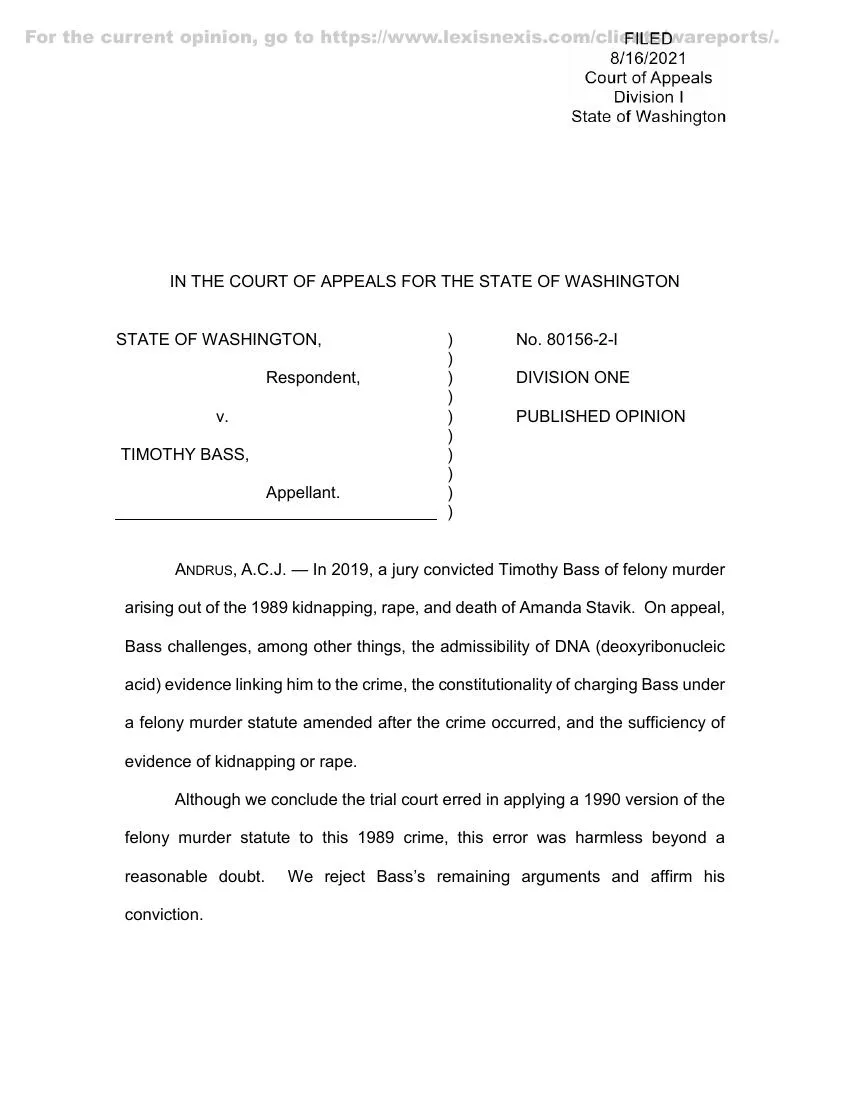
Original analysis of the court-hosted substituted opinion. The DNA result, testimony about collection and judicial findings are identified as different parts of the record.
- State v. Bass, No. 80156-2-I, substituted opinionAugust 16, 2021 · Washington Court of Appeals court-hosted slip opinion
Includes the court’s notice that the slip text was subsequently revised for the official reports. The first PDF page is that notice; the 43-page opinion follows. This replaces the earlier June and August 2 versions.
This article explains the 2021 evidence ruling. It is not a current guide to collecting someone’s DNA and does not claim to cover every later proceeding.