
Washington / How the investigation worked
Whatcom Creek: the computer record that slowed to a crawl
The most revealing entry in a record can be the one that arrives late. After the June 10, 1999 pipeline rupture in Bellingham, federal investigators examined how often a control system had collected new readings. Its changing rhythm helped reconstruct the loss of control over a pipeline carrying gasoline beneath a city park.
Read the original court record ↓A disaster with several causes
Olympic Pipe Line Company’s pipeline released about 237,000 gallons into a creek flowing through Whatcom Falls Park. The gasoline later ignited. Two ten-year-old boys and an eighteen-year-old young man died. The National Transportation Safety Board’s investigation reached well beyond the final rupture: it examined earlier excavation damage, inspection decisions, valves and the computerized system through which controllers operated the line.[1]
The system gathered field readings and allowed commands to pumps and valves. During the critical period it became slow and then unresponsive. That did not make a computer failure the sole explanation for the disaster. The NTSB found that the pipe had already been weakened and that opportunities to identify or repair damage had been missed. The control problem mattered within that larger chain.[1]
Reading the spaces between measurements
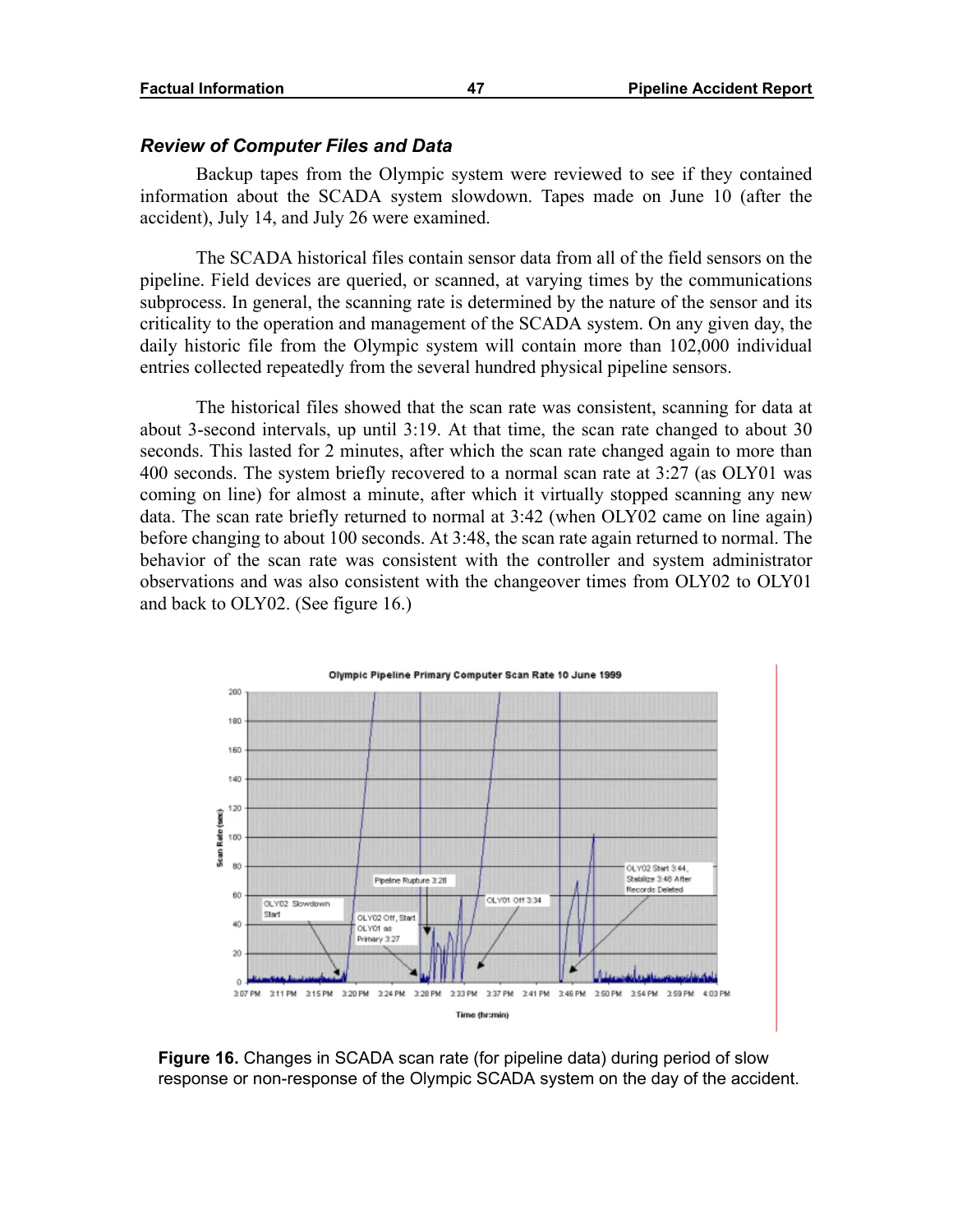
Investigators examined backup tapes. The historical files recorded readings from hundreds of sensors, so the interval between updates provided a way to check how the system was functioning. At first, readings arrived at roughly three-second intervals. At about 3:19 p.m., that interval grew to about thirty seconds, then to more than four hundred seconds. Around the time of the rupture, the system virtually stopped gathering new data.[1]
That pattern could be compared with reported computer changeovers and the observations of employees. It offered a different kind of evidence from a witness remembering a frozen display. The surviving record showed a measurable loss of fresh information. The report’s chart is especially useful because it makes the interruption visible without pretending that every missing instant can be recovered.[1]
A likely cause and an unresolved mechanism
Shortly before the trouble, database records had been added while the operating system was live. Performance improved after those records were removed. The board concluded that the development work likely caused the degraded performance. But investigators and software specialists could not reproduce the slowdown by introducing known errors. The exact database fault remained unknown. A probable explanation for the sequence was not a successfully repeated experiment.[1]
The investigation also found missing administrative computer files. Those were not the files containing pipeline readings, and their absence did not cause the control-system failure. All authorized operators had used the same login, limiting the ability to attribute actions to individuals. The report identified weak security but found no evidence that an unauthorized intruder caused the slowdown. Those distinctions prevent an incomplete archive from becoming an invented sabotage story.[1]
What prevention could still learn
The board recommended testing database changes on a separate workstation before introducing them into the live system. It also addressed the testing of safety valves. These were recommendations from a safety investigation, not criminal verdicts. Separate proceedings produced guilty pleas and, in June 2003, prison sentences for two former managers and probation for a control operator, as the Department of Transportation’s inspector general reported.[1][2]
The Bellingham record demonstrates why a useful investigation preserves uncertainty. It could show when control deteriorated, identify a likely trigger and recommend a safer working practice without discovering the precise software fault. The strongest account keeps those levels of confidence separate. Otherwise a clear chart can seem to promise more than the evidence behind it can deliver.[1]
Sources and references
Independently researched companion article, with paragraph-level references to the records examined.
- NTSB/PAR-02/02: Pipeline Rupture and Subsequent Fire in BellinghamOctober 8, 2002 · Primary institutional record
Complete 88-page original report.
- DOT Inspector General: Olympic Pipeline sentencingJune 19, 2003 · Primary institutional record
Separate criminal outcome; not an NTSB judgment.
This article addresses the specific historical record described here; it is not a complete account of every proceeding.