
West Virginia / Institutions and accountability
The Clarksburg VA murders: how warning signs failed to become a pattern
A criminal prosecution can identify the person responsible while leaving another urgent question unanswered: why was the harm not stopped earlier? At the Louis A. Johnson VA Medical Center in Clarksburg, that question produced a separate healthcare inspection. Its findings show how information can exist in patient charts, conversations and supply records without reaching the people who could connect it.
Read the original court record ↓Two investigations with different purposes
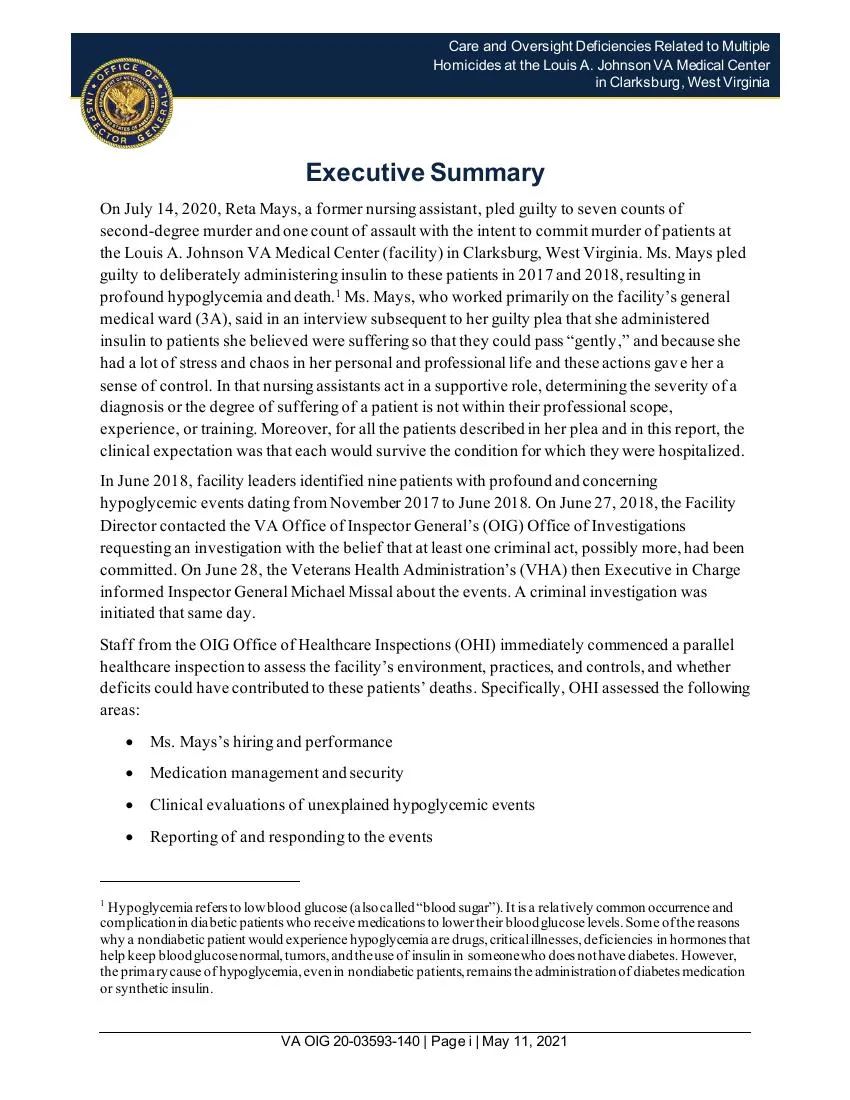
Former nursing assistant Reta Mays pleaded guilty in July 2020 to seven counts of second-degree murder and one count of assault with intent to commit murder. On May 11, 2021, she received seven consecutive life sentences and an additional twenty years. The charges concerned eight veterans; the eighth count was not another murder conviction.[2]
The VA Office of Inspector General described deliberate insulin administration in 2017 and 2018. It also rejected an easy assumption about the patients’ illnesses: the clinical expectation was that each would survive the condition for which he had been hospitalized. The healthcare review examined failures that delayed recognition of Mays’s conduct, while the prosecution addressed her criminal responsibility.[1]
Facility leaders reported suspicious events to investigators in June 2018. Healthcare inspectors began a parallel review, later paused to protect the criminal investigation, and resumed after the guilty plea. Their work included interviews, medical records and hospital policies. The published report is an inspection finding, not a jury verdict against everyone who worked on the ward.[1]
Signals that stayed in separate places
Most hospitalists told inspectors they had encountered only one or two of the affected patients. They therefore did not appreciate the significance of the cases together. Daily interdisciplinary rounds generally concentrated on length of stay and discharge planning, rather than patient outcomes and unusual events. Informal conversations did not consistently carry concerns through the hospital’s reporting structure.[1]
One overlooked signal appeared in medication supplies. Inspectors found that the pharmacy’s informal inventory process did not identify an extraordinary use of a rescue medication used during the patients’ emergencies. The report treated that as a missed opportunity to investigate. A supply record could have helped reveal a clinical pattern if someone had been responsible for reviewing it.[1]
The review also found missing or inadequate clinical documentation and a lack of patient-safety reports. Staff were not consistently clear about which events to report or how. These findings describe failures to communicate and examine concerns; they do not establish that staff other than Mays knowingly participated in her crimes.[1]
A pattern was not the same as proof
The inspectors were careful about hindsight. They did not label the first patient’s episodes in one spring 2018 cluster a missed reporting opportunity, because clinicians could then have viewed them as isolated effects of illness. Their concern grew with subsequent unexplained cases and the opportunities those cases created to compare information and escalate review.[1]
Likewise, the report did not equate a rise in mortality with murder. It said unusual mortality patterns could warrant examination, while recognizing that they did not automatically establish poor care or unlawful activity. The failure was the absence of further review, not the absence of an immediate criminal accusation based on a chart.[1]
What accountability required beyond a sentence
The inspector general issued fifteen recommendations spanning national VA leadership, the regional network and the facility. They addressed matters including background-check follow-up, medication accountability, communication, documentation, mortality review and patient-safety reporting. The breadth of those recommendations reflects how many separate safeguards had to function for warning signs to receive attention.[1]
The OIG’s report page records closure on July 6, 2022. That follow-up status belongs alongside the original findings; it should not be omitted to imply that no corrective work occurred. It also does not undo the deaths. The enduring lesson of this record is specific: collecting information was not enough when responsibility for comparing it, reporting concerns and following through remained fragmented.[3][1]
Sources and references
Original analysis of a federal healthcare inspection, paired with the official sentencing account. Clinical details are limited to what is needed to explain the reporting failures.
- Care and Oversight Deficiencies Related to Multiple Homicides at the Louis A. Johnson VA Medical CenterMay 11, 2021 · VA Office of Inspector General healthcare inspection, Report 20-03593-140
Complete public report, including appendices and agency responses. The article focuses on the executive summary; numbered patients remain unidentified here.
- Reta Mays sentenced to seven consecutive life sentencesMay 11, 2021 · U.S. Attorney’s Office sentencing announcement
Identifies seven murder counts, one assault-with-intent-to-murder count, and the imposed sentences.
- OIG report information and recommendation follow-upClosure recorded July 6, 2022 · VA Office of Inspector General report catalog
Public tracking page records the report’s closure date and individual recommendation status.
The article reports historical findings and the OIG’s recorded closure date. It does not assess current care at the hospital or attribute additional crimes to staff or patients outside the convictions.