
West Virginia / Places and memory
Two towns in the story of Matewan
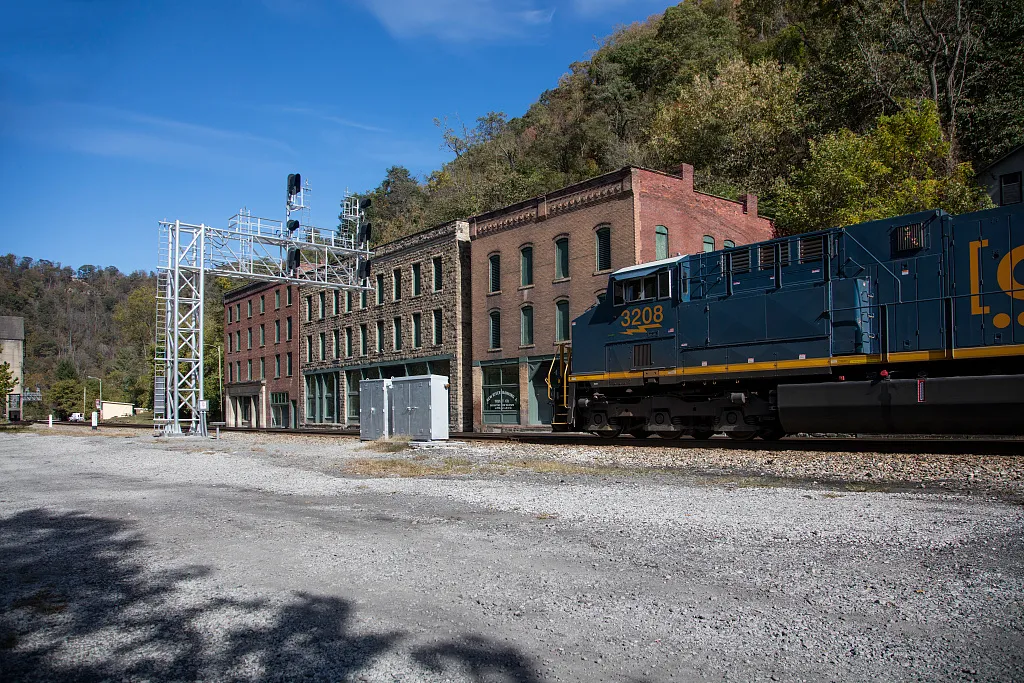
A train passes a row of brick storefronts beneath a wooded hillside. The photograph looks like an invitation into the world of Matewan. It was actually made in Thurmond in 2015, decades after that town served as a location for John Sayles’ film. Keeping the two places distinct makes both more interesting.
Read the original court record ↓The town beside the tracks
The historic-landmark nomination describes the real Matewan on a narrow floodplain beside the Tug Fork and Mate Creek. Steep hills limited its room to grow. The railroad helped organize the commercial district: several buildings presented substantial storefronts both toward Mate Street and toward the tracks. The railway side was a public face of the town, not simply a service alley.[1]
That arrangement gives physical context to May 19, 1920. Baldwin-Felts agents had come to evict miners from company housing during a union drive. The nomination places the confrontation near the railroad as the agents prepared to leave. Police chief Sid Hatfield, townspeople and the agents were operating in a cramped commercial center where homes, business and industrial power were close together.[1]
A setting is not a verdict
Ten people died: seven agents, two miners and Mayor Testerman. The nomination discusses competing accounts of the first shot. A street plan can clarify where groups gathered and why the depot mattered, but it cannot settle that disagreement. Buildings provide context for testimony; they do not speak as eyewitnesses. The survey also records the 1921 acquittal of Hatfield and other defendants, a legal outcome distinct from arguments about who fired first.[1]
Nor did the town stand still after 1920. The survey records floods, a later floodwall and the loss of important buildings. The hotel used by the agents burned in 1992. The hardware-store building associated with the confrontation was also gone when the survey was prepared. Its descriptions distinguish surviving fabric from remembered sites rather than presenting the whole district as an untouched scene.[1]
The other West Virginia town
Carol M. Highsmith’s photograph belongs to a separate place history. Its Library of Congress record identifies Thurmond and dates the image to October 20, 2015. The catalog explains that the town retained characteristics of a 1920s coal town and became a location for the 1987 film Matewan. The photograph documents that later setting; it is neither a movie still nor an image of the 1920 shooting site.[2]
The distinction is useful when a compelling image travels without its caption. A viewer may recognize the film’s industrial landscape and mentally place its buildings in Matewan. Naming Thurmond keeps the photograph accurate while opening another question: how does a surviving town become the means of imagining a different town’s past?[2]
Preserving history and its retelling
The Library of Congress selected Matewan for the National Film Registry in 2023. Its description calls the film a dramatization and notes that Sayles drew elements from related labor struggles into the story. That is an explicit warning against treating every scene or character as a literal reconstruction of a single day. The registry preserves an important cultural work; it does not certify its script as sworn testimony.[3]
Read together, the sources offer three different encounters with the same history: Matewan’s documented streets, Thurmond’s use as a filming location and the film’s later recognition. The surviving places can deepen the story precisely because they are not interchangeable. One anchors the confrontation in its physical setting; the other helps explain how that confrontation entered popular memory.[1][2][3]
Sources and references
Independently researched companion article, with paragraph-level references to the records examined.
- Matewan Historic District: National Historic Landmark nomination1996 · Primary institutional record
Description and significance, especially PDF pages 4-6 and 10-17.
- Carol M. Highsmith: train and storefronts at ThurmondOctober 20, 2015 · Primary institutional record
Item notes identify Thurmond as a filming location.
- Library of Congress: 2023 National Film Registry selectionsDecember 13, 2023 · Primary institutional record
Read the Matewan (1987) entry.
This article addresses the specific historical record described here; it is not a complete account of every proceeding.