
Wisconsin / Evidence and the courtroom
Julie Jensen’s letter: why the warning and the evidence were different questions
Before Julie Jensen died in 1998, she left a letter with a neighbor to be given to police if something happened to her. She also left voicemails for a Pleasant Prairie officer. Her warnings became part of the investigation into her death. Whether a jury could hear those statements was a different question, one that eventually brought the case back before Wisconsin’s Supreme Court.
Read the original court record ↓A warning intended to reach police
The court’s account describes statements directing suspicion toward Julie’s husband, Mark Jensen. He was charged with first-degree intentional homicide in 2002. During the ensuing litigation, judges had to decide whether the letter and voicemails were testimonial: statements serving the purpose of establishing evidence for a prosecution. That classification mattered because Julie could no longer be questioned about them.[1]
Under the constitutional rule applied in this case, testimonial statements from an unavailable witness required a prior opportunity for cross-examination. Jensen had no such opportunity. Calling the statements testimonial did not mean that the judges had found Julie dishonest. The ruling concerned the procedure for using her statements against an accused person at trial.[1]
Why the first conviction did not end the dispute
In 2007, Wisconsin’s Supreme Court classified the statements as testimonial but returned the case for consideration of a separate exception. The trial court then admitted them under the version of forfeiture by wrongdoing applied at the time: a defendant who caused a witness’s absence could lose the right to object. The first jury convicted Jensen.[1]
The United States Supreme Court subsequently clarified that exception in a different case. Causing a witness’s absence was not enough; the defendant must have acted with the specific intent to prevent testimony. Later federal proceedings found that admitting Julie’s statements had harmed Jensen’s trial rights and ordered his conviction vacated. Those rulings addressed the trial’s fairness, rather than declaring him innocent.[1]
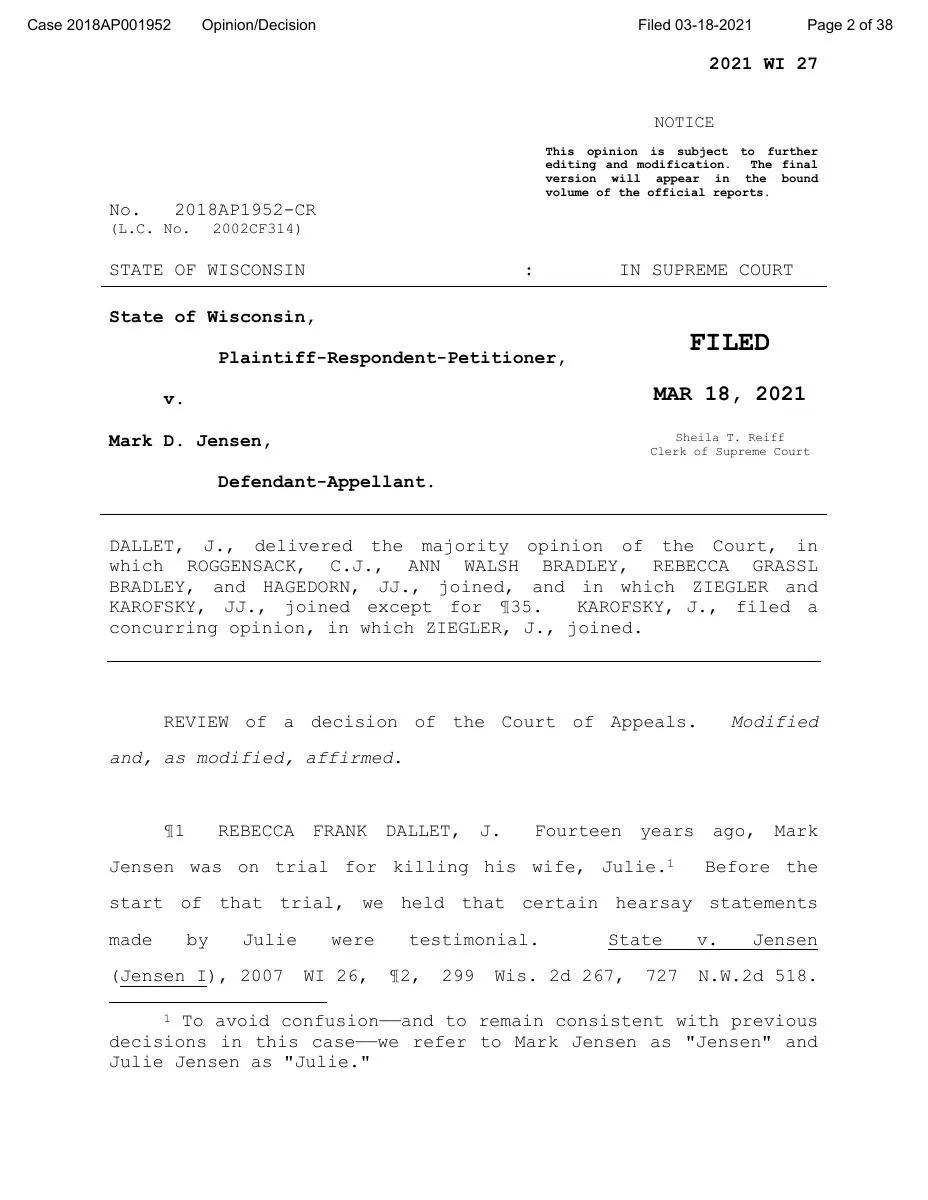
When the prosecution began again, the State argued that newer decisions had changed the meaning of testimonial evidence. The circuit court agreed, declared the statements admissible and reinstated the original conviction without another trial. That sequence produced the dispute resolved in the March 18, 2021 opinion.[1]
New decisions did not erase the earlier ruling
The Supreme Court approached the issue through the law of the case: an appellate ruling normally continues to govern later proceedings in the same prosecution. There can be exceptions, including a contrary decision from a controlling court. The question was therefore more precise than whether judges had discussed similar evidence since 2007. Had the governing rule actually changed?[1]
The court concluded that the newer decisions refined the existing inquiry rather than contradicted it. Statements made to resolve an emergency and statements intended to supply evidence for prosecution could receive different treatment. Context remained essential. But the later cases did not permit the circuit court to discard the earlier classification of Julie’s particular letter and voicemails.[1]
Agreement on the result, disagreement about the context
Justice Jill Karofsky, joined by Justice Annette Ziegler, agreed that the earlier ruling controlled. Her concurrence nevertheless criticized the original analysis for failing to confront the domestic-abuse setting in which Julie spoke. She argued that Julie’s fear for her life and concern for her sons deserved attention when evaluating the purpose of her words.[1]
The concurrence did not make the statements admissible. It showed that judges could agree about the legal result while disagreeing about how the record had been understood. Reading it alongside the majority prevents a misleading shorthand: the case was not simply a court dismissing a woman’s warning as unimportant.[1]
The prosecution continued. Wisconsin Public Radio reported that a second jury convicted Jensen in February 2023 without hearing the letter or voicemails. WGTD reported a life sentence without parole that April. The evidentiary ruling changed the trial; it did not end the case.[2][3]
Sources and references
Original analysis of the Wisconsin Supreme Court’s opinion. Later verdict and sentencing information is separately attributed to contemporaneous local reporting.
- State v. Jensen, 2021 WI 27March 18, 2021 · Wisconsin Supreme Court opinion and concurrence
Complete court-issued PDF, including the majority opinion, separate concurrence and original court pagination.
- Second jury finds Mark Jensen guiltyFebruary 1, 2023 · Wisconsin Public Radio contemporaneous reporting
Used only for the later verdict and confirmation that the second jury did not hear the letter or voicemails.
- Mark Jensen resentencedApril 14, 2023 · WGTD contemporaneous reporting
The first item reports the sentence imposed following the second trial.
This article explains the 2021 ruling and notes the 2023 retrial outcome. It does not claim to summarize every subsequent filing or offer advice on admitting evidence.