Wyoming / Inside the court record
Marcella Yellowbear: four theories of guilt, one murder conviction
Marcella Hope Yellowbear was twenty-two months old when she died in Riverton in July 2004. The prosecution of her father, Andrew John Yellowbear Jr., eventually produced a verdict form with four findings of guilt. Yet Wyoming’s Supreme Court directed that the judgment show only one murder conviction. Understanding that apparent contradiction requires following the paperwork as carefully as the outcome.
Read the original court record ↓One child, one original charge
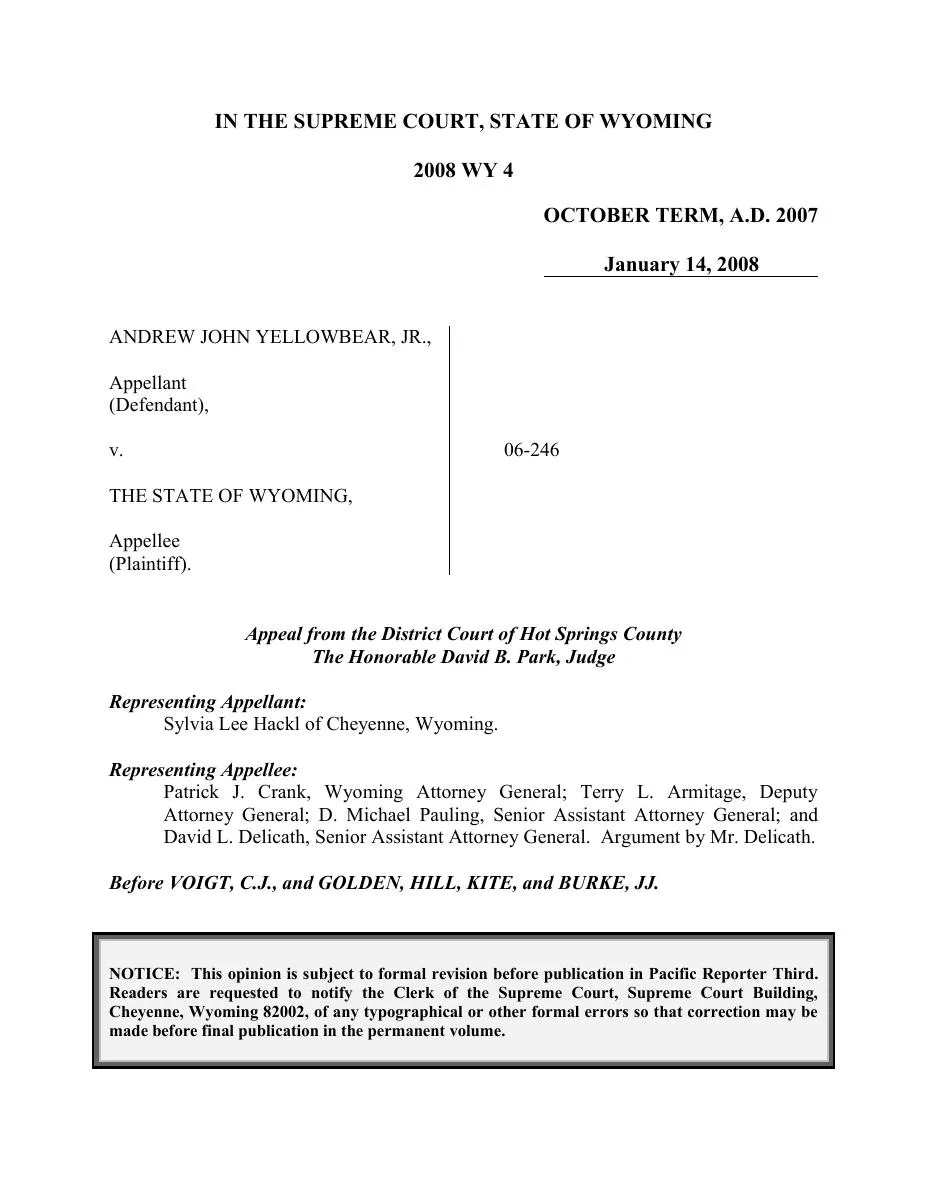
The medical examination determined that Marcella’s death resulted from abuse. Both parents were charged, and her mother, Macalia Blackburn, later pleaded guilty to an amended accessory charge and agreed to testify. Yellowbear received a sentence of life without parole after his trial. The appeal examined how his single original murder charge had become a judgment that appeared to record four crimes.[1]
The original charge alleged felony murder during child abuse. Yellowbear had a preliminary hearing on that charge and was sent to district court for trial. That starting point mattered: the Supreme Court later emphasized that he had been given a hearing, arraigned and entered a plea on one crime, not four.[1]
A request for clarity changed the paperwork
The defense repeatedly asked the prosecution to identify more precisely what Yellowbear was alleged to have done. Child abuse could be charged in different ways, and the defense argued that a broad accusation did not provide enough notice to prepare a response. The trial court eventually ordered an amended charging document, proposed instructions and a verdict form identifying the alternative theories.[1]
The resulting document separated those theories into four apparent crimes. Two treated Yellowbear as the person who caused the death through intentional or reckless physical abuse. Two treated him as an accessory who aided Blackburn in intentional or reckless abuse. The State insisted that it had not introduced new crimes, only different routes to proving the original one.[1]
The distinction carried consequences beyond word choice. A theory explains how the prosecution says a charged crime was committed. Listing several theories does not automatically create several properly charged offenses. In this case, the Supreme Court concluded that the jury’s answers established guilt through alternative methods under one felony-murder charge.[1]
The extra question on the verdict form
A separate problem arose in the jury instructions. The trial judge told jurors about a parent’s duty to protect a child. The Supreme Court held that this instruction improperly added a general parental-duty concept to the statutory crimes being tried. The court needed to know whether jurors had convicted Yellowbear merely because he failed to intervene.[1]
The verdict form supplied an answer. For each accessory theory, jurors also had to say whether Yellowbear knowingly associated himself with the crime as a participant who wanted it committed, rather than as a spectator. They answered yes twice. The Supreme Court therefore found that the jury had made the participation findings required by the statute despite the erroneous duty instruction.[1]
That is why the appeal did not turn into a choice between finding no mistakes and ordering a new trial. The court acknowledged an instructional error but found it harmless beyond a reasonable doubt on this record. It upheld the murder finding while requiring the judgment to reflect the single crime properly before the jury.[1]
What the correction did, and did not, mean
A later federal order confirms that the state trial court amended the judgment in 2008 from four counts to one and that the life sentence remained. The 2022 federal proceeding concerned permission to bring another habeas challenge; it was not a new jury trial or an acquittal. Fewer recorded counts did not mean that Marcella’s killing went unpunished.[2]
The parental-duty discussion also has limits. In a different case in 2024, the Wyoming Supreme Court explained that Yellowbear had not ruled out every child-abuse conviction based on a failure to act. The defect involved how the particular statutory theories were presented. The record’s lesson is precision: charges, instructions, jury findings and the final judgment must describe the same criminal case.[3]
Sources and references
Original analysis of the court’s charging and jury-instruction discussion, checked against the later federal procedural history and the Wyoming Supreme Court’s 2024 clarification.
- Yellowbear v. State, 2008 WY 4January 14, 2008 · Wyoming Supreme Court opinion, National Indian Law Library copy
Complete court opinion preserved by the Native American Rights Fund’s law library. Includes other appellate issues and descriptions of child abuse.
- Yellowbear v. Hill, No. 22-8014May 26, 2022 · Tenth Circuit order reproduced by Justia
Records the 2008 amended judgment and addresses a later procedural habeas issue. The order is nonprecedential except as stated in its own footnote.
- Aune v. State, 2024 WY 137December 20, 2024 · Wyoming Supreme Court opinion reproduced by Justia
Paragraphs 39-43 explain the limits of Yellowbear’s parental-duty discussion in a different prosecution.
This article focuses on the 2008 judgment correction. It does not attempt a complete history of reservation-boundary litigation or every later challenge to the conviction.