
Wyoming / Law and aftermath
Matthew Shepard’s name and the boundaries of the 2009 law
A law bearing a victim’s name can become a shorthand for a much longer public response. The Matthew Shepard and James Byrd, Jr. Hate Crimes Prevention Act is also a detailed working document. Its 2009 text describes when federal authorities may prosecute, when they may assist local investigators and which forms of expression remain protected.
Read the original court record ↓More than a memorial title
Congress placed the act in Division E of Public Law 111-84, enacted on October 28, 2009. Its opening findings describe bias-motivated violence as a harm extending beyond the person attacked to a wider community. The same findings anticipate that state and local authorities will continue handling the overwhelming majority of violent crimes, including those motivated by bias.[1]
That statement helps explain the design. Congress did not simply transfer every such case into federal court. Section 4704 authorized technical, forensic and prosecutorial help at the request of state, local or tribal agencies. It singled out rural jurisdictions facing extraordinary investigation costs for priority, alongside cases involving offenders who operated across state lines.[1]
The federal charge has conditions
Section 4707 created a federal offense centered on willfully causing bodily injury because of specified actual or perceived characteristics, with certain dangerous attempts also covered. The text includes race, religion and national origin, and extends coverage to categories including gender, sexual orientation, gender identity and disability. “Perceived” matters: the law’s wording addresses the attacker’s selection of a target without requiring that the attacker’s assumption be correct.[1]
Different portions of the offense have different jurisdictional requirements. The provision covering the additional categories lists connections to interstate or foreign commerce, while another addresses conduct within special federal territorial or maritime jurisdiction. Reading the categories alone misses these conditions. The original statute ties the new authority to defined circumstances rather than making every act of prejudice a federal offense.[1]
A separate decision to prosecute
The act also required written certification by the Attorney General or a designee before a federal prosecution. It supplied alternative grounds: a state lacked jurisdiction, requested federal intervention, left the federal interest insufficiently vindicated through its verdict or sentence, or a federal prosecution was needed in the public interest to secure substantial justice. Investigation and prosecution were treated separately; the certification provision did not cut off federal investigative authority.[1]
This is a practical part of the statute’s aftermath story. A named federal law can support local work, produce a separate federal case or do neither in a particular matter. The text establishes tools and thresholds. It is not itself a finding about the evidence against any individual defendant, and the article here examines the original enactment rather than offering advice about a present case.[1]
Violence, motive and protected expression
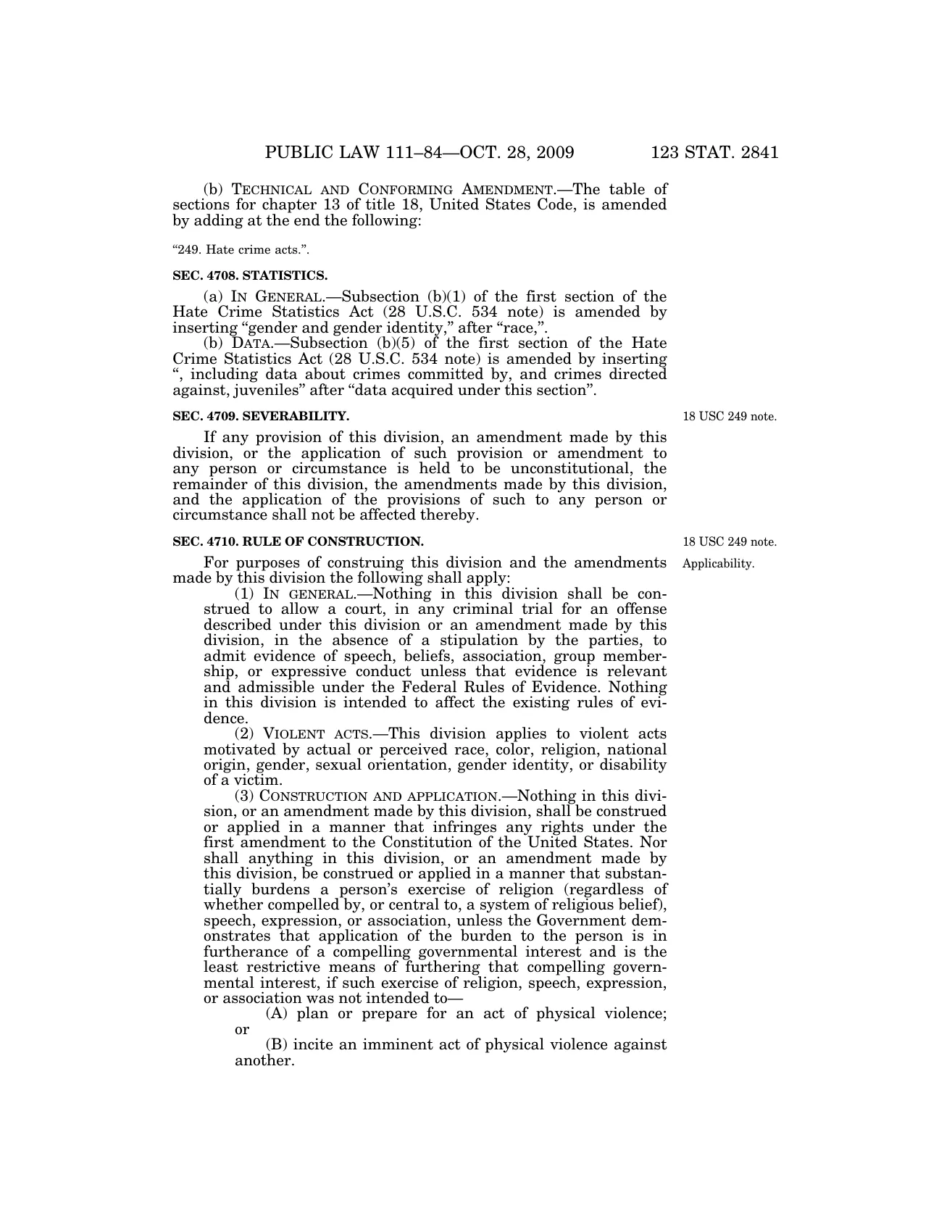
Section 4710 explicitly rejects prosecution based solely on expressed beliefs or group membership. It also preserves constitutional protections for speech, religion and peaceful demonstrations. That does not make every statement inadmissible: the preceding page says evidence of speech or association must meet the ordinary federal rules of relevance and admissibility. Proof of motive and punishment of belief are different questions in the statutory design.[1]
At the Justice Department’s fifteenth-anniversary commemoration, Matthew Shepard’s parents and James Byrd Jr.’s sister spoke about their families’ continuing work. The original pages put legal substance beside that public remembrance. They preserve both the expanded response to violent bias and the limits Congress wrote into it, details easily lost when the law is reduced to its familiar name.[2][1]
Sources and references
Independently researched companion article, with paragraph-level references to the records examined.
- Public Law 111-84, Division E: Shepard–Byrd ActOctober 28, 2009 · Primary institutional record
Full original law. Division E begins at PDF page 647; the passages examined are PDF pages 647-654, printed 2835-2842.
- Justice Department: fifteenth-anniversary commemorationNovember 20, 2024 · Primary institutional record
Original report of the anniversary event and family participation.
This article addresses the specific historical record described here; it is not a complete account of every proceeding.