
Pennsylvania / Aftermath and reform
Jeanne Clery’s legacy: making campus safety information public
An annual campus security report can look like administrative paperwork. Behind that routine is a demand that families should not have to judge safety from appearances alone. Jeanne Clery’s parents helped turn that demand into federal legislation after her death at Lehigh University. Reading the original 1990 law reveals the practical machinery of that change: information collected, published and made available year after year.
Read the original court record ↓A life before a law
Jeanne was a first-year Lehigh student when she was murdered in her residence hall on April 5, 1986. At a university remembrance in 2024, speakers recalled a competitive tennis player with humor, friendships and growing independence. Those details resist the reduction of a student to the name of a statute. Connie and Howard Clery’s subsequent advocacy brought campus safety into a national public debate.[2]
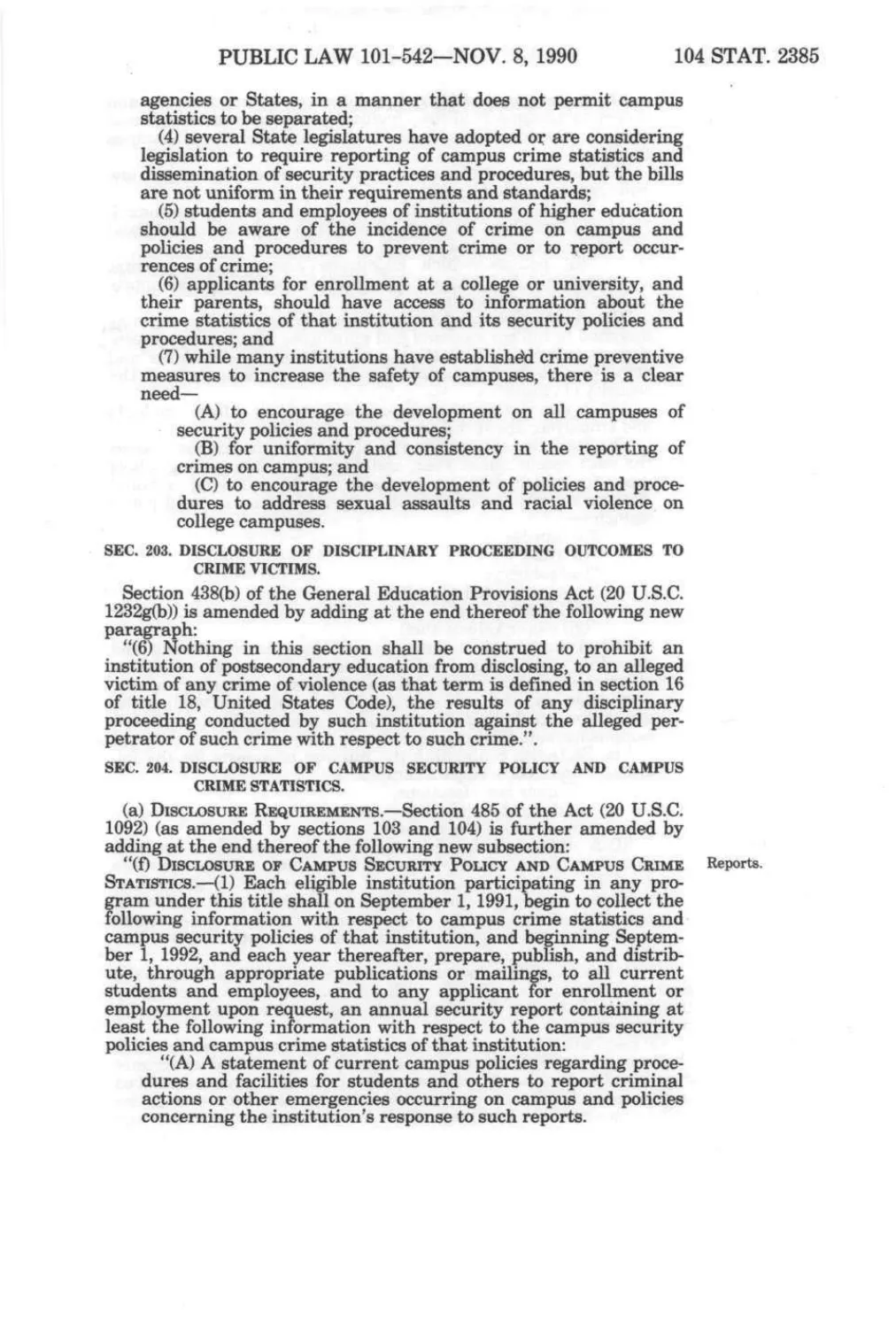
The resulting federal measure did not begin as a promise that crime could be eliminated. Title II of Public Law 101-542 identified an information problem: reporting practices varied, and many institutions did not provide separately identifiable campus crime statistics. Congress wanted applicants, families, students and employees to have access to both crime information and the policies governing institutional responses.[1]
More than a column of numbers
The original law required participating institutions to collect information beginning in September 1991 and publish annual security reports beginning in September 1992. Those reports were to reach current students and employees, with access for applicants on request. The annual cycle mattered. A disclosure made once could grow stale; a recurring report required the institution to revisit its account of safety.[1]
Statistics were only one part. The report also had to describe how to report crimes and emergencies, how the institution would respond, and its policies for access to campus facilities, including residences. It had to explain security personnel’s authority and relationship with local police. Readers could therefore ask operational questions alongside numerical ones: where to report, who could act, and how access was controlled.[1]
What a count could and could not mean
The statute listed categories of reported offenses and specified the reporting period. It separately requested arrest statistics for liquor, drug and weapons violations. It also defined campus and required separate treatment of geographically distant branches. Those distinctions shaped what appeared in a table. A count of reported incidents, a count of arrests and a claim about every crime in a surrounding city were never interchangeable measures.[1]
Another provision addressed urgency rather than the annual calendar. Institutions had to make timely reports about covered crimes considered a threat to others, in a way intended to help prevent similar occurrences. The two forms of communication served different purposes: an annual record supported informed scrutiny, while a warning could help people respond to a developing danger.[1]
An enduring obligation, not a finished guarantee
This is the original enactment, not a guide to every requirement in force today. The framework developed over time. Lehigh’s 2024 remembrance connected Jeanne’s legacy to contemporary security reporting, notifications and survivor support. Its account also described the Clery family’s creation of a nonprofit organization to help institutions improve campus safety. The work extended beyond obtaining a signature on a bill.[1][2]
The enduring change is visible in the kind of question a reader can ask. A reassuring impression of a campus can be tested against a published record of incidents and procedures. That record cannot guarantee the next person’s safety, and its categories must be understood before comparing totals. It does make the institution explain more than its reputation. For Jeanne’s family, public information became one means of protecting students they would never meet.[1][2]
Sources and references
Independently researched companion article, with paragraph-level references to the records examined.
- Student Right-To-Know and Campus Security Act, Public Law 101-542November 8, 1990 · Primary institutional record
Complete eight-page 1990 act; campus-security provisions are Title II, printed pages 2384-2387.
- Remembering Jeanne: Lehigh University LibrariesApril 23, 2024 · Primary institutional record
The university’s account of its 2024 remembrance, family advocacy and institutional response.
This article addresses the specific historical record described here; it is not a complete account of every proceeding.